
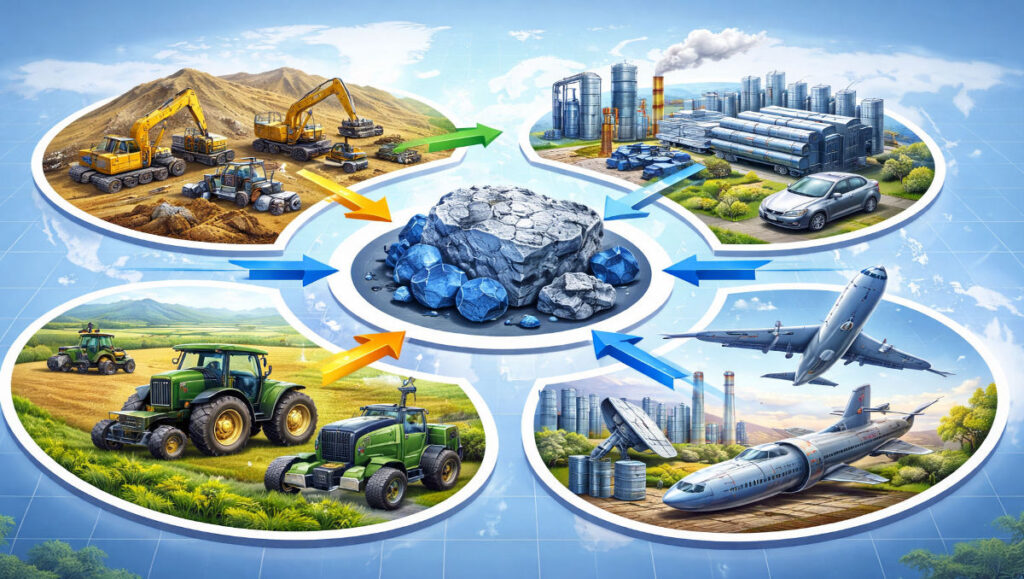
The global cobalt supply chain overview is increasingly important for understanding how battery production, advanced manufacturing, and US industrial resilience are interconnected. Cobalt plays a crucial role in lithium-ion batteries, aerospace alloys, precision machinery, and defense technologies.
Although cobalt mining is geographically concentrated, its economic influence extends into US agriculture, infrastructure, and energy systems. A proper global cobalt supply chain overview focuses on structural supply dependencies rather than short-term price fluctuations.
This 2026 outlook explains mining concentration, refining dominance, geopolitical exposure, agriculture relevance, and long-term structural risks shaping US industry.
Broader battery metal demand trends are also reflected in our detailed breakdown of Top Lithium Stocks for Electric Vehicle Growth, where lithium supply expansion faces similar structural challenges.
Key Takeaways: Global Cobalt Supply Chain Overview
The global cobalt supply chain overview reveals a structurally concentrated production model with limited geographic diversification.
Cobalt supply elasticity is restricted because most production is a byproduct of copper and nickel mining.
Refining capacity concentration creates greater risk than mining concentration alone.
US agriculture and manufacturing indirectly depend on stable cobalt imports for machinery electrification and industrial equipment.
Long-term demand from EVs, storage systems, and aerospace sectors may sustain structural tightness through 2035.
Table of Contents
- Why the Global Cobalt Supply Chain Overview Matters
- Structural Supply Imbalance in the Cobalt Market
- Major Cobalt Producing Regions
- Refining and Processing Bottlenecks
- China’s Role in the Global Cobalt Supply Chain
- Cobalt in US Manufacturing, Agriculture and Farming
- Geopolitical and Regulatory Risks
- Long-Term Demand Outlook (2026–2035)
- Key Indicators US Investors Should Monitor
- FAQ
- Final Thoughts
- Author
- Disclaimer
Why the Global Cobalt Supply Chain Overview Matters
The global cobalt supply chain overview matters because production remains heavily concentrated in a small number of regions. This geographic imbalance increases vulnerability to political instability, regulatory changes, and logistical disruptions.
According to the U.S. Geological Survey (USGS), the majority of global cobalt reserves remain concentrated in a limited number of countries.
Unlike standalone commodities, cobalt production depends largely on copper and nickel mining cycles. This structural dependency limits supply responsiveness during periods of accelerating battery demand.
For US stakeholders, understanding this framework is essential when assessing industrial resilience.
Structural Supply Imbalance in the Cobalt Market
A central finding in the global cobalt supply chain overview is structural rigidity. Since cobalt is primarily a byproduct, supply expansion requires broader base metal investment rather than direct cobalt price incentives.
This dynamic can create tight supply conditions even when cobalt prices are moderate. Refining bottlenecks further amplify this imbalance.
This structural imbalance is similar to what we explained in our analysis of Why Nickel Is Crucial for EV Batteries and Future Demand, where byproduct supply constraints influence battery metal volatility.
Structural constraints matter more than short-term volatility.
Major Cobalt Producing Regions
The majority of global cobalt mining originates from the Democratic Republic of Congo. Indonesia and Australia are expanding output, but diversification remains gradual.
This production concentration introduces systemic risk across downstream supply chains. Even modest disruptions can influence battery material availability worldwide.
A comprehensive global cobalt supply chain overview begins with this production imbalance.
Refining and Processing Bottlenecks
Refining is the most strategic stage in the global cobalt supply chain overview. Processing into battery-grade chemicals requires specialized facilities and environmental compliance.
A large portion of global refining capacity is concentrated in Asia. Even stable mining output cannot guarantee supply security if refining remains centralized.
This processing concentration represents a structural chokepoint.
China’s Role in the Global Cobalt Supply Chain
China plays a dominant role in cobalt refining and precursor production. Even when cobalt is mined in Africa or other regions, it frequently enters Chinese processing networks.
This structure increases exposure for US battery manufacturers seeking supply independence. A balanced global cobalt supply chain overview must therefore evaluate refining diversification alongside mining expansion.
Cobalt in US Manufacturing, Agriculture and Farming
Cobalt’s importance extends beyond electric vehicles. US agriculture increasingly relies on precision farming equipment, automated irrigation systems, and battery-supported tools.
Electrification of farming machinery indirectly embeds cobalt into agricultural productivity. A constrained global cobalt supply chain could influence machinery pricing and rural infrastructure costs.
Cobalt-containing alloys are also used in turbines, engines, and industrial systems that support food storage and logistics networks.
Energy transition dynamics affecting battery materials also influence broader commodity markets, including our coverage of The Future of Natural Gas in the US Energy Transition.
Geopolitical and Regulatory Risks
Mining concentration increases political exposure, while refining concentration creates processing dependency. Environmental regulations and trade policies add further complexity.
US strategic mineral policies aim to strengthen domestic capacity and allied partnerships. However, infrastructure expansion requires capital, permitting, and long development timelines.
Diversification will likely evolve gradually.
The U.S. Department of Energy outlines strategic mineral supply initiatives aimed at strengthening domestic resilience.
Long-Term Demand Outlook (2026–2035)
Battery demand remains the primary driver of cobalt consumption growth. Although battery chemistries continue to evolve, total EV adoption supports aggregate demand expansion.
Energy storage systems, aerospace components, and defense technologies further reinforce long-term demand.
The global cobalt supply chain overview suggests ongoing volatility cycles as supply and demand attempt to rebalance over the next decade.
Global battery demand projections published by the International Energy Agency provide insight into long-term electrification trends.
Key Indicators US Investors Should Monitor
Investors analyzing the global cobalt supply chain overview should track domestic mining approvals, refining expansion projects, EV production growth, and battery chemistry innovation.
Monitoring strategic mineral partnerships and trade agreements also provides insight into supply resilience.
Structural signals matter more than daily price swings.
Investors tracking base metals often use industrial indicators such as copper trends, which we explored in Dr. Copper Indicator Explained: What Copper Reveals About the Economy.
FAQ: Global Cobalt Supply Chain Overview
Why is cobalt production concentrated?
Cobalt is largely produced as a byproduct of copper mining in regions with major copper deposits.
Is the US self-sufficient in cobalt?
The United States remains heavily dependent on imports.
Can battery innovation eliminate cobalt demand?
Some battery chemistries reduce cobalt intensity, but complete elimination is unlikely in the near term.
Why does cobalt matter to agriculture?
Battery electrification of agricultural machinery and industrial equipment indirectly increases cobalt relevance in farming systems.
Final Thoughts on the Global Cobalt Supply Chain Overview
The global cobalt supply chain overview reveals a structurally concentrated system with meaningful geopolitical exposure. Demand growth from electrification continues to interact with slow diversification progress.
For US investors, manufacturers, and agriculture stakeholders, structural analysis provides clearer insight than headline-driven narratives. Long-term supply resilience, refining diversification, and policy coordination will shape cobalt market stability.
Author
US Commodity Market Research Team
Our research team focuses on structural commodity analysis across energy, metals, and agricultural supply chains. We emphasize observable supply dynamics, long-term demand shifts, and market structure rather than short-term speculation.
Disclaimer
This content is provided for informational and educational purposes only. It does not constitute financial, investment, or trading advice. Commodity markets involve risk, including price volatility and geopolitical uncertainty. Readers should conduct independent research or consult a qualified financial professional before making investment decisions.
