
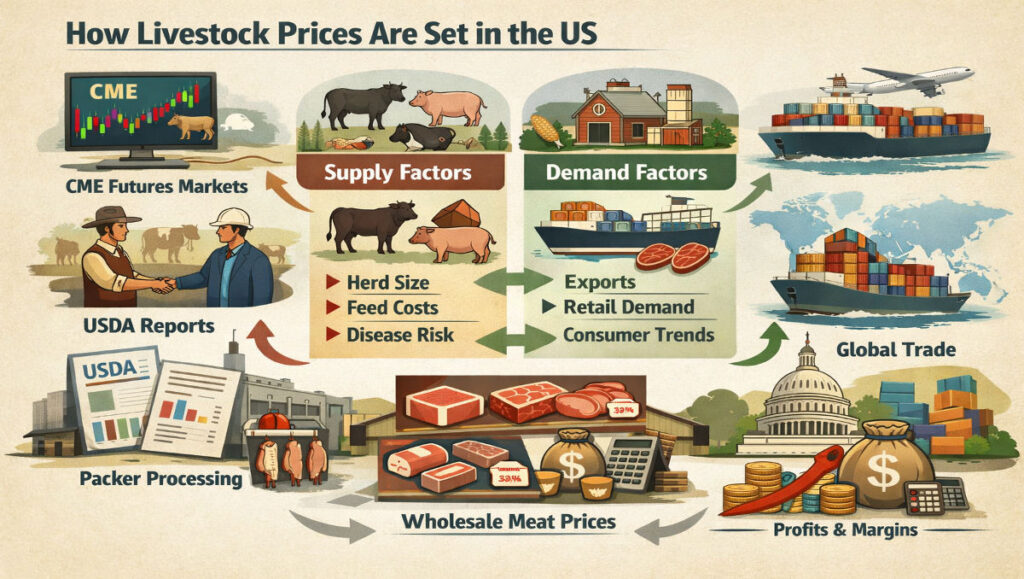
Understanding how livestock prices are set in the US requires more than a simple supply-and-demand explanation. Cattle and hog pricing operates through a structured system combining futures markets, negotiated cash trade, federally reported data, packer margins, export flows, and feed cost dynamics.
In the United States, price discovery in livestock markets happens continuously through the Chicago Mercantile Exchange (CME), USDA Livestock Mandatory Reporting (LMR), wholesale meat pricing, and regional basis relationships. Producers, packers, traders, and investors rely on this integrated structure to understand how livestock prices are set in the US and to manage risk effectively.
Key Takeaways
- Livestock prices are discovered through both futures markets and negotiated cash trade.
- CME contracts serve as national benchmarks for cattle and hog pricing.
- USDA reports strongly influence price volatility.
- Feed costs, especially corn and soybean meal, directly affect margins.
- Export demand and packer capacity shape short-term price movements.
- Biological production cycles drive long-term price trends.
Table of Contents
- Overview: How Livestock Prices Are Set in the US
- Role of CME Futures in Livestock Price Discovery
- Cash Market Pricing and Livestock Mandatory Reporting
- Understanding Basis in Livestock Markets
- Supply Drivers of Cattle and Hog Prices
- Demand Drivers and Wholesale Meat Values
- Feed Costs and Margin Economics
- Packer Concentration and Market Power
- Seasonal and Biological Cycles
- Forward Outlook for US Livestock Prices
- What This Means for Producers and Investors
- FAQ
- Final Thoughts
- Disclaimer
- Author
Overview: How Livestock Prices Are Set in the US
To understand how livestock prices are set in the US, one must examine the interaction between futures contracts, negotiated cash trade, wholesale meat demand, and government-reported supply data.
Livestock markets involve multiple production stages including cow-calf operations, feedlots, meat packers, and retailers. Price discovery begins with futures markets and is finalized in negotiated cash transactions reported through USDA Livestock Mandatory Reporting. This layered system explains how livestock prices are set in the US at both national and regional levels.
Role of CME Futures in Livestock Price Discovery
Futures contracts traded on the Chicago Mercantile Exchange serve as primary pricing benchmarks.
Key contract specifications include:
- Live Cattle Futures: 40,000 pounds
- Feeder Cattle Futures: 50,000 pounds
- Lean Hog Futures: 40,000 pounds
These contracts reflect expectations for future supply, feed costs, export demand, and slaughter capacity. This futures structure is a foundational component of how livestock prices are set in the US because it anchors forward price expectations across the industry.
When futures prices move higher, they signal tightening supply or stronger demand expectations. Cash markets typically adjust accordingly, although basis differences may persist.
Detailed contract specifications for live cattle, feeder cattle, and lean hog futures are published by the CME Group exchange.
Cash Market Pricing and Livestock Mandatory Reporting
Actual livestock transactions occur in the negotiated cash market between feedlots and packers.
The USDA’s Livestock Mandatory Reporting system publishes weekly negotiated trade volumes, price averages, and slaughter data. The interaction between negotiated trade and futures pricing further clarifies how livestock prices are set in the US at the regional level.
Cash cattle pricing often reflects local packer demand and transportation costs. Hog pricing frequently uses formula contracts tied to wholesale pork values.
The USDA Livestock Mandatory Reporting system provides weekly negotiated trade and slaughter data used in price discovery.
Understanding Basis in Livestock Markets
Basis is the difference between local cash prices and futures prices.
Basis = Cash Price – Futures Price
If live cattle futures trade at $180 per hundredweight and local cash prices are $178, basis equals -$2.
Basis risk is critical because even when futures rise, weak local demand can reduce realized prices. Regional basis fluctuations are one of the most practical examples of how livestock prices are set in the US across different production regions.
Supply Drivers of Cattle and Hog Prices
Livestock supply is governed by biological production cycles.
Cattle production takes years to expand. Drought conditions can accelerate herd liquidation, increasing short-term supply but reducing long-term calf crops. Hog production cycles are shorter and respond faster to market conditions.
Feed availability, slaughter weights, disease outbreaks, and herd size adjustments all influence how livestock prices are set in the US over multi-year cycles.
Official herd inventory data is released in the USDA Cattle and Hogs reports.
Demand Drivers and Wholesale Meat Values
Wholesale boxed beef and pork cutout values determine packer margins and willingness to pay producers.
Demand depends on domestic retail consumption, foodservice activity, export demand to countries like China and Mexico, and overall economic conditions.
Export demand plays an especially important role in pork markets. When export volumes rise, they strengthen how livestock prices are set in the US by tightening domestic supply availability.
Global trade flows that influence pork and beef demand are also shaped by energy costs, as detailed in How OPEC Meetings Impact US Gasoline Prices, which indirectly affects transportation and food distribution expenses.
Export sales data influencing livestock markets are published weekly by the USDA Foreign Agricultural Service.
Feed Costs and Margin Economics
Feed represents the largest input cost for livestock producers.
Corn and soybean meal prices directly impact profitability. A rise in corn prices can sharply reduce feedlot margins even if cattle prices remain steady.
Feed economics are one of the most powerful variables influencing how livestock prices are set in the US because they determine whether producers expand or reduce herd sizes.
Feed cost volatility, especially in corn markets, plays a critical role in livestock profitability — as explained in our detailed analysis of The Impact of US Ethanol Policy on Corn Demand, which directly affects feed grain pricing.
Packer Concentration and Market Power
The US cattle processing industry is concentrated among a few large firms. Packer concentration can affect negotiation leverage and regional price spreads.
When slaughter capacity tightens, cash cattle prices may weaken even if wholesale meat values remain elevated. This structural element adds complexity to how livestock prices are set in the US beyond simple supply-demand equations.
Seasonal and Biological Cycles
Livestock markets follow predictable seasonal patterns.
Cattle prices often strengthen in spring due to tighter fed cattle supplies and stronger grilling demand. Hog prices frequently peak before summer and soften later in the year as production increases.
Seasonality remains a consistent factor in how livestock prices are set in the US each year.
Forward Outlook for US Livestock Prices
Looking ahead, herd rebuilding, feed cost stability, export demand growth, and slaughter capacity expansion will determine pricing trends.
Future herd cycles and global protein demand will continue shaping how livestock prices are set in the US over the next several years.
Monitoring USDA herd reports, corn markets, and export sales data remains essential for anticipating structural shifts.
Weather-driven production risks are also discussed in our report on How Droughts and Weather Patterns Impact Corn Prices, which highlights how climate cycles influence livestock feed costs.
What This Means for Producers and Investors
Producers who understand how livestock prices are set in the US can better manage hedging strategies using futures contracts.
Investors gain exposure to agricultural cycles through cattle and hog futures, offering diversification benefits compared to energy or metals markets.
However, livestock markets remain sensitive to weather, disease, policy shifts, and feed cost volatility.
Investors looking to diversify across agricultural commodities may also consider our analysis on Factors Affecting Coffee and Cocoa Prices, which explores similar supply-demand dynamics in soft commodities.
FAQ: How Livestock Prices Are Set in the US
How are cattle prices determined in the US?
Cattle prices are determined through CME futures benchmarks, negotiated cash trade, USDA reporting data, wholesale beef demand, and feed costs.
How are hog prices set?
Hog prices are influenced by lean hog futures, pork cutout values, export demand, and formula-based pricing systems.
What role does USDA reporting play?
USDA Livestock Mandatory Reporting provides transparency in negotiated trade and slaughter data.
Why do feed costs matter?
Feed is the largest production cost. Grain price fluctuations directly impact livestock profitability.
Final Thoughts
Understanding how livestock prices are set in the US requires analyzing futures markets, negotiated trade, basis relationships, feed economics, export demand, and packer dynamics.
Livestock markets are cyclical, structured, and deeply interconnected with grain and global protein markets. Those who understand how livestock prices are set in the US gain a strategic advantage in managing agricultural risk and identifying long-term pricing trends.
Author
US Commodity Price Research Team
Specialized in structural commodity market analysis across energy, metals, and agricultural sectors in the United States.
Disclaimer
This article is for informational and educational purposes only. It does not constitute financial or investment advice. Commodity markets are volatile and subject to risk from weather, disease, policy changes, and global trade disruptions.
