
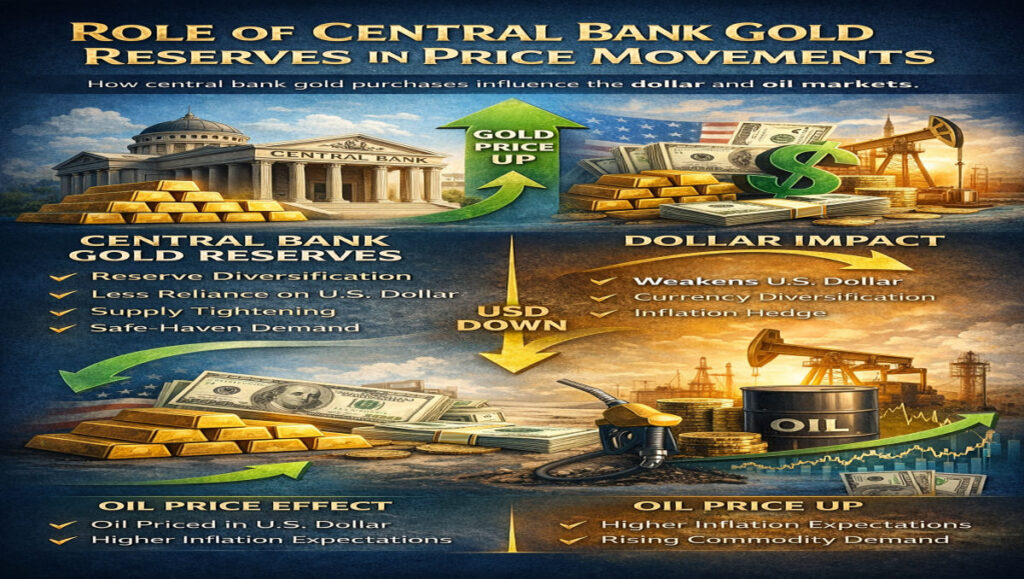
The role of central bank gold reserves in price movements has evolved from a passive monetary relic into a powerful structural force shaping global commodity cycles. In the past several years, central banks have accumulated gold at the fastest pace in decades, signaling major shifts in reserve strategy, currency diversification, and geopolitical positioning.
When official institutions increase gold holdings, they do not speculate for short-term gain. They reposition sovereign balance sheets. This strategic behavior directly influences long-term gold price floors, U.S. dollar strength, and indirectly affects oil and energy markets priced globally in dollars.
Understanding the role of central bank gold reserves in price movements provides investors with a macro lens for interpreting both precious metals and energy market trends.
Key Takeaways
- Central banks are structural long-term buyers of gold.
- Official purchases reduce tradable supply.
- Reserve diversification pressures the U.S. dollar.
- Dollar weakness supports both gold and oil prices.
- Dedollarization trends are accelerating gold demand.
- Gold reserve behavior signals macroeconomic regime shifts.
Table of Contents
- What Are Central Bank Gold Reserves?
- Historical Context of Gold in Monetary Systems
- Central Bank Gold Buying Data and Recent Trends
- How the Role of Central Bank Gold Reserves in Price Movements Shapes Global Commodity Cycles
- Gold vs U.S. Treasury Reserves Allocation
- Dedollarization and the Petrodollar Framework
- How the Role of Central Bank Gold Reserves in Price Movements Influences Oil Markets
- Real Yields, Inflation, and Reserve Strategy
- What This Means for Investors
- 2026–2027 Forward Outlook
- FAQ
- Final Thoughts
- Disclaimer
- Author
What Are Central Bank Gold Reserves?
Central bank gold reserves are physical bullion holdings maintained as part of a nation’s foreign exchange reserves. Unlike currency holdings or government bonds, gold carries no counterparty risk and cannot be printed.
These reserves serve as crisis insurance, inflation protection, and balance sheet credibility. Because central banks hold gold for decades, their actions play a foundational role in the role of central bank gold reserves in price movements across commodity markets.
When official institutions accumulate gold, that supply is effectively removed from circulating liquidity.
Historical Context of Gold in Monetary Systems
Gold anchored global finance under the gold standard and later the Bretton Woods system. Although convertibility ended in 1971, gold remained a strategic reserve asset.
Even in a fiat system, gold functions as monetary collateral during periods of instability. Its historical credibility explains why the role of central bank gold reserves in price movements continues to matter despite modern currency regimes.
During inflationary shocks and geopolitical fragmentation, gold often regains prominence within reserve portfolios.
Central Bank Gold Buying Data and Recent Trends
In recent years, central bank gold purchases have reached multi-decade highs. Emerging market central banks such as China, India, and Turkey have increased gold allocations significantly.
This surge reflects reserve diversification away from U.S. Treasuries and dollar-denominated assets. As official demand accelerates, the role of central bank gold reserves in price movements becomes more visible through structural price support.
Unlike ETF investors, central banks rarely liquidate reserves quickly. Their buying reinforces long-term floor dynamics rather than speculative spikes.
According to data published by the World Gold Council, central bank gold purchases have reached multi-decade highs, reflecting accelerated reserve diversification trends.
How the Role of Central Bank Gold Reserves in Price Movements Shapes Global Commodity Cycles
The mechanism operates through supply tightening, currency adjustments, and macro expectations.
First, gold supply grows slowly through mining output. When central banks accumulate large volumes, available market supply tightens structurally.
Second, official buying signals macro caution. Investors interpret central bank behavior as a warning of inflation risk or monetary instability.
Third, diversification away from dollar reserves reduces demand for U.S. Treasuries. This portfolio reallocation is a direct example of the role of central bank gold reserves in price movements within the global financial system.
Understanding currency dynamics is also essential when analyzing oil benchmarks. For a deeper breakdown of pricing structures, read our guide on Understanding WTI vs. Brent Crude Oil: Key Differences, which explains how global crude benchmarks respond to dollar strength and macro shifts.
Oil pricing mechanisms and reserve currency effects are documented by the U.S. Energy Information Administration (EIA), which monitors global crude benchmarks and currency impacts.
Gold vs U.S. Treasury Reserves Allocation
Foreign exchange reserves traditionally consist largely of U.S. Treasury securities. However, many emerging economies have gradually increased gold’s share of total reserves.
Gold provides immunity from sanctions risk, default exposure, and currency debasement. When central banks shift allocation from Treasuries to gold, dollar demand weakens at the margin.
This adjustment further reinforces the role of central bank gold reserves in price movements, especially during periods of geopolitical stress.
Official reserve allocation statistics are also tracked by the International Monetary Fund (IMF), which reports changes in gold and foreign currency holdings globally.
Dedollarization and the Petrodollar Framework
The petrodollar system established global oil trade pricing in U.S. dollars. Oil-exporting nations historically recycled surplus dollars into U.S. assets, strengthening dollar dominance.
However, reserve diversification and bilateral trade agreements have gradually reduced exclusive dollar settlement structures. Dedollarization trends amplify the role of central bank gold reserves in price movements as reserve architectures evolve.
As gold replaces a portion of dollar reserves, marginal dollar demand softens. Over time, this shift can influence commodity pricing volatility, including oil benchmarks.
The long-term implications of reserve diversification also connect to energy transition dynamics. Our detailed report on The Future of Natural Gas in the US Energy Transition explains how currency shifts and energy pricing mechanisms interact in evolving commodity cycles
How the Role of Central Bank Gold Reserves in Price Movements Influences Oil Markets
Gold and oil are linked through macroeconomic channels rather than direct supply mechanisms.
When central banks increase gold reserves, it often reflects inflation concerns and reduced confidence in fiat currency stability. These same conditions influence oil pricing through inflation expectations and currency effects.
Oil is globally priced in dollars. If reserve diversification pressures the dollar lower, oil prices may rise to maintain real purchasing power.
This interaction further reinforces the role of central bank gold reserves in price movements across both precious metals and energy markets.
Real Yields, Inflation, and Reserve Strategy
Real yields represent nominal interest rates minus inflation. When real yields decline, gold becomes more attractive because its opportunity cost falls.
Central banks tend to accumulate gold in environments of monetary expansion, rising sovereign debt, or structural inflation. This interaction further reinforces the role of central bank gold reserves in price movements during periods of declining real yields.
These same macro conditions often coincide with stronger oil price environments, particularly when inflation expectations accelerate.
What This Means for Investors
Investors who monitor central bank reserve trends gain structural insight into macro cycles. When official institutions accumulate gold, it signals long-term positioning rather than speculative behavior.
Tracking the role of central bank gold reserves in price movements allows investors to anticipate currency shifts, inflation regimes, and correlated commodity behavior.
Gold often acts as a macro absorber during instability, while oil responds to inflation transmission effects. Together, they reflect evolving monetary architecture.
Investors comparing physical exposure and paper exposure should also review our analysis on Physical Gold vs. Gold ETFs: Pros and Cons for US Investors, where we break down structural ownership differences in inflationary cycles.
2026–2027 Forward Outlook
Looking ahead, several structural forces remain supportive of official gold demand.
High sovereign debt levels, geopolitical fragmentation, and persistent inflation pressures encourage reserve diversification. If these conditions persist, the role of central bank gold reserves in price movements will likely remain a dominant structural driver.
While short-term volatility may occur due to interest rate shifts, sustained official accumulation reduces downside risk over multi-year horizons.
Energy markets may experience increased volatility if dollar dominance gradually weakens, reinforcing macro linkages between gold and oil.
If oil market geopolitics interest you, see our in-depth analysis on How OPEC Meetings Impact US Gasoline Prices, which explores production decisions and dollar sensitivity in energy markets.
Frequently Asked Questions
Why does the role of central bank gold reserves in price movements matter for investors?
Because official buying reflects structural macro positioning that supports long-term gold price floors and influences currency dynamics.
Do central bank purchases immediately raise gold prices?
Not always immediately, but sustained accumulation reduces supply and strengthens structural support levels.
How does gold reserve diversification affect oil markets?
Through dollar weakness and inflation expectations, reserve shifts can indirectly influence oil prices.
Where is official reserve data reported?
Reserve data is published by institutions such as the World Gold Council and the International Monetary Fund.
Final Thoughts
The role of central bank gold reserves in price movements reflects deeper monetary transitions shaping global commodities. Official sector accumulation tightens supply, signals macro uncertainty, and pressures dollar demand.
Through currency and inflation channels, these reserve decisions ripple into oil and broader energy markets. Investors who understand these structural dynamics gain insight beyond short-term volatility.
Gold reserve behavior is not speculation. It is strategic repositioning at the sovereign level.
Author
US Commodity Price Research Team
Providing institutional-level analysis of gold, energy, metals, and agricultural markets.
Disclaimer
This article is for informational purposes only and does not constitute financial or investment advice. Commodity markets involve risk and volatility.
