
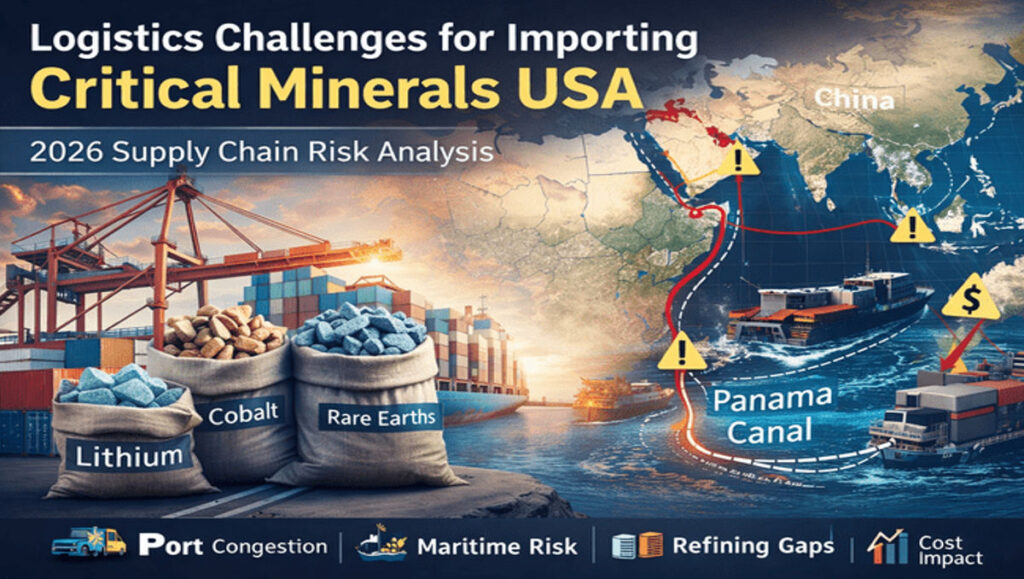
The logistics challenges for importing critical minerals USA represent one of the most consequential structural risks in the modern industrial economy. Critical minerals such as lithium, cobalt, rare earth elements, graphite, manganese, and nickel are foundational to electric vehicles, battery storage systems, advanced semiconductors, aerospace platforms, and national defense systems.
According to recent U.S. Geological Survey summaries, the United States remains more than 50% import-reliant for numerous designated critical minerals and nearly 100% dependent for certain rare earth processing streams. As global demand accelerates and geopolitical tensions persist, logistics reliability has transformed from a commercial issue into a strategic national infrastructure priority.
This institutional-grade analysis dissects the logistics challenges for importing critical minerals USA through quantified import dependency data, mineral-by-mineral risk exposure, maritime chokepoint instability, refining concentration risk, inland transportation bottlenecks, regulatory complexity, and forward-looking 2026 resilience modeling.
What Are the Core Logistics Challenges for Importing Critical Minerals USA?
The logistics challenges for importing critical minerals USA stem from five structural pressures: concentrated foreign refining capacity, maritime chokepoint exposure, port congestion, regulatory clearance delays, and limited domestic processing infrastructure. These combined factors create delivery uncertainty, elevate landed cost volatility, and expose U.S. manufacturing systems to geopolitical disruption.
In simple terms, the logistics challenges for importing critical minerals USA are not temporary disruptions — they are embedded structural vulnerabilities within the global mineral supply chain architecture.
Key Takeaways
- The United States imports over half of many critical minerals.
- China dominates more than 60–80% of certain refining processes.
- Red Sea and Panama Canal disruptions have extended shipping times by 10–20 days in peak events.
- Domestic refining capacity remains insufficient for several battery materials.
- Freight rate spikes during crisis cycles have increased mineral shipping costs by 30–200%.
- Supply chain diversification is now a competitive advantage, not an option.
Table of Contents
- Structural Import Dependence in the United States
- Logistics Challenges for Importing Critical Minerals USA by Mineral Category
- Maritime Chokepoint Risk and Transit Time Escalation
- Port Congestion and U.S. Infrastructure Capacity
- Regulatory, Compliance, and Sanctions Exposure
- Domestic Refining Bottlenecks and Processing Gaps
- Inland Rail and Trucking Constraints
- Freight Cost Volatility and Insurance Premium Risk
- Case Study: Red Sea Conflict and Panama Canal Drought
- Policy Response: IRA, CHIPS Act, and Strategic Stockpiling
- Risk Mitigation Framework for Importers
- 2026 Forward Outlook for Critical Mineral Logistics
- What This Means for U.S. Manufacturers and Investors
- Frequently Asked Questions
- Final Strategic Assessment
- Author
- Disclaimer
Structural Import Dependence in the United States
The logistics challenges for importing critical minerals USA begin with structural dependency. For materials such as graphite, rare earth oxides, and manganese, import reliance exceeds 50%, while rare earth refining dependence approaches near-total concentration in Asia.
According to the latest U.S. Geological Survey Mineral Commodity Summary, the United States remains heavily import-reliant for numerous designated critical materials.
Battery-grade lithium hydroxide and cobalt intermediates frequently pass through Chinese refining facilities before entering global markets. This layered supply chain multiplies the logistics challenges for importing critical minerals USA because raw material extraction, refining, intermediate shipping, and final manufacturing occur across multiple jurisdictions.
When disruption occurs at any node, cascading delivery delays follow.
This structural dependency resembles the concentrated exposure seen in precious metals markets, where supply concentration and geopolitical risk heavily influence price stability and investor positioning.
Logistics Challenges for Importing Critical Minerals USA by Mineral Category
Not all minerals carry identical risk.
Lithium often travels from South America or Australia for refining, then ships again to battery manufacturers. Cobalt mining is heavily concentrated in the Democratic Republic of Congo, exposing transit routes to political instability. Rare earth elements frequently require Chinese separation and processing before re-export.
Graphite processing concentration exceeds 70% in specific Asian regions. Nickel supply chains depend on Southeast Asian maritime corridors.
The logistics challenges for importing critical minerals USA therefore differ by mineral type, creating complex risk matrices for manufacturers dependent on multiple material inputs.
Maritime Chokepoint Risk and Transit Time Escalation
Ocean freight remains the backbone of mineral imports. However, maritime chokepoints such as the Strait of Hormuz, the Suez Canal, the Red Sea corridor, and the Panama Canal introduce systemic fragility.
Recent Red Sea security tensions forced vessels to reroute around Africa, increasing voyage distance by approximately 3,000–3,500 nautical miles. Transit times extended by up to two weeks. Simultaneously, Panama Canal drought restrictions reduced daily vessel capacity, creating backlogs and elevated freight bidding competition.
The logistics challenges for importing critical minerals USA intensify dramatically during such events because delivery windows for battery plants and semiconductor facilities are tightly synchronized.
Extended shipping timelines disrupt just-in-time manufacturing strategies.
Port Congestion and U.S. Infrastructure Capacity
U.S. ports including Los Angeles, Long Beach, Houston, and Savannah process significant volumes of mineral cargo.
During surge cycles, container dwell times can increase by several days, while inland rail transfers experience congestion. Hazardous material classification and bulk handling restrictions slow unloading procedures for specific mineral categories.
Although port modernization investments are underway, the logistics challenges for importing critical minerals USA persist when global demand spikes coincide with infrastructure constraints.
Port resilience directly affects industrial continuity.
Regulatory, Compliance, and Sanctions Exposure
Customs inspections, environmental compliance reviews, anti-dumping investigations, and sanctions enforcement add additional friction to mineral imports.
Forced labor regulations and trade policy scrutiny increase documentation requirements. When shipments originate from politically sensitive regions, clearance delays expand.
The logistics challenges for importing critical minerals USA therefore include not only transportation risk but also regulatory uncertainty that lengthens working capital cycles.
Domestic Refining Bottlenecks and Processing Gaps
Import arrival does not guarantee production readiness. The United States lacks sufficient domestic refining capacity for several critical mineral categories.
Rare earth separation, battery-grade lithium processing, and graphite purification remain concentrated abroad. This refining concentration creates a secondary layer of logistics challenges for importing critical minerals USA, because inbound raw materials often require additional offshore processing before re-entry.
The result is circular supply exposure that compounds systemic risk.
The Department of Energy has identified refining concentration as a national vulnerability within its Critical Materials Strategy roadmap.
Inland Rail and Trucking Constraints
After port discharge, minerals must travel via rail or trucking networks to processing plants and manufacturing facilities.
Rail congestion across Midwest corridors and trucking labor shortages increase inland transit variability. Diesel price volatility further elevates transportation costs.
Inland distribution fragility compounds the logistics challenges for importing critical minerals USA by extending exposure beyond maritime transit.
Freight Cost Volatility and Insurance Premium Risk
During crisis cycles, container and bulk freight rates have spiked between 30% and 200% depending on route and vessel capacity constraints.
For example, elevated shipping premiums during geopolitical stress often coincide with sharp crude oil price fluctuations, which further amplify freight and insurance costs across global mineral supply routes.
Marine insurance premiums increase sharply when vessels transit high-risk conflict zones. These additional costs increase landed mineral pricing and compress manufacturer margins.
The logistics challenges for importing critical minerals USA therefore create direct economic impact through cost escalation, not merely delivery delay.
Case Study: Red Sea Conflict and Panama Canal Drought
The simultaneous Red Sea disruption and Panama Canal drought illustrated how geographically distant events can destabilize mineral supply chains.
Extended voyage times, reduced canal throughput, and rising insurance costs converged to increase freight rates while delaying delivery windows.
This case underscores the systemic fragility embedded within the logistics challenges for importing critical minerals USA and demonstrates how global climate and geopolitical events interact.
Policy Response: IRA, CHIPS Act, and Strategic Stockpiling
The Inflation Reduction Act introduced domestic sourcing requirements for EV battery credits. The CHIPS Act supports semiconductor resilience, including mineral supply security.
The Inflation Reduction Act outlines domestic sourcing thresholds for battery materials to qualify for EV tax credits under clean energy policy frameworks.
The Defense Production Act and strategic stockpiling initiatives aim to reduce long-term vulnerability.
While these policies mitigate aspects of the logistics challenges for importing critical minerals USA, implementation timelines remain multi-year and capital-intensive.
Risk Mitigation Framework for Importers
Leading firms reduce exposure by diversifying supplier geography, negotiating long-term freight contracts, building strategic inventory buffers, investing in domestic processing partnerships, and adopting predictive logistics analytics.
Supply chain resilience is now a measurable competitive advantage.
Companies that proactively model the logistics challenges for importing critical minerals USA outperform those reliant on single-route procurement strategies.
2026 Forward Outlook for Critical Mineral Logistics
Global EV deployment and renewable infrastructure expansion will continue to elevate mineral trade volumes.
Geopolitical tensions and maritime route instability remain elevated risk factors. Domestic refining capacity will expand gradually but will not eliminate structural import dependence in the near term.
The logistics challenges for importing critical minerals USA will remain central to industrial strategy throughout 2026 and beyond.
What This Means for U.S. Manufacturers and Investors
Manufacturers must prioritize supply redundancy, refine long-term procurement contracts, and evaluate refining exposure risk.
Investors should assess companies based on geographic diversification, inventory management strategy, domestic processing partnerships, and freight cost stability.
The logistics challenges for importing critical minerals USA create systemic risk, but also create strategic opportunity for resilient operators.
Manufacturers tracking exposure to supply volatility should also monitor broader commodity price behavior across metals and energy markets. Our detailed breakdown of gold, silver, and crude oil market structure provides additional insight into how global logistics disruptions ripple through industrial pricing dynamics.
Frequently Asked Questions
Why are logistics challenges for importing critical minerals USA increasing?
Rising global demand, refining concentration, maritime chokepoint instability, and regulatory scrutiny have amplified structural supply chain risk.
Can domestic production eliminate logistics challenges for importing critical minerals USA?
Domestic expansion reduces exposure but cannot fully replace global refining networks in the short term.
Which mineral faces the highest logistics concentration risk?
Rare earth elements and battery-grade graphite currently exhibit the highest refining concentration vulnerability.
Final Strategic Assessment
The logistics challenges for importing critical minerals USA represent a structural, not cyclical, supply chain vulnerability. Concentrated refining capacity, maritime chokepoint exposure, infrastructure constraints, regulatory complexity, and geopolitical tension form an interconnected risk system.
Supply chain resilience is no longer a peripheral strategy. It is foundational industrial policy.
Strategic diversification, domestic capacity investment, and predictive logistics modeling will determine which firms maintain continuity and which remain exposed.
Author
Commodity logistics and energy materials analyst specializing in strategic resource security and global supply chain risk modeling.
Disclaimer
This article is for informational purposes only and does not constitute investment, trade, or policy advice. Supply chain conditions evolve rapidly and vary by mineral category and jurisdiction.
