
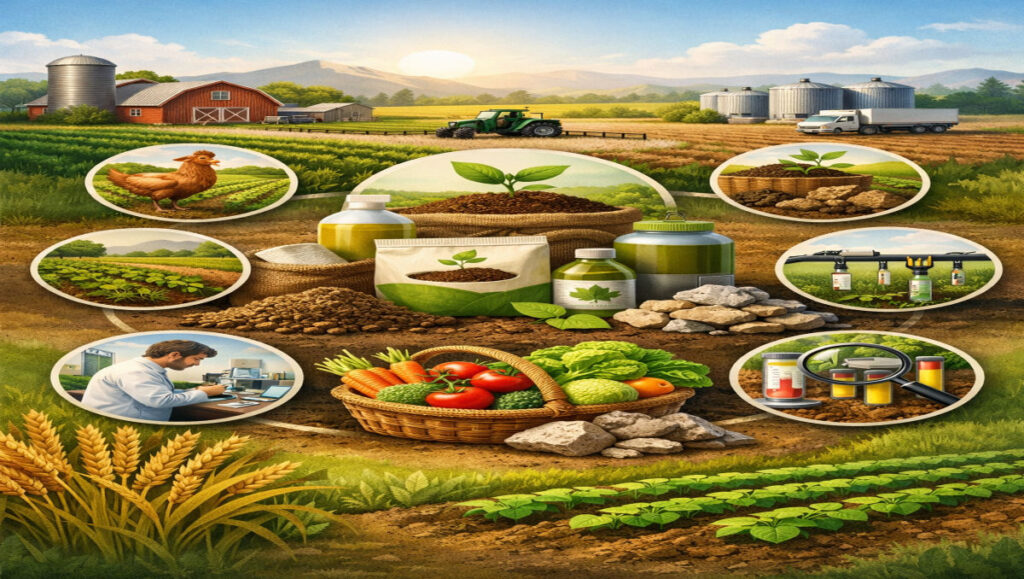
The top organic fertilizer suppliers for small farms in USA include Nature Safe, Sustane Natural Fertilizer, Ferti-Organic, Espoma, California Organic Fertilizers, Dr. Earth, and Midwestern BioAg. These suppliers provide OMRI-listed products, verified nutrient analysis, and reliable regional distribution for certified organic and regenerative farms.
Organic agriculture in the United States continues expanding as consumer demand for certified produce rises. According to USDA reporting, certified organic acreage has steadily increased over the past decade, strengthening demand for reliable organic fertilizer manufacturers in USA. For small farms, fertilizer selection directly affects soil structure, certification compliance, and long-term profitability.
Choosing from the top organic fertilizer suppliers for small farms in USA is no longer optional, it is a structural farm management decision.
Key Takeaways
- The top organic fertilizer suppliers for small farms in USA prioritize OMRI compliance and nutrient transparency.
- Nitrogen concentration and release timing influence real cost per acre.
- Freight distance can account for 15–25% of delivered fertilizer cost.
- Compost-based inputs improve soil carbon and microbial resilience long term.
- Strategic supplier selection protects yield stability and certification status.
Table of Contents
- Why Supplier Selection Matters for Small Farms
- What Defines the Top Organic Fertilizer Suppliers for Small Farms in USA
- Top 7 Organic Fertilizer Suppliers for Small Farms in USA
- Animal-Based vs Plant-Based Fertilizers: Performance Comparison
- USDA Market Trends Supporting Organic Fertilizer Growth
- Cost Per Acre and Margin Impact Example
- Strategic Supplier Selection Framework
- Frequently Asked Questions
- Final Strategic Outlook
- Disclaimer
- Author
Why Supplier Selection Matters for Small Farms
Small farms operate under tighter margin structures than large-scale commercial agriculture. With limited acreage, diversified cropping systems, and direct-market exposure, fertilizer miscalculations can materially impact seasonal revenue.
Organic fertilizer influences soil organic matter, microbial diversity, nutrient retention, and long-term yield stability. Unlike synthetic inputs, organic fertilizers build soil capital over time. The wrong supplier can introduce nutrient inconsistency, contamination risk, or freight delays that disrupt planting cycles.
Selecting from the top organic fertilizer suppliers for small farms in USA reduces operational volatility and supports sustainable growth.
What Defines the Top Organic Fertilizer Suppliers for Small Farms in USA
Not all organic fertilizer manufacturers in USA operate at institutional standards. Elite suppliers meet structured criteria that align with long-term soil economics.
Farmers maintaining USDA organic certification should verify product eligibility through the Organic Materials Review Institute (OMRI), which maintains an official database of approved soil amendments and fertilizer inputs.
Second, nutrient transparency must include full N-P-K breakdown, micronutrient disclosure, and application guidance. Suppliers lacking analytical clarity create economic risk.
Third, source integrity matters. Animal-based fertilizers deliver concentrated nitrogen. Plant-based compost improves carbon density. Mineral-based amendments correct specific deficiencies. Clear labeling protects agronomic precision.
Fourth, distribution stability reduces seasonal exposure. Regional warehousing significantly lowers freight volatility.
Finally, regenerative performance separates basic vendors from strategic partners. The top organic fertilizer suppliers for small farms in USA focus on soil regeneration rather than short-term yield spikes.
Top 7 Organic Fertilizer Suppliers for Small Farms in USA
Below are leading suppliers consistently recognized for nutrient reliability, OMRI compliance, and small-farm compatibility.
1. Nature Safe
Nature Safe produces poultry-based organic fertilizers known for high nitrogen concentration and consistent analysis. Their granular format simplifies application for small vegetable farms.
Strategic advantage lies in nutrient density, which often reduces per-acre application volume and lowers total operational handling cost.
2. Sustane Natural Fertilizer
Sustane emphasizes compost-based, slow-release fertilizers that enhance soil carbon and microbial activity. These products are particularly valuable for farms transitioning from conventional inputs.
The long-term soil structure benefits can reduce future fertility costs.
3. Ferti-Organic Inc.
Ferti-Organic provides regionally adapted formulations tailored to soil mineral imbalances. This approach supports orchards and specialty crop operations requiring targeted nutrient correction.
Precision blending improves nutrient efficiency.
4. Espoma Company
Espoma offers nationally distributed organic fertilizer products widely accessible to small farms. Their balanced formulations provide consistent performance across diversified operations.
Supply reliability is a major strength.
5. California Organic Fertilizers
Specializing in liquid organic fertilizers, this supplier supports drip irrigation systems common in specialty crop production.
Liquid compatibility increases nutrient-use efficiency in precision irrigation setups.
6. Dr. Earth
Dr. Earth integrates beneficial microbes into fertilizer blends, enhancing biological soil performance. This aligns strongly with regenerative agriculture models.
Microbial enhancement supports long-term nutrient cycling.
7. Midwestern BioAg
Midwestern BioAg combines mineral balancing programs with soil-testing advisory services. Their structured approach improves long-term fertility planning.
Advisory integration strengthens agronomic precision.
Animal-Based vs Plant-Based Fertilizers: Performance Comparison
Animal-based fertilizers generally provide higher nitrogen percentages and faster nutrient release. This benefits crops with immediate vegetative demand, such as leafy greens and corn.
Plant-based compost fertilizers release nutrients more gradually while improving soil organic matter and moisture retention. Their structural benefits often compound over multiple seasons.
Mineral-based amendments address targeted deficiencies but must be guided by soil analysis.
Many small farms achieve optimal performance by blending nutrient types rather than relying on a single source.
USDA Market Trends Supporting Organic Fertilizer Growth
USDA reports show continued expansion in certified organic farmland across the United States. As acreage increases, demand for organic fertilizer manufacturers in USA grows proportionally.
As organic acreage expands, demand for fertilizer inputs also moves alongside broader agricultural supply trends, including developments in organic corn farming profit margins in the Midwest, where soil input efficiency directly influences long-term yield economics.
According to the USDA National Agricultural Statistics Service (NASS), certified organic farmland in the United States has expanded steadily over the past decade, strengthening long-term demand for organic fertilizer manufacturers.
Long-term soil improvement strategies also align with conservation frameworks promoted by the USDA Natural Resources Conservation Service (NRCS), which supports soil health and sustainable nutrient management across U.S. farms.
Structural demand drivers include:
- Consumer preference for certified produce
- Regenerative agriculture adoption
- Soil carbon management initiatives
This expansion reinforces the importance of identifying the top organic fertilizer suppliers for small farms in USA capable of scaling production and maintaining analytical consistency.
As certified acreage expands and regenerative farming accelerates, competition among the top organic fertilizer suppliers for small farms in USA is expected to intensify. Suppliers that combine OMRI compliance, transparent nutrient analysis, and regional distribution strength will likely dominate long-term farm partnerships.
For small-scale producers, selecting from the top organic fertilizer suppliers for small farms in USA ensures structural alignment with soil health initiatives and evolving federal conservation programs.
Cost Per Acre and Margin Impact Example
Per-ton pricing does not accurately reflect economic value. A fertilizer priced at $700 per ton with 8% nitrogen may require lower application volume than a $500 per ton product with 3% nitrogen.
When evaluating pricing models, farmers must compare nutrient density, freight cost, and release timing across the top organic fertilizer suppliers for small farms in USA. A higher upfront per-ton price may translate into lower per-acre application volume if nitrogen concentration is stronger.
Therefore, analyzing performance differences between the top organic fertilizer suppliers for small farms in USA allows growers to protect long-term margins rather than focusing solely on sticker price.
Freight can add 15–25% to delivered cost depending on distance. Selecting a regional supplier reduces this exposure and protects margin stability.
Over time, compost-based fertilizers that improve soil carbon may reduce total nutrient demand in subsequent seasons, creating compounding economic benefit.
Transportation volatility can materially affect delivered fertilizer pricing, particularly during peak planting season, which is why understanding refrigerated freight services for agricultural products also helps farmers evaluate broader logistics cost exposure.
True profitability analysis must consider nutrient density, application rate, and logistics.
Strategic Supplier Selection Framework
Small farms should follow a structured evaluation model.
Begin with certified soil testing. Identify crop-specific nutrient demand. Confirm OMRI listing and regulatory compatibility. Compare nutrient concentration per acre rather than per ton. Evaluate freight impact. Align fertilizer strategy with long-term soil-building objectives.
The top organic fertilizer suppliers for small farms in USA consistently meet these evaluation benchmarks.
Small farms should begin with certified soil testing and can access region-specific agronomic guidance through programs supported by the USDA National Institute of Food and Agriculture (NIFA).
Farms that already analyze crop export channels and international demand dynamics such as those exploring how to sell agricultural commodities to foreign markets often apply similar disciplined evaluation frameworks when selecting fertilizer suppliers.
A disciplined selection process helps farms narrow options among the top organic fertilizer suppliers for small farms in USA based on soil compatibility, logistics reliability, and nutrient transparency.
Rather than choosing based on marketing claims, producers should compare analytical data and distribution networks across the top organic fertilizer suppliers for small farms in USA to ensure long-term operational stability.
Frequently Asked Questions
What are the top organic fertilizer suppliers for small farms in USA?
Leading suppliers include Nature Safe, Sustane Natural Fertilizer, Ferti-Organic, Espoma, California Organic Fertilizers, Dr. Earth, and Midwestern BioAg.
Are all organic fertilizers OMRI listed?
No. Farmers must verify OMRI certification to maintain USDA organic compliance.
Which fertilizer type offers better nitrogen efficiency?
Animal-based fertilizers generally provide higher nitrogen concentration per application.
Do compost fertilizers improve soil long term?
Yes. Compost-based fertilizers enhance soil organic matter and microbial resilience.
Can small farms purchase fertilizer in bulk?
Many organic fertilizer suppliers in USA provide bulk purchasing options to reduce per-acre cost.
Final Strategic Outlook
The top organic fertilizer suppliers for small farms in USA function as long-term agronomic partners rather than transactional vendors. As organic acreage expands and regenerative agriculture deepens, supplier selection becomes a structural competitive advantage.
Small farms that align with reliable organic fertilizer manufacturers in USA build soil resilience, yield stability, and economic durability.
Fertilizer strategy also connects to federal biofuel demand policies, particularly in corn-producing regions influenced by the impact of US ethanol policy on corn demand, which shapes nutrient planning decisions.
Fertilizer strategy defines future soil capital.
Disclaimer
This article is for educational and informational purposes only. Soil conditions, nutrient requirements, and regulatory standards vary by region and crop type. Farmers should conduct certified soil testing and consult licensed agronomists or agricultural extension services before selecting organic fertilizer suppliers or products. USCommodityPrice.com does not endorse specific brands and assumes no liability for operational decisions.
Author
This article was prepared by the US Commodity Research Desk, an independent market analysis team specializing in agricultural inputs, commodity markets, and supply chain economics across the United States. Content is reviewed for factual accuracy and updated periodically to reflect evolving market conditions.
