
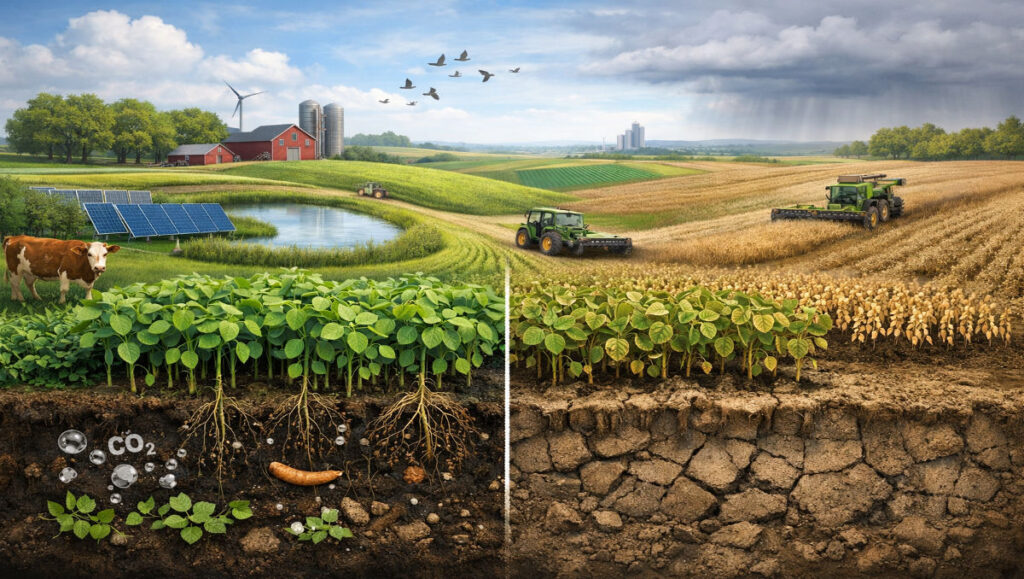
The regenerative agriculture impact on soy yields is no longer a theoretical debate. It has become a strategic decision point for Midwest farmers navigating rising fertilizer costs, soil degradation, and climate volatility.
Soybeans represent one of the most economically critical crops in the United States. Understanding the regenerative agriculture impact on soy yields is essential not only for farm-level profitability but also for commodity supply stability and investor forecasting models.
As we have analyzed in our report on Organic Corn Farming Profit Margins in Midwest, long-term soil health trends increasingly determine yield durability across major row crops.
The regenerative agriculture impact on soy yields varies during early transition years but improves long-term yield stability, drought resilience, and profit durability. While short-term yields may decline slightly as soil biology rebuilds, regenerative systems often reduce downside volatility and maintain competitive output after year four.
This stability becomes economically significant during extreme climate events.
Key Takeaways
- The regenerative agriculture impact on soy yields improves yield stability more than peak output.
- Transition years may reduce yields 3–8%, but long-term downside risk declines.
- Higher soil organic matter reduces drought-year yield loss.
- Margin durability improves as fertilizer dependency declines.
- By 2028, regenerative systems may outperform conventional models in volatile climates.
Table of Contents
- What Is Regenerative Agriculture?
- US Soy Yield Baseline and Structural Constraints
- Transition Timeline: Years 1–5 Yield Breakdown
- Regenerative Agriculture Impact on Soy Yields in Drought Modeling
- Illinois Case Scenario: 1,000-Acre Financial Model
- Soil Carbon, Water Retention, and Yield Stability
- Nitrogen Fixation and Biological Efficiency
- Cost Structure Comparison and Margin Analysis
- Carbon Credits and Premium Market Access
- What This Means for US Farmers and Investors
- 2026–2028 Institutional Forecast
- Frequently Asked Questions
- Final Thoughts
- Author
- Disclaimer
What Is Regenerative Agriculture?
Regenerative agriculture is a soil-centered farming system focused on rebuilding organic matter, improving biodiversity, and enhancing ecosystem function. Core practices include reduced tillage, cover cropping, diversified rotations, and biological nutrient management.
The regenerative agriculture impact on soy yields depends heavily on soil carbon accumulation and microbial activity. Soybeans benefit directly from healthy rhizobia populations, which improve nitrogen fixation efficiency.
Unlike conventional systems that prioritize chemical inputs, regenerative systems prioritize biological resilience.
US Soy Yield Baseline and Structural Constraints
Average US soybean yields range between 49 and 52 bushels per acre. However, yield growth has plateaued in high-production states due to soil compaction and nutrient depletion.
In drought years, Midwest yields can decline 10–20%. This variability creates financial stress and increases dependence on crop insurance.
The regenerative agriculture impact on soy yields must therefore be evaluated not only in average seasons but in stress scenarios where volatility determines profitability.
Input cost exposure also ties agricultural margins to energy markets, similar to what we examined in our analysis on How to Hedge Against Rising Freight Fuel Prices, where energy volatility directly impacts farm operating expenses.
Transition Timeline: Years 1–5 Yield Breakdown
Average US soybean yields range between 49 and 52 bushels per acre. However, yield growth has plateaued in high-production states due to soil compaction and nutrient depletion.
In drought years, Midwest yields can decline 10–20%. This variability creates financial stress and increases dependence on crop insurance.
The regenerative agriculture impact on soy yields must therefore be evaluated not only in average seasons but in stress scenarios where volatility determines profitability.
Transition Timeline: Years 1–5 Yield Breakdown
Year 1 typically reflects adjustment to reduced synthetic inputs. Yield compression between 3% and 5% is common.
Year 2 may show additional variability as soil microbial networks stabilize. Yield reductions of up to 8% may occur in some operations.
Year 3 often marks stabilization. By year 4, the regenerative agriculture impact on soy yields frequently converges with conventional performance.
Year 5 and beyond reflect improved consistency, particularly in dry seasons. Volatility narrows as soil organic matter rises.
This structured transition explains why short-term comparisons can misrepresent long-term outcomes.
Regenerative Agriculture Impact on Soy Yields in Drought Modeling
To quantify the regenerative agriculture impact on soy yields, consider a drought scenario reducing regional yields by 15%.
A conventional 52 bushel baseline may fall to 44 bushels. A regenerative 50 bushel baseline may decline only 8%, producing 46 bushels.
Across 1,000 acres, that two-bushel difference equals 2,000 bushels. At $12 per bushel, this represents $24,000 in additional revenue during stress conditions.
The regenerative agriculture impact on soy yields therefore reduces downside financial risk.
According to the USDA Economic Research Service, increasing soil organic matter improves water-holding capacity and reduces drought-related yield volatility across major field crops.
Illinois Case Scenario: 1,000-Acre Financial Model
Consider a central Illinois operation managing 1,000 soybean acres.
Under conventional farming:
- Yield: 52 bushels
- Price: $12
- Gross revenue: $624,000
- Fertilizer + chemical inputs: $180 per acre
Under regenerative transition (Year 4 stabilized):
- Yield: 50 bushels
- Price: $12
- Gross revenue: $600,000
- Input costs reduced to $140 per acre
Total input savings: $40,000 across 1,000 acres.
The University of Illinois FarmDoc research has similarly documented transition-year variability in soybean systems before long-term stabilization occurs.
Even with slightly lower yields, profit margin remains competitive. In drought years, regenerative systems may outperform, further strengthening net income.
This illustrates how the regenerative agriculture impact on soy yields interacts with cost structure, not yield alone.
Soil Carbon, Water Retention, and Yield Stability
Each 1% increase in soil organic matter improves water-holding capacity by approximately 20,000 gallons per acre. Enhanced water retention protects soybean plants during heat stress.
The regenerative agriculture impact on soy yields becomes particularly visible during late-season dryness. Regenerative fields often maintain stronger canopy health and pod fill.
Improved aggregation also reduces runoff and nutrient loss. Stability replaces volatility as the primary economic advantage.
The Natural Resources Conservation Service highlights soil carbon accumulation as a key driver of long-term agricultural resilience in Midwest production systems.
Nitrogen Fixation and Biological Efficiency
Soybeans rely on symbiotic nitrogen fixation. Healthy soil biology enhances nodulation efficiency and nutrient cycling.
The regenerative agriculture impact on soy yields strengthens as fungal and bacterial diversity increases. Reduced compaction allows deeper root penetration.
Research published through Iowa State University Extension confirms that improved soil biology enhances nodulation efficiency and soybean nitrogen uptake.
Biological nutrient efficiency decreases dependency on synthetic nitrogen, stabilizing both yields and cost exposure.
Cost Structure Comparison and Margin Analysis
Conventional soybean production ties profitability to global fertilizer markets. Input price spikes directly reduce margins.
Margin durability in agricultural systems often mirrors structural commodity trends, much like industrial supply dynamics discussed in our report on LNG Facility Construction Impact Aluminum Demand 2026.
Regenerative systems gradually lower synthetic dependency. While cover crops require investment, long-term cost savings emerge.
The regenerative agriculture impact on soy yields must be evaluated in a margin framework. Yield stability combined with reduced input volatility enhances durable profitability.
Margin resilience becomes the defining advantage.
Carbon Credits and Premium Market Access
Carbon markets now reward measurable soil carbon sequestration. Farms adopting regenerative systems may qualify for supplemental revenue streams.
Food companies increasingly commit to regenerative sourcing standards. Premium pricing contracts provide additional income potential.
The regenerative agriculture impact on soy yields therefore connects to ESG capital flows and sustainability premiums.
What This Means for US Farmers and Investors
For farmers, reduced yield volatility improves credit access and land valuation. Stability enhances long-term financial planning.
For investors, the regenerative agriculture impact on soy yields influences commodity supply modeling and farmland asset performance.
Reduced volatility in national soybean production may moderate extreme futures market swings.
Structural shifts in agricultural production can influence broader commodity markets, similar to how supply constraints affect strategic minerals discussed in our Logistics Challenges for Importing Critical Minerals USA analysis.
2026–2028 Institutional Forecast
Climate modeling suggests increased heat variability in the Midwest. Under these conditions, regenerative systems may demonstrate superior stress resilience.
While peak yields in optimal seasons may remain similar, drought-year performance is projected to diverge.
The regenerative agriculture impact on soy yields is positioned to become a structural production strategy rather than a niche experiment.
By 2028, resilience may outweigh maximum yield as the primary profitability driver.
Broader commodity cycles, including precious metals volatility examined in our Best Time to Buy Silver During Market Correction analysis, demonstrate how structural shifts often precede long-term price stabilization.
Frequently Asked Questions
Does regenerative agriculture reduce soy yields?
The regenerative agriculture impact on soy yields may include short-term reductions during transition but often improves long-term stability.
How long does transition take?
Most systems stabilize within three to five growing seasons.
Is regenerative soybean farming profitable?
Profitability depends on cost management, but margin durability often improves due to lower synthetic input exposure.
Does regenerative agriculture increase drought resilience?
Yes. Improved soil organic matter enhances water retention and reduces yield loss during dry cycles.
Final Thoughts
The regenerative agriculture impact on soy yields should be evaluated through a resilience and margin lens rather than short-term output comparison.
In a climate-defined agricultural economy, stability carries measurable economic value. For Midwest producers and commodity investors, regenerative systems represent structural durability.
Long-term competitiveness may increasingly depend on soil capital rather than chemical intensity.
Author
This article was prepared by the US Commodity Research Desk, an independent market analysis team specializing in agricultural inputs, commodity markets, and supply chain economics across the United States. Content is reviewed for factual accuracy and updated periodically to reflect evolving market conditions.
Disclaimer
This article is for informational and educational purposes only. It does not constitute agricultural, financial, or investment advice. Consult qualified professionals before making operational decisions.
