
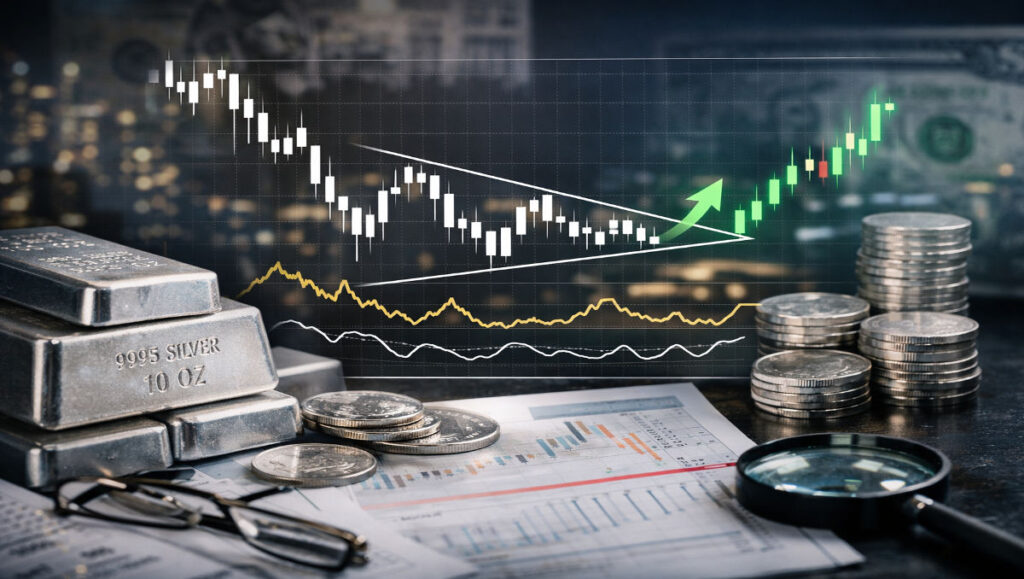
The best time to buy silver during market correction is not when panic is highest, but when structural stability returns. Silver behaves differently from gold during downturns because it is both a monetary hedge and an industrial commodity. When liquidity tightens, silver often falls sharply before stabilizing.
Understanding margin pressure, real interest rates, ETF flows, and macro regime transitions is essential to identifying the best time to buy silver during market correction with discipline rather than emotion. This guide provides an institutional framework for timing accumulation during volatility.
When Is the Best Time to Buy Silver During Market Correction?
The best time to buy silver during market correction typically occurs after forced liquidation subsides, volatility compresses, price stabilizes above long-term support, real yields stop rising, and the U.S. dollar momentum weakens. Institutional capital accumulates during consolidation phases, not during peak panic.
Key Takeaways
- Silver declines more aggressively than gold during liquidity squeezes.
- Margin calls and ETF redemptions amplify downside volatility.
- The best time to buy silver during market correction appears after stabilization, not during emotional extremes.
- Real interest rates and dollar strength are critical timing variables.
- Structured scaling improves risk-adjusted entry.
- Gold-to-silver ratio extremes can strengthen conviction.
Table of Contents
- Why Silver Falls During Market Corrections
- Liquidity Contraction and Margin Liquidation
- Best Time to Buy Silver During Market Correction: Structural Confirmation
- Macro Regimes That Influence Silver Timing
- Technical Stabilization and Base Formation
- Gold-to-Silver Ratio as a Relative Value Indicator
- Investor Psychology During Corrections
- Strategic Entry Models for Long-Term Investors
- What This Means for US Investors
- Frequently Asked Questions
- Final Thoughts
- Author
- Disclaimer
Why Silver Falls During Market Corrections
Silver typically declines more than gold during market corrections because it is exposed to both monetary and industrial demand. When equity markets fall, liquidity tightens and investors raise cash. This often results in silver being sold alongside equities and other risk-sensitive assets.
Because silver markets are smaller and more volatile than gold markets, price swings become amplified during forced liquidation cycles. Recognizing this structural behavior is the first step in identifying the best time to buy silver during market correction.
To understand how silver behaves relative to gold during stress periods, review our detailed breakdown in Silver Price Today in USA, which tracks live structural price behavior and participation shifts.
Liquidity Contraction and Margin Liquidation
Market corrections frequently trigger margin calls across leveraged portfolios. When investors must reduce exposure quickly, silver becomes a liquidity source.
ETF outflows and industrial hedging further intensify downward pressure. During these phases, price declines are often driven more by liquidity stress than by fundamental deterioration.
Silver ETF inflows and outflows can be monitored through fund data provided by iShares Silver Trust (SLV) disclosures.
The best time to buy silver during market correction usually does not occur during this liquidation spike. It appears after selling pressure slows and volatility begins to contract.
Institutional buyers wait for stability before deploying capital.
Best Time to Buy Silver During Market Correction: Structural Confirmation
The best time to buy silver during market correction emerges when structural confirmation replaces chaos.
Four elements typically align:
- Volatility peaks and begins compressing.
- Price holds above major weekly support.
- Real interest rates flatten rather than accelerate.
- The U.S. dollar loses upside momentum.
When these conditions converge, downside momentum weakens and accumulation probability improves. Institutional allocation decisions prioritize structural alignment over emotional entry timing.
Macro Regimes That Influence Silver Timing
Silver’s recovery behavior depends on macroeconomic regime.
During aggressive monetary tightening cycles, rising real yields pressure metals. During stabilization phases, when rate expectations plateau, silver begins forming bases.
Silver performance during corrections is heavily influenced by U.S. Treasury real yield movements published by the U.S. Department of the Treasury.
For real-time insight into monetary policy expectations and their impact on commodities, see our analysis in US Commodity Prices Today: Gold, Silver & Crude Oil Market Snapshot.
During easing or reflationary cycles, silver often outperforms gold due to improving industrial expectations.
The best time to buy silver during market correction often coincides with the transition from tightening acceleration to stabilization.
Monitoring Federal Reserve policy signals, Treasury yield direction, and inflation expectations enhances timing precision.
Technical Stabilization and Base Formation
Silver rarely reverses in a single day. Instead, it forms base structures characterized by narrowing ranges and higher lows.
Volatility compression is a key signal. When daily price swings shrink after panic spikes, structural balance returns.
Declining sell volume and multi-week consolidation channels often precede sustainable recoveries. Waiting for base formation reduces the risk of premature entries and improves alignment with the best time to buy silver during market correction.
Gold-to-Silver Ratio as a Relative Value Indicator
During severe corrections, the gold-to-silver ratio frequently spikes. Elevated ratio levels may signal relative undervaluation of silver.
Historically, extreme ratio readings have preceded periods of silver outperformance. While not sufficient alone, ratio extremes combined with macro stabilization reinforce conviction when assessing the best time to buy silver during market correction.
Relative value analysis adds depth to timing decisions.
You can monitor ratio-driven shifts alongside gold structure in our ongoing coverage at Gold Price Today in USA, which highlights broader precious metal positioning.
Investor Psychology During Corrections
Corrections unfold in psychological phases: denial, panic, forced liquidation, exhaustion, stabilization.
Retail investors often buy during panic or sell during exhaustion. Institutional capital typically accumulates when volatility fades and sentiment stabilizes.
The best time to buy silver during market correction often appears during emotional neutrality, not during media-driven fear.
Understanding crowd behavior prevents reactive decision-making.
Strategic Entry Models for Long-Term Investors
Short-term traders may attempt to capture oversold bounces, but this requires precision and tolerance for volatility.
Long-term investors benefit from structured scaling. Allocating capital gradually during stabilization phases reduces timing error and emotional bias.
The best time to buy silver during market correction is not a single price level but a disciplined accumulation window supported by macro and technical confirmation.
Patience improves probability.
What This Means for US Investors
For US investors, silver serves as both an inflation hedge and a cyclical industrial exposure. Monitoring real yields, dollar strength, and Federal Reserve policy direction enhances decision-making.
When liquidity stress fades and macro deterioration slows, opportunity improves. US investors seeking the best time to buy silver during market correction should prioritize structural stabilization over emotional reaction.
Silver’s long-term demand from renewable energy, electronics, and manufacturing adds structural support beyond short-term volatility.
Long-term structural demand trends are documented by the Silver Institute, which tracks global silver supply and industrial consumption.
Frequently Asked Questions
Is silver more volatile than gold during corrections?
Yes. Silver historically exhibits larger percentage swings due to smaller market depth and industrial exposure.
Should investors buy silver immediately during a selloff?
Buying during peak panic increases risk. Structural confirmation improves entry probability.
How important are real interest rates for silver?
Real yields strongly influence precious metals because they affect opportunity cost.
Does the gold-to-silver ratio help identify value?
Elevated ratios can indicate relative undervaluation when combined with macro stabilization.
Final Thoughts
The best time to buy silver during market correction is defined by structural confirmation, not emotional intensity. Silver frequently overshoots during liquidity squeezes but stabilizes once forced selling subsides and macro headwinds plateau.
Disciplined investors focus on volatility compression, support defense, and macro stabilization. In precious metals markets, patience during corrections often delivers superior long-term outcomes.
Author
Prepared by a commodity market analyst specializing in precious metals cycles, macroeconomic regime shifts, and liquidity-driven volatility structure.
Disclaimer
This content is for educational purposes only and does not constitute investment advice. Commodity markets involve risk, including potential loss of principal. Investors should conduct independent research or consult a licensed financial professional before making investment decisions.
