
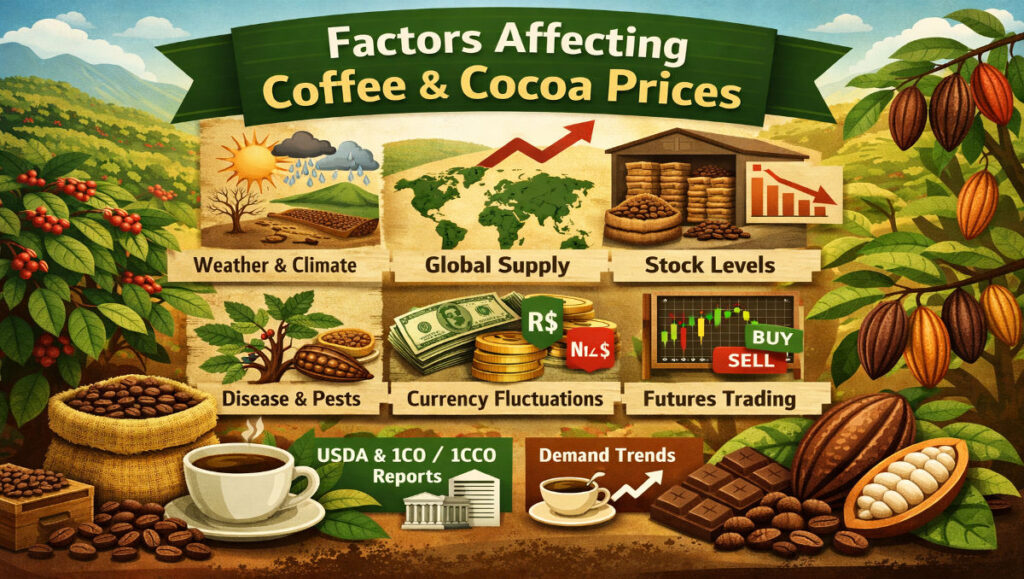
Coffee and cocoa prices rarely move quietly. In recent years, extreme weather in Brazil pushed Arabica coffee futures up more than 60% during 2021, while cocoa prices surged to multi-decade highs following West African supply deficits. These sharp moves highlight the core reality behind the factors affecting coffee and cocoa prices: soft commodities are driven by biological risk, concentrated supply, currency shifts, and futures market dynamics.
Unlike energy or metals, coffee and cocoa depend on crop cycles that cannot be instantly increased to meet demand. Understanding what structurally moves these markets is essential for traders, investors, and anyone monitoring agricultural inflation.
This guide explains the primary drivers influencing coffee and cocoa prices using institutional data sources and historical examples.
Key Takeaways
- Weather disruptions remain the strongest short-term driver
- Production concentration increases systemic supply risk
- USDA, ICO, and ICCO reports shape market expectations
- Currency fluctuations affect export competitiveness
- Stock-to-use ratios determine supply tightness
- Futures market positioning amplifies volatility
Table of Contents
- Global Production Concentration and Supply Risk
- Weather and Climate Impact on Crop Yields
- Cocoa Supply Deficits and Historical Price Spikes
- Currency Movements and Export Economics
- Global Demand Trends and Consumption Growth
- Stock-to-Use Ratios and Inventory Levels
- Futures Markets and Speculative Activity
- What This Means for Investors
- FAQ: Factors Affecting Coffee and Cocoa Prices
- Final Thoughts
Global Production Concentration and Supply Risk
One of the most critical factors affecting coffee and cocoa prices is geographic production concentration.
Brazil and Vietnam dominate global coffee production, particularly Arabica and Robusta varieties. Meanwhile, Côte d’Ivoire and Ghana account for more than half of global cocoa output. When production is heavily concentrated in a few regions, localized disruptions can ripple through global markets quickly.
Political instability, export restrictions, port congestion, or labor shortages in these key countries can restrict supply and elevate futures prices. Because expansion of agricultural production takes years, supply shocks are not easily reversed.
This structural concentration increases long-term volatility in both commodities.
To understand how supply concentration impacts broader commodity cycles, see our detailed analysis on Commodity Market Structure and Global Supply Risks.
Weather and Climate Impact on Crop Yields
Weather is the most immediate factor affecting coffee and cocoa prices.
In 2021, Brazil experienced severe frost events that damaged large portions of Arabica coffee trees. Arabica futures surged dramatically as traders priced in reduced harvest expectations. Coffee trees require multiple seasons to fully recover, extending supply constraints beyond a single year.
Cocoa crops are equally sensitive. West African drought conditions have historically reduced yields, tightening global balances. Excess rainfall can also spread fungal diseases that weaken cocoa trees.
The United States Department of Agriculture publishes monthly WASDE reports (World Agricultural Supply and Demand Estimates), which influence pricing expectations globally.
Weather-driven volatility is not unique to soft commodities. Our article on How Droughts and Weather Patterns Impact Corn Prices explains similar agricultural price dynamics.
Climate variability increases pricing uncertainty before harvest confirmation occurs.
Cocoa Supply Deficits and Historical Price Spikes
Cocoa markets offer a clear example of structural deficit pricing.
In 2023–2024, production shortfalls in West Africa contributed to sharp price increases as global stock levels tightened. Futures prices reflected concerns about declining inventories and lower export flows.
The International Cocoa Organization (ICCO) publishes quarterly supply-demand balance data used by institutional traders to assess whether markets face deficit or surplus conditions.
When global stock-to-use ratios decline, price sensitivity increases significantly.
Currency Movements and Export Economics
Because both commodities trade in US dollars on ICE Futures, currency dynamics are key factors affecting coffee and cocoa prices.
When the Brazilian real weakens against the dollar, Brazilian exporters can increase shipments profitably, expanding supply. Conversely, currency strength may limit export incentives.
Exchange rate volatility during periods of global monetary tightening often impacts agricultural prices independently of crop conditions.
Currency shifts can therefore amplify or offset weather-driven price movements.
For deeper insight into how currency shifts affect commodity pricing, read our guide on How Renewable Energy Trends Impact Fossil Fuel Commodities where we discuss dollar-driven commodity movements.
Global Demand Trends and Consumption Growth
Long-term demand growth supports structural pricing trends.
Coffee consumption continues expanding in emerging markets while specialty demand rises in developed economies. Cocoa demand correlates with chocolate consumption and disposable income growth.
The International Coffee Organization (ICO) provides annual global balance data that influences market expectations.
Economic slowdowns may reduce discretionary chocolate purchases, affecting cocoa demand more than coffee.
Demand growth builds long-term support, but cyclical weakness increases volatility.
Stock-to-Use Ratios and Inventory Levels
Stock-to-use ratio is a critical institutional metric for evaluating supply tightness. It measures available inventories relative to annual consumption.
Low ratios indicate tight markets and increase price sensitivity to disruptions. High ratios suggest adequate buffers.
Certified warehouse stocks held at ICE Futures facilities directly influence deliverable supply for futures contracts.
Inventory dynamics also influence energy markets. See our breakdown of How OPEC Meetings Impact US Gasoline Prices to understand how supply decisions affect pricing.
Monitoring inventory trends helps distinguish between temporary weather fears and structural shortages.
Inventory contraction often precedes sustained price rallies.
Futures Markets and Speculative Activity
Speculative positioning is among the structural factors affecting coffee and cocoa prices.
Hedge funds and managed money participants increase long exposure during weather scares or supply deficit expectations. When crop forecasts improve, liquidation can accelerate price declines.
Managed money positioning reports provide insight into whether markets are overextended or under-positioned.
While speculation does not alter physical supply, it magnifies short-term volatility.
Understanding positioning improves risk assessment.
What This Means for Investors
Understanding the factors affecting coffee and cocoa prices allows investors to approach soft commodities with structural clarity rather than emotional reaction.
Agricultural commodities offer diversification benefits relative to energy and metals. However, they carry higher biological risk and weather sensitivity.
Investors should monitor:
- USDA WASDE crop reports
- ICO and ICCO supply-demand balances
- Brazilian real currency trends
- West African weather patterns
- ICE Futures stock levels
- Managed money positioning
Long-term trends depend on sustainable production growth relative to expanding global demand. Short-term moves often reflect weather or speculative positioning.
Structural analysis consistently outperforms headline-driven reactions.
For broader commodity cycle context, review our analysis on commodity market volatility and agricultural pricing dynamics.
For investors exploring diversification beyond agriculture, review our analysis on Aluminum Market Trends in Aerospace and Construction to compare industrial commodity cycles.
FAQ: Factors Affecting Coffee and Cocoa Prices
What is the biggest factor affecting coffee prices?
Weather in Brazil remains the most immediate driver due to its dominant Arabica production share.
Why are cocoa prices highly volatile?
Cocoa production concentration in West Africa increases sensitivity to drought, disease, and political instability.
How do currency movements affect coffee and cocoa prices?
Since both are priced in US dollars, local currency weakness increases export competitiveness and influences supply dynamics.
What is stock-to-use ratio in agricultural markets?
It measures inventories relative to annual consumption and indicates whether markets face tight or ample supply.
Final Thoughts
The factors affecting coffee and cocoa prices combine climate risk, geographic concentration, currency movements, inventory levels, institutional reporting, and futures positioning.
Unlike industrial commodities, soft commodities depend on biological cycles that cannot be rapidly adjusted. This makes them structurally sensitive to weather disruptions and disease outbreaks.
Monitoring USDA reports, ICO and ICCO balances, stock-to-use ratios, and ICE Futures positioning provides deeper insight than reacting to short-term price headlines.
Understanding structure leads to informed decisions.
Author
US Commodity Price Editorial Team
Specializing in structured analysis of energy, metals, and agricultural commodity markets for US-focused investors.
Disclaimer
This article is for informational purposes only and does not constitute financial or investment advice. Commodity markets involve risk, including weather risk, geopolitical uncertainty, and price volatility.
