
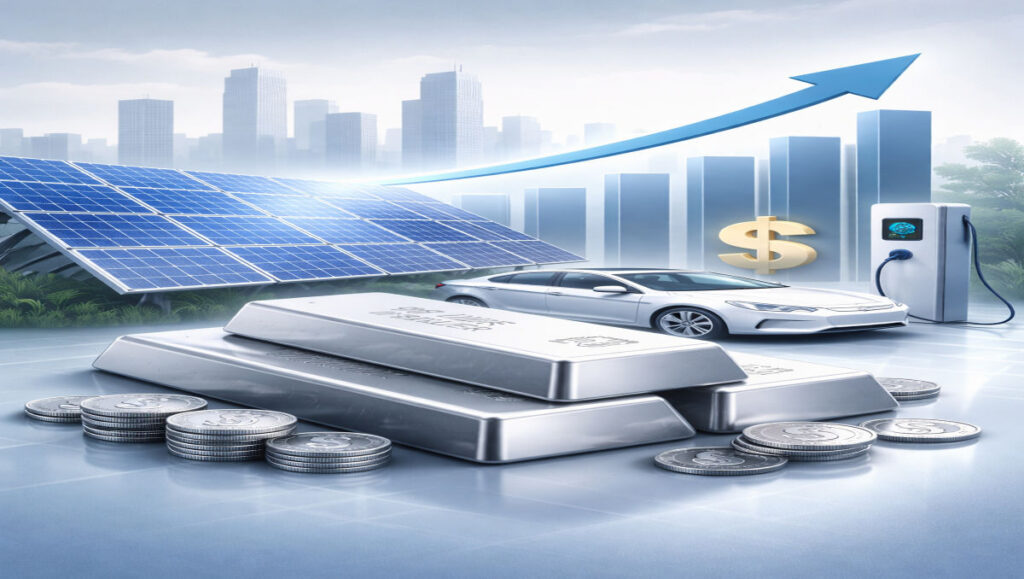
The factors influencing silver prices in 2026/2027 are becoming increasingly complex as the metal sits at the intersection of industrial growth, renewable energy expansion, and shifting monetary policy. After a powerful rally in 2025, silver has entered a structurally tighter phase where supply constraints and macroeconomic trends are shaping forward expectations.
Investors evaluating the factors influencing silver prices in 2026/2027 must focus on structural supply dynamics, industrial demand acceleration, Federal Reserve policy direction, and market positioning indicators rather than short-term volatility.
Key Takeaways
- The global silver market remains in a multi-year structural supply deficit.
- Solar and EV demand continue to drive long-term consumption growth.
- Federal Reserve policy and U.S. dollar strength significantly impact silver volatility.
- Silver behaves as a higher-beta alternative to gold.
- Market structure indicators are essential to confirm trend sustainability.
Table of Contents
- Structural Supply Deficit in the Global Silver Market
- Industrial Demand and Energy Transition Growth
- Macroeconomic and Monetary Policy Drivers
- Geopolitical and Market Sentiment Factors
- Gold-to-Silver Ratio and Relative Performance
- Market Structure Indicators to Watch
- Outlook: Factors Influencing Silver Prices in 2026/2027
- What This Means for Investors
- FAQ: Key Factors Influencing Silver Prices in 2026/2027
- Final Thoughts
Structural Supply Deficit in the Global Silver Market
One of the most important factors influencing silver prices in 2026/2027 is the persistent structural supply deficit.
Global mine production typically ranges between 800 and 900 million ounces annually, while total global demand has recently hovered near or above 1 billion ounces. This imbalance has produced consecutive years of deficits, tightening available inventories.
Approximately 70% of silver production comes as a byproduct of base metals such as copper, zinc, and lead. Because mining decisions are primarily driven by base metal economics, silver supply cannot easily expand in response to rising prices. This inelastic supply structure strengthens long-term price support.
Declining ore grades, limited large-scale discoveries, regulatory constraints, and disciplined capital expenditure across the mining industry further reinforce supply rigidity. These structural pressures remain central among the factors influencing silver prices in 2026/2027.
For a broader perspective on supply-demand mechanics in precious metals, see our analysis of how droughts and weather patterns impact corn prices, which also demonstrates how structural imbalances drive commodity volatility.
According to data from the U.S. Geological Survey (USGS), global silver production trends highlight ongoing structural constraints in mine output.
Industrial Demand and Energy Transition Growth
Industrial consumption now accounts for more than half of total silver demand, making it one of the strongest drivers of the silver market outlook for 2027.
Solar Photovoltaic Expansion
Silver plays a critical role in photovoltaic solar cells due to its superior conductivity. As global solar installations expand, especially across the United States and Asia, structural demand continues to rise.
Although manufacturers are reducing silver intensity per panel, total installation growth has offset these efficiency gains. The renewable energy transition remains one of the most durable factors influencing silver prices in 2026/2027.
Electric Vehicles and Advanced Electronics
Silver is widely used in EV power systems, battery management technologies, AI data infrastructure, and 5G communications hardware. Electrification trends and digital transformation create consistent baseline demand.
However, elevated prices may encourage substitution toward copper in select applications, which could moderate extreme upside pressure.
Global solar installation growth data from the International Energy Agency (IEA) reinforces silver’s role in photovoltaic expansion.
Macroeconomic and Monetary Policy Drivers
Silver’s dual identity as both an industrial and monetary asset makes macroeconomic policy central to the silver market outlook for 2026.
Federal Reserve Policy and Real Yields
When real yields decline or the Federal Reserve shifts toward rate cuts, non-yielding assets like silver typically gain support. If monetary easing accelerates in 2026, investment flows into precious metals may strengthen.
Conversely, persistent high real yields could cap momentum despite strong industrial fundamentals.
U.S. Dollar and Inflation Dynamics
Silver prices often move inversely to the U.S. dollar. A weaker dollar environment generally supports commodities.
Rising global debt levels and inflation concerns also enhance silver’s role as a tactical hedge, adding to the macroeconomic factors influencing silver prices in 2026/2027.
Federal Reserve policy decisions and real yield movements remain critical variables influencing precious metals markets.
Geopolitical and Market Sentiment Factors
Geopolitical uncertainty, trade policy shifts, and global supply chain realignments continue to influence commodity markets.
Silver benefits from safe-haven demand during periods of instability, though it remains more volatile than gold. Futures positioning, ETF flows, and speculative capital movements can significantly amplify short-term price swings.
Because silver’s market capitalization is smaller than gold’s, capital inflows and outflows tend to produce larger percentage moves.
Gold-to-Silver Ratio and Relative Performance
The gold-to-silver ratio remains a key valuation metric.
Historically fluctuating between 40 and 80 in stable cycles, the ratio compresses during strong industrial growth and risk-on phases. When the ratio narrows, silver often outperforms gold.
Investors comparing precious metals should also review our detailed breakdown of Physical Gold vs. Gold ETFs: Pros and Cons for US Investors to better understand relative positioning and portfolio allocation.
Monitoring ratio trends helps investors evaluate whether the broader factors influencing silver prices in 2026/2027 are supportive of continued outperformance or signaling defensive rotation back into gold.
Market Structure Indicators to Watch
To determine whether price moves are sustainable, investors should monitor:
COMEX inventory trends, which reflect physical tightness.
Silver ETF holdings, which signal investment demand strength.
Industrial manufacturing data and solar installation figures.
Real yield direction and U.S. dollar momentum.
Gold-to-silver ratio movements.
These indicators help confirm whether the factors influencing silver prices in 2026/2027 are strengthening structurally or merely driven by speculative positioning.
For real-time market updates, monitor our daily Commodity Market Today in USA snapshot covering gold, silver, and crude oil structure.
Outlook: Factors Influencing Silver Prices in 2026/2027
Silver’s trajectory into 2027 depends on macroeconomic balance and industrial resilience.
In a soft-landing environment with gradual rate cuts, industrial demand combined with monetary easing could support elevated prices.
In a recessionary scenario, industrial demand may temporarily weaken, but aggressive monetary stimulus could drive renewed investment inflows.
In a strong-growth environment with tight policy, industrial demand would remain firm, though higher real yields could limit upside acceleration.
Across these scenarios, structural supply constraints suggest downside risk may be more limited than in previous cycles, even if volatility remains elevated.
What This Means for Investors
Understanding the factors influencing silver prices in 2026/2027 allows investors to position strategically rather than react emotionally to short-term swings.
Silver offers higher upside potential than gold but carries greater volatility. It provides exposure to clean energy growth, industrial expansion, and monetary cycles simultaneously.
For portfolio allocation, evaluating the factors influencing silver prices in 2026/2027 reduces reactionary positioning and supports disciplined risk management.
Silver exposure can be achieved through physical holdings, ETFs, mining equities, or futures depending on investor sophistication and risk tolerance.
You may also find our guide on Why Nickel Is Crucial for EV Batteries and Future Demand helpful when evaluating how industrial metals influence long-term commodity trends.
FAQ: Key Factors Influencing Silver Prices in 2026/2027
Why is silver more volatile than gold?
Silver’s smaller market size and dual industrial-monetary role increase price sensitivity.
Is the supply deficit real?
Yes. Multiple years of demand exceeding mine output have reduced inventories.
How does Fed policy affect silver?
Lower real yields and a weaker dollar typically support precious metals.
Will industrial demand remain strong through 2027?
Solar and EV expansion suggest structural growth, though substitution risks exist.
Final Thoughts
The factors influencing silver prices in 2026/2027 revolve around structural supply tightness, renewable energy demand, Federal Reserve policy shifts, and evolving global risk conditions.
While volatility is likely to persist following recent rallies, long-term fundamentals remain constructive. Monitoring inventories, ETF flows, industrial data, and macro policy signals will be essential for assessing trend durability.
Silver increasingly operates at the intersection of industrial growth and monetary hedging, making it one of the most strategically dynamic commodities heading into 2026 and 2027.
Author
US Commodity Price Research Team
Independent commodity analysis focused on structural supply-demand dynamics and macro-driven market trends.
Disclaimer
This content is for informational and educational purposes only and does not constitute financial advice. Commodity markets are volatile and involve risk. Investors should conduct independent research or consult a qualified financial advisor before making investment decisions.
