
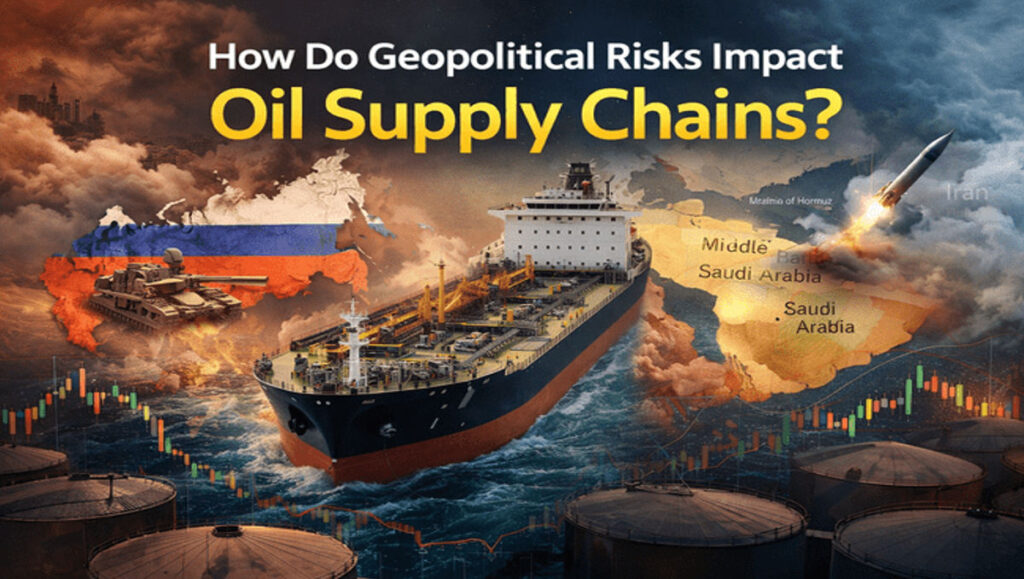
Geopolitical risks impact oil supply chains by disrupting production, threatening maritime chokepoints, triggering sanctions, increasing freight and insurance costs, tightening refining compatibility, and driving immediate futures market volatility. Even before physical supply is removed, global energy markets reprice geopolitical risk within minutes.
The world consumes roughly 102–103 million barrels of oil per day, with nearly 20 percent flowing through critical transit corridors such as the Strait of Hormuz. Because production and transport infrastructure remain geographically concentrated, instability in a single region can rapidly reshape global trade flows, tanker routing, and pricing benchmarks.
Understanding how do geopolitical risks impact oil supply chains is essential for policymakers, energy executives, refiners, logistics operators, and institutional investors operating in an increasingly fragmented geopolitical environment.
Key Takeaways
- Roughly 17–20 million barrels per day move through the Strait of Hormuz.
- A single infrastructure attack in 2019 disrupted 5.7 million barrels per day.
- Sanctions reshape trade flows rather than eliminate supply.
- Freight and war-risk insurance premiums can multiply several times during conflict.
- Futures markets react before physical shortages occur.
- US shale production provides partial supply stabilization.
Table of Contents
- Defining Geopolitical Risk in Energy Markets
- Architecture of the Global Oil Supply Chain
- Five Transmission Channels of Disruption
- Case Study: Russia–Ukraine War
- Case Study: Saudi Infrastructure Attacks
- Maritime Chokepoints and Transit Risk
- Sanctions and Trade Realignment
- Freight, Insurance, and Logistics Escalation
- Refining Constraints and Grade Mismatch
- OPEC Strategy and Political Leverage
- The Strategic Role of US Shale
- Futures Market Volatility Transmission
- Strategic Petroleum Reserves
- 2026–2030 Risk Scenario Model
- What This Means for US Investors
- Frequently Asked Questions
- Final Thoughts
- Author
- Disclaimer
Defining Geopolitical Risk in Energy Markets
Geopolitical risk refers to political instability, armed conflict, sanctions, diplomatic breakdowns, regime changes, and territorial disputes that directly or indirectly affect oil production and transportation.
Oil production remains geographically concentrated. The Middle East accounts for roughly one-third of global crude exports. Russia and Saudi Arabia each produce more than 9–10 million barrels per day under stable conditions. When instability affects any of these regions, oil supply chains experience immediate stress.
This concentration explains structurally how do geopolitical risks impact oil supply chains on a global scale.
Geopolitical instability is the primary structural variable explaining how do geopolitical risks impact oil supply chains in real time. When production zones or export corridors face uncertainty, markets immediately adjust flows, pricing, and logistics exposure across the global energy system.
Architecture of the Global Oil Supply Chain
Oil supply chains operate through five integrated stages: upstream production, pipeline and maritime transport, storage hubs, refining, and downstream fuel distribution.
Each stage spans multiple jurisdictions. A disruption in production in one country can affect refinery margins in another continent within days. Because oil flows are continuous and capital intensive, even short disruptions can have disproportionate pricing effects.
Understanding how do geopolitical risks impact oil supply chains requires analyzing how shocks propagate across these five stages.
The 5 Transmission Channels of Disruption
To fully understand how do geopolitical risks impact oil supply chains, we must analyze the five measurable transmission mechanisms through which instability spreads across the global energy system. These channels operate simultaneously and compound one another.
1.Production Removal Shock
The most visible impact occurs when geopolitical instability directly disrupts oil production. Infrastructure attacks, civil unrest, or export sanctions can remove millions of barrels per day from accessible markets.
For example, the 2019 Saudi facility disruption temporarily affected 5.7 million barrels per day, nearly 5 percent of global supply at that time. Even short-lived production losses can trigger immediate price repricing.
This is the most direct way how geopolitical risks impact oil supply chains through physical supply contraction.
2. Transit and Chokepoint Disruption
Approximately 17–20 million barrels per day pass through the Strait of Hormuz. The Suez Canal and Bab el-Mandeb are also critical corridors for Europe and Asia-bound shipments.
If geopolitical escalation threatens these chokepoints, tankers reroute. A rerouting around Africa can extend voyages by 10–14 days, increasing freight costs significantly and tightening vessel availability.
Transit disruption magnifies how geopolitical risks impact oil supply chains by increasing time, cost, and uncertainty.
3. Trade Realignment and Sanctions Diversion
Sanctions rarely eliminate oil from global markets. Instead, they reshape trade flows.
When Western sanctions were imposed on Russian crude, exports were redirected toward Asian markets at discounted prices. Shipping distances increased, alternative payment systems emerged, and market transparency declined.
This structural redirection increases inefficiency and logistical complexity, demonstrating how geopolitical risks impact oil supply chains beyond production loss.
4. Financial Market Repricing and Volatility Surge
Oil futures markets react within minutes to geopolitical escalation. During the early stages of the Russia–Ukraine conflict, crude prices briefly exceeded $120 per barrel, reflecting risk premium repricing.
Even rumors of instability can widen Brent-WTI spreads and increase options volatility. Financial markets often move before confirmed physical shortages occur.
This financial transmission channel accelerates how geopolitical risks impact oil supply chains through investor behavior and hedging activity.
5. Logistics, Insurance, and Cost Amplification
War-risk insurance premiums can increase several times during periods of conflict. Tanker charter rates may surge 50–100 percent depending on severity and region.
Higher freight and insurance costs feed directly into delivered crude pricing, raising downstream fuel costs even if production remains stable.
Cost amplification is the final layer explaining how geopolitical risks impact oil supply chains across global energy markets.
These five transmission mechanisms provide a measurable framework for understanding how do geopolitical risks impact oil supply chains beyond headline-driven price spikes. Production shocks, transit risk, sanctions, financial repricing, and logistics escalation interact simultaneously rather than independently.
Case Study: Russia–Ukraine War
Before 2022, Russia exported approximately 7–8 million barrels per day of crude and refined products.
Following sanctions, European imports declined sharply. Russian crude was redirected primarily toward Asia. Shipping distances expanded by thousands of nautical miles. Freight rates increased. Brent crude prices briefly exceeded $120 per barrel in 2022, reflecting risk premium repricing.
The International Energy Agency documented the sharp reconfiguration of Russian crude trade flows following 2022 sanctions.
Global output did not collapse entirely. However, oil supply chains were fundamentally reorganized. This case demonstrates how do geopolitical risks impact oil supply chains through structural reconfiguration rather than absolute supply elimination.
Case Study: Saudi Infrastructure Attacks
In September 2019, drone strikes temporarily disrupted 5.7 million barrels per day of Saudi output, roughly 5 percent of global supply.
Oil prices surged nearly 15 percent in a single trading session. Production recovered within weeks, but the event revealed the fragility of concentrated infrastructure.
This incident illustrates how do geopolitical risks impact oil supply chains even when disruption is temporary.
Maritime Chokepoints and Transit Risk
The Strait of Hormuz, Suez Canal, and Bab el-Mandeb represent critical transit corridors.
In recent years, tensions in the Red Sea forced some tankers to reroute around Africa, increasing shipping time by 10–14 days. This extended route elevated freight costs and tightened tanker availability.
According to the U.S. Energy Information Administration (EIA), nearly one-fifth of global petroleum liquids consumption transits the Strait of Hormuz annually.
Transit vulnerability amplifies how do geopolitical risks impact oil supply chains because alternative routes are limited and significantly more expensive.
To understand how freight and fuel volatility amplify geopolitical disruptions, see our detailed analysis on how to hedge against rising freight fuel prices, which explains how shipping cost spikes feed into oil logistics risk.
Transit concentration risk is central to how do geopolitical risks impact oil supply chains, particularly when nearly 20 percent of global flows pass through narrow maritime corridors. Even temporary naval tensions can force rerouting that reshapes tanker availability and freight pricing worldwide.
Sanctions and Trade Realignment
Sanctions reshape global energy geography.
When sanctioned, producers often sell crude at discounted rates to alternative buyers. Payment systems shift outside traditional Western clearing networks. Shipping insurance markets adjust accordingly.
This redirection increases inefficiency and reduces transparency in oil supply chains. Understanding how do geopolitical risks impact oil supply chains requires recognizing that trade does not stop; it becomes more complex and costly.
Our institutional forecast on LNG facility construction impact aluminum demand 2026 also shows how sanctions and infrastructure realignment reshape global commodity trade flows beyond oil.
Freight, Insurance, and Logistics Escalation
War-risk insurance premiums can multiply during active conflict. Tanker charter rates may surge 50–100 percent depending on severity.
Higher logistics costs feed directly into wholesale and retail fuel prices. Even if production remains stable, cost escalation increases volatility.
Thus, how do geopolitical risks impact oil supply chains extends beyond physical availability into pricing transmission.
Refining Constraints and Grade Mismatch
Crude oil varies in sulfur content and density. Refineries are configured for specific grades.
When geopolitical disruptions alter crude sources, refineries may struggle to substitute supply efficiently. This can widen gasoline and diesel crack spreads and create regional imbalances.
Refining compatibility is a frequently overlooked dimension of how do geopolitical risks impact oil supply chains.
OPEC Strategy and Political Leverage
OPEC+ controls a significant share of global spare capacity, often estimated at 3–5 million barrels per day during stable periods.
OPEC production data and policy statements are publicly available through the OPEC Secretariat’s official reports.
You can compare this with our macro breakdown on how geopolitical fragmentation affects industrial metals supply chains, which highlights similar concentration risks across commodity markets.
Production decisions can either stabilize markets or intensify tightness during geopolitical shocks. Political coordination among members directly influences supply outcomes.
OPEC policy plays a decisive role in determining how do geopolitical risks impact oil supply chains globally.
The Strategic Role of US Shale
US shale production offers flexibility. Output can increase within months compared to multi-year offshore projects.
However, capital discipline, labor constraints, and regulatory considerations limit responsiveness.
US shale reduces but does not eliminate systemic vulnerability in global oil supply chains.
Futures Market Volatility Transmission
Oil markets are forward-looking. During major geopolitical escalation, volatility indexes spike and benchmark spreads widen.
In 2022, crude prices experienced multiple double-digit percentage swings within weeks. Financial transmission often precedes confirmed physical shortages.
Understanding how do geopolitical risks impact oil supply chains requires integrating futures market behavior with physical flows.
Strategic Petroleum Reserves
Strategic reserves serve as temporary shock absorbers.
Coordinated releases can moderate short-term price spikes. However, reserves are finite and cannot replace prolonged production loss.
Policy decisions shape the duration and severity of supply disruption.
The U.S. Department of Energy publishes weekly data on Strategic Petroleum Reserve inventory levels and release programs.
2026–2030 Risk Scenario Model
If a major chokepoint were blocked for 30 days, daily global inventories could decline rapidly depending on spare capacity deployment. If sanctions expand to additional producers, trade realignment would intensify and freight costs would rise further.
Conversely, diversified sourcing and increased domestic production could reduce exposure over time.
Energy security strategy remains the primary long-term mitigation mechanism.
What This Means for US Investors
For US investors, geopolitical risk introduces both opportunity and volatility.
Energy producers may benefit from elevated crude prices. Airlines and logistics companies face margin pressure from rising fuel costs. Refiners experience grade-sensitive margin fluctuations.
Monitoring geopolitical developments allows investors to anticipate inflationary pressures and sector rotation before broader economic impact emerges.
Understanding how do geopolitical risks impact oil supply chains provides a strategic edge in macro portfolio positioning.
Investors tracking macro commodity positioning may also review our latest US commodity market snapshot for gold, silver, and crude oil structural trends.
For institutional portfolios, understanding how do geopolitical risks impact oil supply chains provides a strategic edge in anticipating volatility, inflation pressure, and sector rotation. Energy markets typically reprice geopolitical risk before macroeconomic data reflects disruption.
Frequently Asked Questions
How do geopolitical risks impact oil supply chains immediately?
They influence futures pricing, freight premiums, insurance costs, and shipment rerouting before physical shortages are confirmed.
Which chokepoint poses the highest systemic risk?
The Strait of Hormuz handles nearly one-fifth of global oil flows and represents the most critical transit corridor.
Can OPEC offset geopolitical shocks?
Sometimes, but effectiveness depends on spare capacity and political coordination.
Does US shale eliminate geopolitical exposure?
No. It mitigates risk but does not remove global vulnerability.
Why do prices spike before confirmed supply loss?
Markets price anticipated risk rather than waiting for verified disruption.
Final Thoughts
How do geopolitical risks impact oil supply chains? They influence production, transit, trade flows, logistics costs, refining compatibility, and financial markets simultaneously.
Oil remains the most geopolitically sensitive global commodity. As geopolitical fragmentation intensifies, supply chain resilience becomes increasingly critical.
Diversified sourcing, strategic reserves, domestic production capacity, and proactive risk modeling remain the strongest defenses against future disruption.
Author
US Commodity Research Team
Our analysts specialize in macro energy modeling, geopolitical risk assessment, global supply chain analysis, and institutional commodity strategy using publicly available energy statistics and market data.
Disclaimer
This content is provided for informational and educational purposes only and does not constitute financial, investment, legal, or tax advice. The analysis reflects macroeconomic and geopolitical observations based on publicly available energy statistics and market data at the time of writing.
Oil markets are inherently volatile and subject to rapid geopolitical developments. Past market behavior does not guarantee future outcomes. Readers should conduct independent research and consult qualified financial professionals before making investment or strategic decisions related to energy markets.
Neither the authors nor the publisher assume responsibility for any financial losses or decisions made based on this material.
