
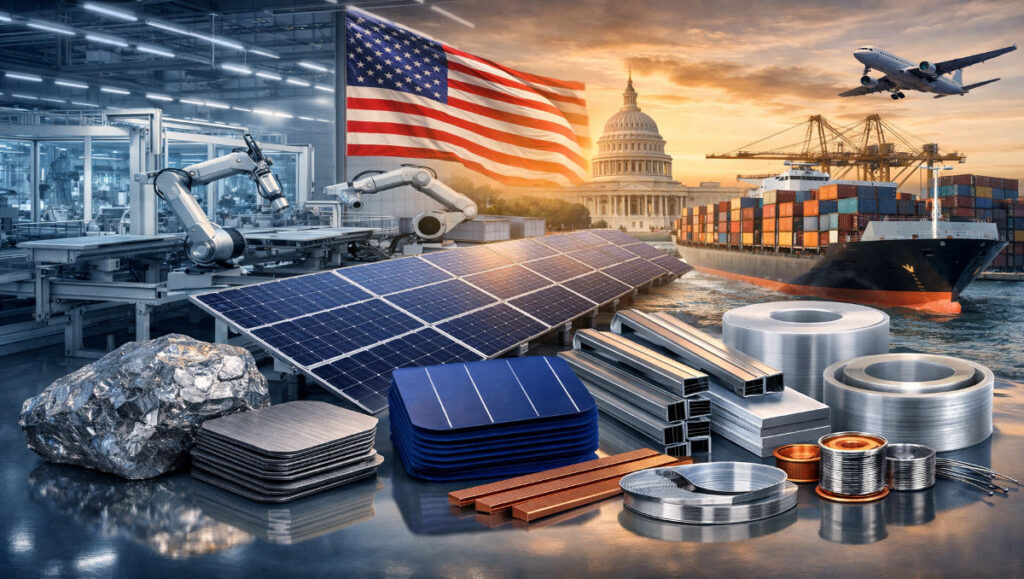
The U.S. solar market has surpassed 170+ gigawatts of installed capacity and continues expanding under the Inflation Reduction Act’s domestic manufacturing incentives. With billions flowing into renewable infrastructure, understanding how to buy solar panel raw materials wholesale in USA is no longer optional ,it is a strategic competitive advantage.
Manufacturers, EPC contractors, private-label brands, and investors must now navigate pricing cycles, trade compliance, certification requirements, and supply chain risk simultaneously.
This guide explains exactly how to buy solar panel raw materials wholesale in USA safely, profitably, and in compliance with federal regulations.
How to Buy Solar Panel Raw Materials Wholesale in USA?
To buy solar panel raw materials wholesale in USA, businesses must source from verified photovoltaic suppliers or compliant import channels, validate UL and IEC certifications, confirm traceability under federal trade law, negotiate bulk contracts, and calculate total landed cost including logistics and tariffs.
Key Takeaways
- Domestic policy incentives influence sourcing decisions
- Compliance risk is as critical as price negotiation
- Total landed cost determines profitability
- Diversified suppliers reduce disruption risk
- Long-term supply agreements improve margin stability
Table of Contents
- Understanding the U.S. Solar Manufacturing Supply Chain
- Core Materials Required for Solar Panel Production
- How to Buy Solar Panel Raw Materials Wholesale in USA: Procurement Models
- Domestic vs Imported Solar Materials
- Federal Compliance & Trade Law Requirements
- Bulk Pricing Benchmarks and Cost Drivers
- Wholesale Price Ranges and Cost Examples in the U.S. Market
- Common Wholesale Procurement Mistakes to Avoid
- Capital Allocation and Margin Strategy for U.S. Solar Investors
- Step-by-Step Wholesale Procurement Framework
- Risk Management and Supply Chain Diversification
- What This Means for U.S. Investors
- Frequently Asked Questions
- Final Thoughts
- Author
- Disclaimer
Understanding the U.S. Solar Manufacturing Supply Chain
Before executing how to buy solar panel raw materials wholesale in USA, buyers must understand the layered structure of solar production.
The U.S. supply chain includes upstream polysilicon production, wafer slicing, solar cell manufacturing, and module assembly. While domestic manufacturing capacity is expanding due to federal incentives, many upstream materials still involve global sourcing.
This hybrid structure means wholesale procurement requires coordination across multiple compliance and logistics frameworks.
For deeper insight into how domestic energy policy affects fossil fuel markets, read our analysis on How OPEC Meetings Impact US Gasoline Prices, which explains how global supply decisions influence U.S. energy pricing.
For up-to-date industry capacity data and supply chain reporting, buyers can reference market analysis published by the Solar Energy Industries Association (SEIA), which tracks U.S. installation growth and manufacturing expansion.
Core Materials Required for Solar Panel Production
Solar panel manufacturing depends on several critical raw materials.
Polysilicon forms the base feedstock for photovoltaic cells. Market prices fluctuate depending on global production cycles and energy costs.
Silicon wafers are cut from ingots and determine electrical efficiency.
Solar cells, typically monocrystalline in the U.S. utility-scale market, provide higher performance output.
Tempered low-iron glass ensures durability and light transmission.
Aluminum frames, encapsulation films, and junction boxes complete structural integrity.
Understanding material classification is fundamental when planning how to buy solar panel raw materials wholesale in USA.
How to Buy Solar Panel Raw Materials Wholesale in USA: Procurement Models
Businesses evaluating how to buy solar panel raw materials wholesale in USA typically use four sourcing models.
Direct supplier contracts offer lower unit pricing for large-scale buyers but require higher minimum order quantities.
B2B exchanges allow buyers to compare supplier pricing transparently while verifying credentials.
Procurement brokers consolidate demand from multiple buyers, negotiating volume discounts and managing shipping logistics.
U.S.-based subsidiaries of global manufacturers provide regulatory confidence but may carry premium pricing.
Choosing the appropriate model depends on scale, capital availability, and compliance risk tolerance.
Domestic vs Imported Solar Materials
When learning how to buy solar panel raw materials wholesale in USA, cost alone cannot drive decision-making.
Domestic materials typically reduce customs risk and compliance exposure under the Uyghur Forced Labor Prevention Act.
Imported materials may offer lower base pricing but can incur anti-dumping duties, countervailing tariffs, or shipment delays.
Buyers must calculate total landed cost including freight, duties, warehousing, insurance, and compliance documentation.
Federal Compliance & Trade Law Requirements
Federal policy significantly impacts how to buy solar panel raw materials wholesale in USA.
The Inflation Reduction Act incentivizes domestic manufacturing through advanced production credits.
Businesses importing photovoltaic materials must understand the enforcement framework of the Uyghur Forced Labor Prevention Act, which is administered by U.S. Customs and Border Protection. Detailed compliance guidance is available directly from the U.S. Customs and Border Protection official website.
The Uyghur Forced Labor Prevention Act requires supply chain transparency for imported materials.
The Solar Energy Industries Association (SEIA) Traceability Protocol sets voluntary but increasingly adopted sourcing standards.
Failure to comply can result in shipment detention, financial penalties, or reputational damage.
Companies evaluating domestic sourcing strategies should review the Inflation Reduction Act manufacturing incentives outlined by the U.S. Department of Energy to understand available production tax credits and domestic content bonuses.
Bulk Pricing Benchmarks and Cost Drivers
Wholesale pricing depends on several economic variables.
Polysilicon markets are cyclical and influenced by global production capacity.
Transportation costs fluctuate based on container availability and fuel prices.
Tariff exposure can significantly alter per-watt economics.
Global polysilicon and photovoltaic component pricing trends are often tracked through market intelligence providers and renewable energy research publications, including data summaries published by the U.S. Energy Information Administration.
Buyers often negotiate long-term supply agreements to stabilize pricing rather than relying on spot purchases.
Understanding pricing structure is central to successfully executing how to buy solar panel raw materials wholesale in USA at competitive margins.
For comparison with other industrial materials, explore our detailed study on How to Invest in Copper Mining Stocks for 2026, which analyzes pricing cycles and supply constraints in energy-transition metals.
Wholesale Price Ranges and Cost Examples in the U.S. Market
Understanding real-world cost dynamics is essential when evaluating how to buy solar panel raw materials wholesale in USA at scale.
While prices fluctuate based on global supply-demand cycles, freight conditions, and policy shifts, wholesale solar material pricing typically varies based on volume commitments and contract structure.
Polysilicon pricing is heavily influenced by global production capacity and energy input costs. Buyers entering long-term supply contracts often secure more stable pricing compared to spot market participants.
Solar cells and wafers are typically priced per watt, and bulk container-level purchases may reduce per-unit cost significantly compared to pallet-level buying.
Freight and logistics represent a meaningful cost component. Ocean freight rates, port congestion, customs clearance timelines, inland trucking, warehousing, and insurance can materially affect total landed cost.
Domestic suppliers often carry a modest price premium, but that premium may be offset by:
- Lower compliance risk
- Reduced customs delays
- Faster fulfillment timelines
- Qualification for domestic content incentives
When learning how to buy solar panel raw materials wholesale in USA, buyers should compare:
- Spot purchases versus annual supply contracts
- Domestic content versus imported alternatives
- Delivered cost versus factory gate pricing
True profitability depends on total landed cost, not just base material price.
Common Wholesale Procurement Mistakes to Avoid
Even experienced procurement teams can make costly errors when implementing how to buy solar panel raw materials wholesale in USA.
One of the most frequent mistakes is prioritizing price without validating compliance documentation. In today’s regulatory environment, inadequate traceability can result in shipment detention or reputational damage, quickly outweighing short-term savings.
Another common issue is underestimating total landed cost. Buyers sometimes focus on factory-gate pricing while overlooking freight volatility, customs clearance timelines, warehousing fees, and insurance expenses. These overlooked variables can compress margins unexpectedly.
Supplier concentration is another significant risk. Relying on a single overseas source increases vulnerability to geopolitical tensions, trade disputes, or production bottlenecks. Diversified sourcing provides greater resilience and flexibility.
Additionally, some buyers delay contract negotiations during favorable pricing cycles, only to face sudden cost increases following policy changes or tariff adjustments. Structured long-term agreements can reduce this exposure and stabilize project economics.
Avoiding these errors strengthens operational discipline and improves execution outcomes when managing wholesale solar procurement in the United States.
Capital Allocation and Margin Strategy for U.S. Solar Investors
For investors, understanding how to buy solar panel raw materials wholesale in USA is directly connected to capital efficiency and return optimization.
Material procurement decisions influence project cost structure, deployment timelines, and long-term profitability. Under the Inflation Reduction Act, domestic sourcing strategies may unlock production tax credits and bonus incentives, yet these benefits must be weighed against potential pricing premiums.
Investors must evaluate the full financial picture, including incentive-adjusted cost comparisons, exposure to tariff volatility, and the reliability of supplier performance. Projects that secure diversified supply contracts often demonstrate stronger resilience during periods of trade disruption or commodity price fluctuation.
Procurement strategy is no longer a purely operational consideration. It is increasingly integrated into financial modeling and risk assessment frameworks used by institutional capital allocators. Wholesale sourcing decisions directly affect internal rate of return calculations, capital allocation timing, and overall competitive positioning.
In a market shaped by policy incentives and global supply chain complexity, disciplined procurement enhances both regulatory compliance and long-term margin stability.
Step-by-Step Wholesale Procurement Framework
Executing how to buy solar panel raw materials wholesale in USA requires disciplined process control:
- Verify supplier registration and financial stability to ensure legitimacy and long-term reliability.
- Request multiple bulk quotations and compare payment terms to strengthen negotiation leverage.
- Validate UL and IEC certifications and confirm full compliance documentation before contract execution.
- Calculate total landed cost, including logistics, insurance, customs duties, and warehousing expenses.
- Negotiate long-term supply agreements where feasible to stabilize pricing and secure priority allocation.
- Inspect shipments immediately upon receipt to confirm quality, quantity, and specification accuracy.
This structured procurement framework reduces operational risk and protects margin integrity.
Risk Management and Supply Chain Diversification
Solar supply chains remain exposed to geopolitical shifts and trade policy changes.
Diversifying suppliers across multiple jurisdictions reduces concentration risk.
Maintaining buffer inventory protects against logistics disruptions.
Institutional buyers increasingly integrate compliance scoring and geopolitical risk analysis into procurement decisions.
Proactive diversification strengthens resilience when implementing how to buy solar panel raw materials wholesale in USA.
Investors evaluating broader renewable exposure may also review our guide on How Renewable Energy Trends Impact Fossil Fuel Commodities to understand cross-commodity capital flows.
What This Means for U.S. Investors
For U.S. investors entering solar manufacturing or module assembly, understanding how to buy solar panel raw materials wholesale in USA directly impacts project internal rate of return.
Federal incentives reward domestic sourcing, but compliance documentation increases operational complexity.
Procurement strategy influences capital allocation efficiency, deployment timelines, and long-term competitive positioning.
Wholesale sourcing decisions are now strategic financial decisions rather than simple operational transactions.
If you are building exposure to physical renewable infrastructure, you may also consider reviewing Sustainable Timber Options for Construction in USA, which covers another growing segment of green industrial demand.
Frequently Asked Questions
What certifications are required when buying wholesale solar materials?
UL and IEC certifications are typically required for U.S. distribution.
Is it cheaper to import solar raw materials?
Imported materials may have lower base pricing but can incur tariffs and compliance costs.
What are typical payment terms in wholesale solar contracts?
Payment structures may include letters of credit, advance deposits, or Net-30 terms depending on supplier agreements.
What is the minimum order quantity for wholesale purchases?
Minimums vary by supplier but often involve pallet or container-level commitments.
How does the Inflation Reduction Act affect procurement?
The IRA incentivizes domestic production and can shift sourcing economics.
How can buyers reduce supply chain risk?
Diversifying suppliers and negotiating long-term contracts reduce volatility exposure.
Can small businesses buy wholesale solar materials?
Yes, provided they meet supplier registration and minimum order requirements.
Final Thoughts
Mastering how to buy solar panel raw materials wholesale in USA requires structured procurement, regulatory awareness, pricing intelligence, and risk diversification.
Businesses that treat wholesale solar sourcing as a strategic function rather than a transactional task , gain durable competitive advantage in a rapidly expanding clean energy economy.
Author
US Commodity Price Research Desk
Independent analysts covering industrial commodities, renewable energy supply chains, and U.S. infrastructure markets.
Disclaimer
This article is for informational purposes only and does not constitute financial, legal, or procurement advice. Businesses should consult qualified professionals before entering wholesale supply agreements.
