
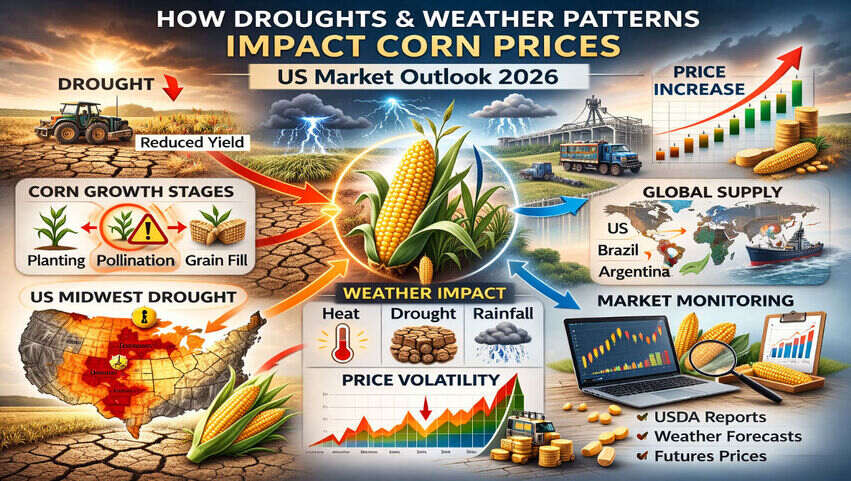
Understanding how droughts and weather patterns impact corn prices is critical for US farmers, grain traders, ethanol producers, and agricultural investors. Corn is one of the most weather-sensitive commodities in global markets, and supply expectations often shift weeks before harvest data confirms production outcomes.
Because corn yield depends directly on rainfall timing, soil moisture conditions, and temperature stability, even short periods of drought can alter national supply projections. Analyzing how droughts and weather patterns impact corn prices requires evaluating structural crop timing rather than reacting to isolated forecasts.
This 2026 outlook explains how drought timing, regional weather variability, and global crop competition influence US corn pricing trends.
Key Takeaways: How Droughts and Weather Patterns Impact Corn Prices
How droughts and weather patterns impact corn prices depends heavily on crop stage timing rather than total seasonal rainfall.
Pollination and grain fill periods represent the highest yield sensitivity windows.
Midwest drought conditions can quickly shift global supply expectations.
Weather-driven corn volatility often begins before official USDA yield revisions.
Long-term climate variability increases structural risk in agricultural pricing models.
Table of Contents
- Why Weather Is Structural in the Corn Market
- How Drought Timing Affects Yield and Corn Prices
- Critical Corn Growth Stages and Weather Sensitivity
- Regional US Drought Patterns and Market Reactions
- Global Weather Competition and Export Balance
- Structural Supply Shifts vs Temporary Volatility
- Long-Term Climate Trends and Corn Price Risk
- What Corn Traders and Farmers Should Monitor
- FAQ
- Final Thoughts
- Author
- Disclaimer
Why Weather Is Structural in the Corn Market
Weather is not a secondary variable in agriculture. It is the foundation of supply formation.
Understanding how droughts and weather patterns impact corn prices means analyzing soil moisture, evapotranspiration rates, and heat accumulation during key development stages. Markets anticipate production stress before final yield data is released.
Price reacts to probability, not confirmation.
Corn is not the only weather-sensitive commodity. Similar structural dynamics can be seen in metals and energy markets. For example, our analysis of Dr. Copper and economic health explains how supply sensitivity affects pricing across industrial commodities.
How Drought Timing Affects Yield and Corn Prices
Drought does not affect corn equally throughout the growing season. Early-season dryness may delay planting, but mid-season drought during pollination can significantly reduce kernel formation.
When pollination occurs under high temperatures and limited moisture, yield potential declines sharply. This is why how droughts and weather patterns impact corn prices becomes most visible during July heat waves in the US Midwest.
Even short moisture deficits during pollination can shift national yield expectations.
Critical Corn Growth Stages and Weather Sensitivity
Corn progresses through vegetative growth, tasseling, pollination, and grain fill. Pollination remains the most weather-sensitive stage.
High temperatures combined with dry soils reduce fertilization efficiency. Grain fill stages also require consistent moisture to maintain kernel weight.
Understanding how droughts and weather patterns impact corn prices requires monitoring these stages rather than annual rainfall totals alone.
Regional US Drought Patterns and Market Reactions
The Corn Belt drives a large portion of global export supply. Drought maps covering Iowa, Illinois, Nebraska, and Indiana often trigger immediate futures market responses.
When drought intensity expands across multiple Midwest states, national yield projections decline rapidly. Traders adjust supply assumptions before USDA confirmation.
Regional drought expansion is often the first structural signal that how droughts and weather patterns impact corn prices will shift seasonally.
Official drought severity classifications can be tracked through the U.S. Drought Monitor, which provides weekly regional updates across the Corn Belt.
Global Weather Competition and Export Balance
Corn prices are also influenced by weather in Brazil and Argentina. Strong South American harvests can partially offset US drought impacts.
However, simultaneous drought conditions across major producing regions amplify global inventory tightening. When multiple exporters face yield stress, price volatility accelerates.
Weather synchronization across continents increases systemic agricultural risk.
Structural Supply Shifts vs Temporary Volatility
Not all weather events create sustained price trends. Temporary heat spikes may cause short-lived rallies, while prolonged soil moisture deficits can trigger structural supply revisions.
Understanding how droughts and weather patterns impact corn prices requires distinguishing between transient stress and season-long yield impairment.
Markets often overshoot during early panic phases before stabilizing around updated supply projections.
Corn futures pricing and contract specifications can be reviewed through the CME Group Corn Futures page, which reflects how markets price weather risk in real time.
Weather-driven volatility is common across commodities. Just as drought reshapes agricultural supply, energy markets react to structural shifts in production and storage.
👉 Read: Why Nickel Is Crucial for EV Batteries and Future Demand
Long-Term Climate Trends and Corn Price Risk
Climate variability is increasing the frequency of extreme heat and precipitation swings. This adds uncertainty to planting decisions and yield modeling.
Farmers respond through irrigation, seed technology, and adaptive planting strategies. However, structural climate shifts may continue increasing yield variability.
Long-term analysis of how droughts and weather patterns impact corn prices suggests volatility cycles may become more frequent.
Energy transition policies and weather variability often intersect. For broader context on US energy supply shifts, see our breakdown of:
👉 The Future of Natural Gas in the US Energy Transition
What Corn Traders and Farmers Should Monitor
Soil moisture anomaly maps provide early stress signals before visible crop damage appears. USDA weekly crop condition reports confirm structural changes in plant health.
NOAA seasonal outlooks help assess temperature and precipitation probabilities. Corn futures spreads often reflect tightening supply expectations before cash markets adjust.
Monitoring these variables improves forecasting accuracy for how droughts and weather patterns impact corn prices throughout the growing season.
The USDA Weekly Crop Progress Report offers updated crop condition ratings and planting progress data that often influence corn futures markets.
Seasonal precipitation and temperature outlooks from NOAA Climate Prediction Center provide forward-looking weather probability models.
Daily commodity monitoring helps contextualize weather-driven price shifts. You can also track broader US commodity structure here:
👉 US Commodity Prices Today: Market Snapshot
FAQ: How Droughts and Weather Patterns Impact Corn Prices
Why does drought have such a strong impact on corn prices?
Corn is highly sensitive to moisture stress during pollination and grain fill stages. When drought reduces yield expectations, markets immediately adjust supply forecasts, which explains how droughts and weather patterns impact corn prices even before harvest.
When is corn most vulnerable to drought?
Corn is most vulnerable during tasseling and pollination, typically in mid-summer. High temperatures combined with low soil moisture during this period can sharply reduce kernel formation.
Do corn prices always rise during drought?
Not always. Prices react to the severity, timing, and geographic spread of drought conditions. If global supply from other producing countries remains strong, US drought effects may be partially offset.
How do weather forecasts affect corn futures markets?
Futures markets react to forecast probability shifts. Even the expectation of worsening drought conditions can move prices before official yield revisions are released.
Can irrigation fully prevent drought-related price spikes?
Irrigation helps reduce yield loss in some regions, but extreme heat stress and widespread moisture deficits can still reduce national production levels.
Final Thoughts on How Droughts and Weather Patterns Impact Corn Prices
Understanding how droughts and weather patterns impact corn prices requires structural analysis of crop timing, regional exposure, and global export balance. Weather is not a temporary disturbance in agricultural markets. It is a primary driver of supply formation.
For US farmers, ethanol producers, and commodity investors, monitoring moisture trends and growth stages provides clearer insight than reacting to isolated weather headlines.
Author
US Commodity Market Research Team
Our research team specializes in structural analysis of US agricultural and energy commodities. We focus on supply-demand dynamics, climate variability, and market structure to provide long-term insights beyond short-term volatility.
Disclaimer
This article is for informational and educational purposes only and does not constitute financial, investment, or trading advice. Agricultural commodity markets involve risk, including weather-driven volatility and global supply uncertainty. Readers should conduct independent research or consult a qualified financial professional before making investment decisions.
