
Freight fuel volatility remains one of the most destabilizing cost drivers in global trade. Diesel, marine bunker fuel, and aviation fuel prices can rise 20–40% within a single quarter due to refinery constraints, geopolitical tension, or supply discipline decisions from major producers. When that happens, transportation margins compress immediately.
Understanding how to hedge against rising freight fuel prices is not a tactical improvement. It is a structural requirement for logistics operators, commodity exporters, fleet managers, and import-dependent businesses seeking predictable cost control.
Fuel expenses typically represent 25% to 40% of total freight operating cost depending on transport mode. A sudden $0.60 per gallon increase in diesel pricing can translate into seven-figure annual cost escalation for mid-sized fleets. Businesses that fail to institutionalize how to hedge against rising freight fuel prices remain exposed to unpredictable earnings volatility.
How to Hedge Against Rising Freight Fuel Prices?
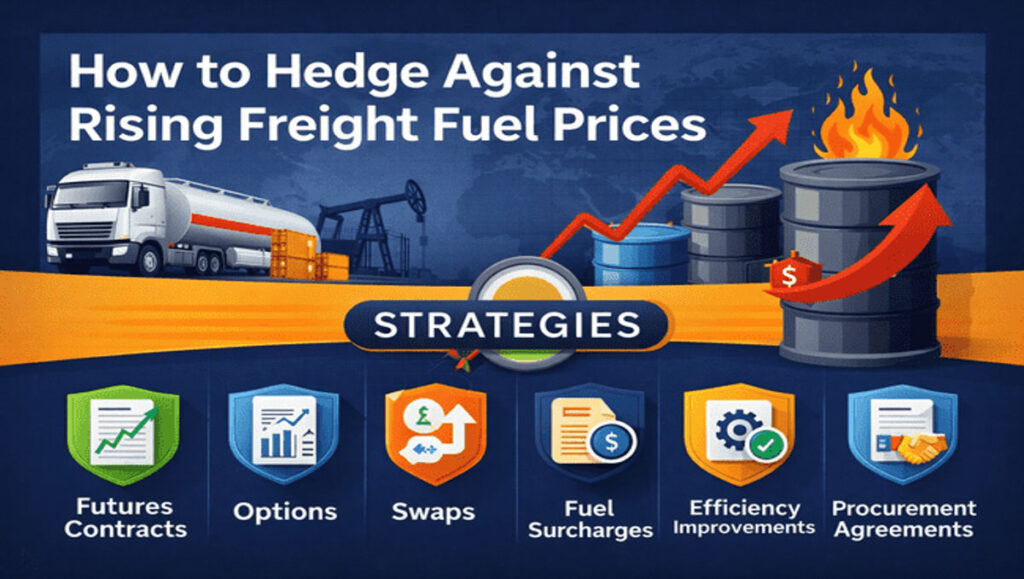
To hedge against rising freight fuel prices, companies combine diesel or crude oil futures, options contracts, energy swaps, structured fuel surcharge clauses, long-term procurement agreements, and operational efficiency improvements. The most effective strategy for how to hedge against rising freight fuel prices integrates financial risk management with structural cost reduction.
Key Takeaways
- Freight fuel volatility is closely tied to crude oil benchmarks and refinery spreads.
- NYMEX ULSD futures provide direct diesel exposure.
- Options cap upside risk while preserving downside flexibility.
- Fuel surcharge mechanisms transfer cost risk contractually.
- Proper hedge ratios must align with real consumption levels.
- Operational efficiency reduces total exposure volume.
- Blended hedging frameworks provide the strongest protection.
Table of Contents
- Structural Drivers of Freight Fuel Volatility
- Diesel, ULSD, and Crack Spread Dynamics
- Quantifying Exposure Before Implementing a Hedge
- How to Hedge Against Rising Freight Fuel Prices Using Futures Contracts
- How to Hedge Against Rising Freight Fuel Prices with Options Strategies
- Marine Fuel Swaps and International Shipping Exposure
- Fuel Surcharge Mechanisms as Risk Transfer Tools
- Long-Term Fuel Procurement Agreements
- Operational Efficiency as a Structural Hedge
- Modal Diversification and Fuel Intensity Reduction
- Hedge Ratio Calibration and Risk Modeling
- Quantitative Example of Margin Protection
- 2026 Energy Market Outlook
- What This Means for U.S. Importers and Exporters
- Frequently Asked Questions
- Final Thoughts
- Author
- Disclaimer
Before exploring advanced instruments, it is critical to understand why fuel volatility persists and how it structurally impacts freight economics.
Structural Drivers of Freight Fuel Volatility
Freight fuel prices move primarily in response to crude oil benchmarks such as WTI and Brent. However, refined product pricing introduces additional complexity because refinery capacity, seasonal demand, and regulatory constraints influence diesel supply.
Crack spreads, which represent the margin between crude input and refined product output, can widen significantly during refinery outages or seasonal demand spikes. When spreads expand, diesel prices often rise faster than crude itself. This dynamic must be considered when designing how to hedge against rising freight fuel prices effectively.
Rising diesel and crude benchmarks directly influence transportation costs, which is why monitoring our US Commodity Prices Today: Gold, Silver & Crude Oil Market Snapshot helps logistics operators anticipate structural shifts in energy pricing before they impact freight contracts.
Diesel, ULSD, and Crack Spread Dynamics
Ultra-Low Sulfur Diesel futures trade on CME Group under NYMEX specifications. These contracts allow commercial participants to hedge diesel exposure directly rather than relying solely on crude oil proxies.
Many businesses incorrectly hedge crude only, ignoring refined product differentials. A disciplined strategy for how to hedge against rising freight fuel prices matches the hedge instrument to the actual fuel consumed. Diesel hedges generally provide more accurate protection for trucking-intensive operations.
Freight fuel prices are closely tied to benchmarks such as WTI crude oil and ULSD futures traded on the CME Group, which serve as primary reference contracts for institutional fuel hedging.
Quantifying Exposure Before Implementing a Hedge
Hedging without quantification introduces unnecessary risk. Exposure modeling must precede execution.
For example, a fleet consuming 1.8 million gallons annually at an average price of $3.40 per gallon incurs $6.12 million in fuel expense. If diesel prices increase by $0.70 per gallon, incremental annual cost equals $1.26 million.
This exposure measurement defines the scale required when implementing how to hedge against rising freight fuel prices responsibly. Professional risk teams evaluate monthly consumption, volatility ranges, benchmark correlations, and liquidity constraints before entering derivatives markets.
How to Hedge Against Rising Freight Fuel Prices Using Futures Contracts
Futures contracts provide price certainty and liquidity. By purchasing ULSD futures corresponding to projected consumption, companies offset rising physical fuel costs with financial gains.
If diesel prices rise 18%, a properly sized futures position appreciates proportionally, compensating for increased spot purchases. Institutional participants often hedge between 60% and 80% of projected consumption to balance protection and flexibility.
Using futures remains one of the most direct and scalable ways to execute how to hedge against rising freight fuel prices with precision.
For a deeper understanding of how crude oil structure influences fuel pricing, see our analysis on Crude Oil Market Status Today (WTI) where we track key resistance and support zones impacting diesel benchmarks.
How to Hedge Against Rising Freight Fuel Prices with Options Strategies
Options introduce asymmetric protection. A diesel call option establishes a price ceiling while allowing benefit if market prices decline.
Although options require premium payments, they limit catastrophic exposure during extreme price spikes. For firms concerned about sudden energy price surges, options represent a disciplined method for how to hedge against rising freight fuel prices without fully locking in costs.
Collar structures may further reduce premium expense while maintaining defined risk parameters.
Marine Fuel Swaps and International Shipping Exposure
Shipping operators frequently hedge bunker fuel using swaps tied to marine fuel indices. These swaps convert floating exposure into fixed pricing over agreed periods.
For international freight networks, marine fuel swaps are an essential tool when designing how to hedge against rising freight fuel prices across long-haul shipping routes.
Fuel Surcharge Mechanisms as Risk Transfer Tools
Fuel surcharge clauses adjust freight pricing according to published diesel benchmarks. While not a derivative instrument, surcharge mechanisms transfer a portion of fuel volatility to customers contractually.
Effective surcharge design includes transparent benchmark references and defined adjustment intervals. Businesses that combine surcharge frameworks with financial hedges build layered defenses for how to hedge against rising freight fuel prices.
Fuel risk is only one component of supply chain vulnerability. We explore broader structural risks in our guide on Logistics Challenges for Importing Critical Minerals USA, highlighting chokepoint exposure and transportation bottlenecks.
The U.S. Energy Information Administration (EIA) publishes weekly diesel price data that many carriers use as the basis for fuel surcharge calculations in long-haul freight agreements.
Institutional hedgers often use structured swaps and options frameworks regulated under oversight standards established by the Commodity Futures Trading Commission (CFTC).
Long-Term Fuel Procurement Agreements
Some operators negotiate fixed-price or formula-based agreements with fuel suppliers. These contracts stabilize budgeting and reduce exposure to short-term market spikes.
Although opportunity cost may arise if prices fall, structured procurement remains a conservative approach for businesses developing how to hedge against rising freight fuel prices without heavy derivatives reliance.
Operational Efficiency as a Structural Hedge
Fuel efficiency improvements permanently reduce exposure volume. Telematics systems minimize idle time, route optimization reduces unnecessary mileage, and aerodynamic enhancements decrease fuel consumption per mile.
Lower structural consumption strengthens any financial hedging program. Operational discipline reinforces the broader framework of how to hedge against rising freight fuel prices by reducing total exposure.
Modal Diversification and Fuel Intensity Reduction
Rail transport consumes substantially less fuel per ton-mile than trucking. Maritime freight offers scale efficiency for bulk shipments.
Integrating intermodal solutions reduces aggregate fuel intensity and enhances resilience. Strategic modal diversification supports long-term implementation of how to hedge against rising freight fuel prices.
Hedge Ratio Calibration and Risk Modeling
Effective hedge ratio calibration balances protection and flexibility. If monthly diesel consumption equals 150,000 gallons, and volatility modeling indicates potential 25% upward movement, firms may hedge between 60% and 75% of exposure.
Over-hedging exposes firms to downside risk if prices fall sharply. Under-hedging leaves margins vulnerable. Precise calibration is essential for executing how to hedge against rising freight fuel prices within institutional risk limits.
Quantitative Example of Margin Protection
Assume monthly consumption of 200,000 gallons at $3.50 per gallon, resulting in $700,000 monthly expense. If diesel rises to $4.20, monthly cost increases to $840,000.
If the firm hedged 75% of projected consumption through ULSD futures, hedge gains offset approximately $105,000 of the $140,000 increase. Net exposure drops significantly.
This numerical example demonstrates how to hedge against rising freight fuel prices in a disciplined, measurable way.
Companies seeking broader commodity exposure strategies may also consider portfolio hedging approaches outlined in our analysis of Best Time to Buy Silver During Market Correction, which explains defensive positioning during volatility cycles.
2026 Energy Market Outlook
Refinery capacity remains structurally tight relative to global demand growth. OPEC production discipline and geopolitical uncertainty continue influencing crude supply stability.
Given persistent volatility, companies that institutionalize how to hedge against rising freight fuel prices will maintain stronger margin resilience than competitors reliant on spot purchasing alone.
What This Means for U.S. Importers and Exporters
U.S. agricultural exporters depend heavily on diesel trucking networks. Importers relying on container shipping remain exposed to bunker fuel pass-through charges.
Mastering how to hedge against rising freight fuel prices strengthens margin predictability, improves contract negotiation leverage, and protects capital during volatile energy cycles.
Frequently Asked Questions
What is the safest way to hedge against rising freight fuel prices?
A blended strategy combining ULSD futures, options protection, and structured fuel surcharge clauses provides the most reliable framework for how to hedge against rising freight fuel prices.
Is crude oil hedging sufficient for diesel exposure?
Not always. Diesel crack spreads can diverge significantly from crude oil pricing. Direct refined product hedging often provides more precise protection when implementing how to hedge against rising freight fuel prices.
Can smaller fleets implement fuel hedging strategies?
Yes. Even partial hedging or well-designed surcharge clauses improve stability when learning how to hedge against rising freight fuel prices effectively.
Final Thoughts
Freight fuel volatility is structural, not temporary. Energy markets will continue responding to geopolitical shifts, refinery constraints, and global demand cycles.
Businesses that master how to hedge against rising freight fuel prices convert uncertainty into managed exposure. Those who ignore structured risk management remain vulnerable to sudden margin compression.
Institutional-grade fuel hedging is disciplined financial defense, not speculation.
Author
Prepared by a commodity and energy risk analyst specializing in freight cost modeling, fuel derivatives, and institutional hedging frameworks.
Disclaimer
This article is for informational purposes only and does not constitute financial, trading, or investment advice. Hedging involves risk and should be implemented with professional oversight.
