
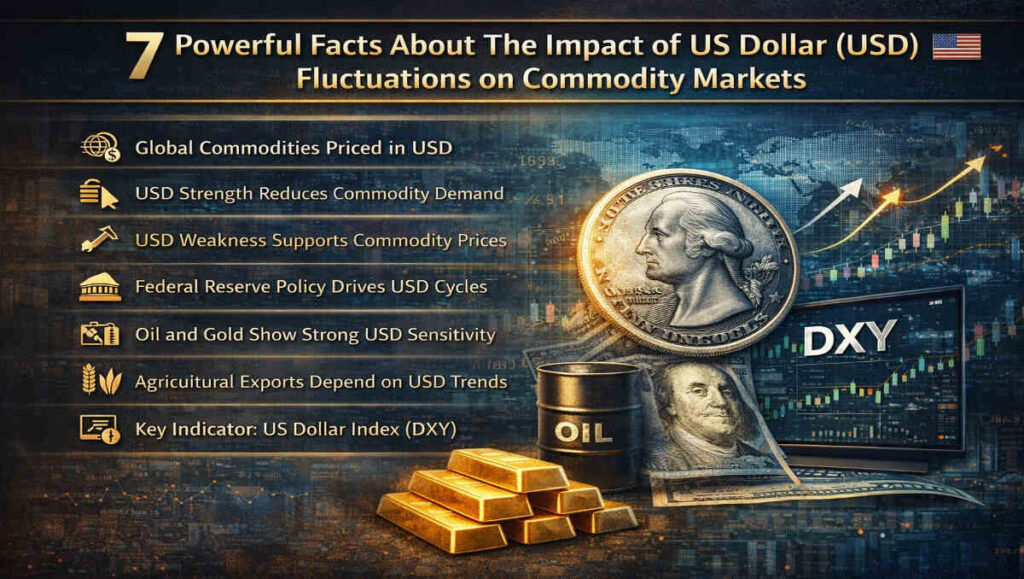
The impact of US dollar (USD) fluctuations on commodity markets occurs because nearly all globally traded commodities are priced in US dollars. When the dollar strengthens, commodities often decline as global purchasing power falls. When the dollar weakens, commodities typically rise as demand improves. Understanding this macro relationship is essential for US investors navigating energy, metals, and agricultural markets.
Key Takeaways
- The impact of US dollar (USD) fluctuations on commodity markets drives pricing cycles across energy, metals, and agriculture because global commodities are settled in USD.
- A rising US dollar typically compresses commodity prices through purchasing power and capital flow effects.
- Federal Reserve policy, real interest rates, and global liquidity determine USD strength.
- The impact of US dollar (USD) fluctuations on commodity markets varies by asset class, with gold and oil showing strong sensitivity.
- US investors who monitor dollar regimes gain structural clarity in commodity allocation decisions
Table of Contents
- Why The Impact of US Dollar (USD) Fluctuations on Commodity Markets Matters in 2026
- The Structural Currency–Commodity Transmission Mechanism
- Federal Reserve Policy, Real Rates, and the Dollar Cycle
- Energy Markets: Oil and Natural Gas Under USD Pressure
- Precious Metals: Gold, Real Yields, and Currency Regimes
- Industrial Metals and Emerging Market Demand
- Agricultural Commodities and Export Competitiveness
- Historical Case Studies of USD Cycles
- How US Investors Can Gain Exposure During USD Regimes
- Risks and Structural Breakdowns in Correlation
- Structural Signals to Monitor
- Comparison With Other Macro Drivers
- Frequently Asked Questions
- Final Institutional Market Perspective
- Disclaimer
- Author & Research Integrity
Why The Impact of US Dollar (USD) Fluctuations on Commodity Markets Matters in 2026
The impact of US dollar (USD) fluctuations on commodity markets has intensified in 2026 as global monetary policy divergence expands. The Federal Reserve’s rate path differs from Europe and Asia, generating capital flows that reinforce currency volatility. This volatility directly feeds into commodity pricing mechanisms.
Global commodities are invoiced and settled in USD. As a result, exchange rate movements alter the real cost of commodities for foreign buyers. When the dollar appreciates, international demand elasticity becomes constrained unless prices adjust downward.
Comparing the current Dollar Index level with its five-year average reveals that sustained dollar strength often aligns with commodity consolidation phases. Conversely, periods of structural dollar weakness frequently coincide with commodity bull cycles.
The impact of US dollar (USD) fluctuations on commodity markets is therefore not incidental. It is systemic.
Because global commodities are priced in dollars, understanding how the currency transmits into price movements is critical, as explained in our detailed guide on Gold Price Today in USA.
The Structural Currency–Commodity Transmission Mechanism
The impact of US dollar (USD) fluctuations on commodity markets operates through three primary transmission channels: purchasing power, capital flows, and cost-of-carry dynamics.
First, purchasing power effects alter foreign demand. If the dollar rises by 8 percent, commodity importers using weaker currencies effectively face higher local costs. This reduces marginal demand unless commodity prices decline to compensate.
Second, capital flow dynamics shift allocation preferences. A stronger dollar often reflects tightening US monetary policy, which attracts capital into US fixed income markets. This reduces speculative flows into commodities.
Third, cost-of-carry increases during higher rate environments. Futures pricing incorporates financing costs, meaning rising rates steepen contango structures and weigh on commodity pricing.
These channels explain why the impact of US dollar (USD) fluctuations on commodity markets persists across cycles.
Federal Reserve Policy, Real Rates, and the Dollar Cycle
Federal Reserve policy is central to understanding the impact of US dollar (USD) fluctuations on commodity markets. When the Fed raises interest rates, yield differentials favor dollar-denominated assets. This strengthens the currency.
Real interest rates, defined as nominal rates minus inflation expectations, play a particularly important role in precious metals pricing. Rising real yields tend to strengthen the dollar and pressure gold simultaneously.
For example, in 2022, the Dollar Index rose above 110 as the Fed accelerated rate hikes. During the same period, gold experienced sustained downside pressure before stabilizing when rate expectations peaked.
Therefore, the impact of US dollar (USD) fluctuations on commodity markets cannot be separated from real rate dynamics.
According to the Federal Reserve’s official data portal, interest rate expectations directly influence capital flows and the US dollar index.
Energy Markets: Oil and Natural Gas Under USD Pressure
Energy markets demonstrate clear sensitivity to dollar regimes. Crude oil, traded globally and settled in USD, reflects currency shifts through demand elasticity.
During periods of dollar strength, emerging market consumers face higher effective costs. This can moderate demand growth expectations, particularly in price-sensitive regions.
However, supply shocks can override currency effects. For instance, OPEC production cuts may sustain oil prices even when the dollar appreciates.
Natural gas shows similar patterns but is influenced more heavily by regional supply-demand balances. Therefore, the impact of US dollar (USD) fluctuations on commodity markets in energy is powerful yet interdependent with geopolitical variables.
Precious Metals: Gold, Real Yields, and Currency Regimes
Among all asset classes, precious metals display one of the strongest inverse relationships with the US dollar. Gold serves as a monetary alternative during periods of currency debasement or declining real yields.
When the dollar strengthens alongside rising real yields, gold typically declines. Conversely, when the dollar weakens and real yields fall, gold often rallies sharply.
Silver and platinum exhibit similar behavior but are also influenced by industrial demand trends. Their correlation with the dollar can therefore vary depending on the economic cycle.
The impact of US dollar (USD) fluctuations on commodity markets is particularly pronounced in precious metals during monetary regime transitions.
Silver often amplifies dollar-driven volatility, which we explore further in Silver Price Today in USA.
Industrial Metals and Emerging Market Demand
Industrial metals such as copper respond to dollar strength through emerging market demand channels. A stronger dollar often tightens financial conditions in developing economies.
Because many infrastructure-intensive economies borrow in USD, currency appreciation increases debt servicing costs. This can slow industrial activity and reduce metal demand.
Copper, often considered a proxy for global growth, tends to weaken during sustained dollar rallies unless offset by supply shortages.
Therefore, the impact of US dollar (USD) fluctuations on commodity markets in industrial metals operates through both financial and trade mechanisms.
Agricultural Commodities and Export Competitiveness
Agricultural commodities respond primarily through export competitiveness. US crop exports become more expensive when the dollar strengthens.
This can reduce international demand for American wheat, corn, and soybeans, applying downward pressure on futures prices. Conversely, dollar weakness enhances export competitiveness and supports pricing.
Weather events and crop yield shocks often dominate short-term movements. However, over longer cycles, currency regimes materially influence trade flows.
The impact of US dollar (USD) fluctuations on commodity markets in agriculture is therefore linked to global trade elasticity.
Historical Case Studies of USD Cycles
Examining historical cycles reinforces the impact of US dollar (USD) fluctuations on commodity markets.
During the 2002–2008 period, sustained dollar weakness coincided with a broad commodity supercycle. Energy, metals, and agricultural commodities experienced multi-year rallies.
In contrast, from 2014 to 2016, a sharp dollar appreciation phase aligned with a commodity downturn, particularly in energy markets.
These historical examples illustrate that while supply and demand factors matter, currency cycles significantly influence commodity pricing regimes.
The ICE U.S. Dollar Index (DXY) is widely followed by institutional traders as a benchmark for global dollar strength.
How US Investors Can Gain Exposure During USD Regimes
Understanding the impact of US dollar (USD) fluctuations on commodity markets helps US investors position strategically.
Investors can gain exposure through commodity ETFs that track futures contracts. Alternatively, futures trading on regulated exchanges provides direct exposure but requires risk management discipline.
During dollar weakness regimes, commodity-heavy allocations may outperform traditional equity benchmarks. During dollar strength cycles, defensive positioning or selective exposure may be appropriate.
Currency-hedged strategies can also reduce dollar-driven volatility in commodity portfolios.
Integrating dollar analysis into allocation decisions enhances structural awareness.
Risks and Structural Breakdowns in Correlation
Although the inverse relationship between the dollar and commodities is persistent, it is not absolute. Supply shocks, geopolitical disruptions, and fiscal policy interventions can override currency effects.
Additionally, speculative positioning can temporarily distort correlation patterns. For example, heavy speculative short positioning may fuel commodity rallies even during dollar strength.
Liquidity tightening events can also generate synchronized declines across asset classes, temporarily breaking the inverse correlation.
Therefore, the impact of US dollar (USD) fluctuations on commodity markets must be evaluated within a broader macro framework.
Structural Signals to Monitor
Investors evaluating the impact of US dollar (USD) fluctuations on commodity markets should monitor the US Dollar Index, real interest rates, and Treasury yields.
Weekly inventory data from the EIA and USDA provide context for price reactions. CFTC Commitment of Traders reports reveal speculative positioning extremes.
Monitoring inflation expectations alongside nominal rates helps interpret real yield movements.
Structural alignment between currency, rates, and positioning often precedes major commodity inflection points.
The U.S. Department of Agriculture (USDA) tracks export competitiveness, which frequently shifts when the dollar strengthens or weakens.
If you want a broader structural framework, see our pillar guide on Technical Indicators for Short-Term Commodity Trading to understand how traders interpret DXY trends.
Comparison With Other Macro Drivers
While currency is a dominant driver, other macro forces shape commodity markets. Supply disruptions, fiscal stimulus, and geopolitical risk can generate powerful trends independent of dollar movement.
For instance, infrastructure spending programs may boost copper demand despite a strong dollar. Similarly, production cuts may sustain oil prices during tightening cycles.
Therefore, the impact of US dollar (USD) fluctuations on commodity markets should be integrated into a multi-factor analysis framework.
Institutional investors rarely rely on single-variable models.
Frequently Asked Questions
What is the impact of US dollar (USD) fluctuations on commodity markets?
The impact of US dollar (USD) fluctuations on commodity markets occurs because commodities are priced in USD, affecting global purchasing power and capital flows.
Why does a strong US dollar lower commodity prices?
A strong dollar reduces foreign demand elasticity and increases financing costs embedded in futures pricing.
Are all commodities equally sensitive to the dollar?
No. Gold and oil tend to show stronger sensitivity, while agricultural commodities are influenced primarily through export competitiveness.
How does the Federal Reserve influence commodity markets?
Federal Reserve policy shifts influence interest rates and capital flows, which directly affect the dollar and indirectly impact commodity pricing.
Can commodities rise during dollar strength?
Yes. Supply shortages or geopolitical disruptions can override currency headwinds.
Final Institutional Market Perspective
The impact of US dollar (USD) fluctuations on commodity markets remains one of the most important macro relationships in global finance. Currency cycles influence purchasing power, capital flows, financing costs, and risk appetite.
For US investors, integrating dollar regime analysis into commodity research enhances timing precision and risk awareness. Structural macro clarity reduces reactionary trading behavior.
In 2026’s evolving monetary landscape, currency awareness is no longer optional. It is foundational.
Disclaimer
This content is for informational purposes only and does not constitute financial or investment advice. Commodity trading involves substantial risk and may not be suitable for all investors.
Author & Research Integrity
Prepared by the USCommodityPrice Research Team, specializing in US macro-currency dynamics, futures market structure, and institutional commodity analysis.
Updated: February 2026
Data references include Federal Reserve publications, EIA statistics, USDA trade data, and CFTC positioning reports.
