
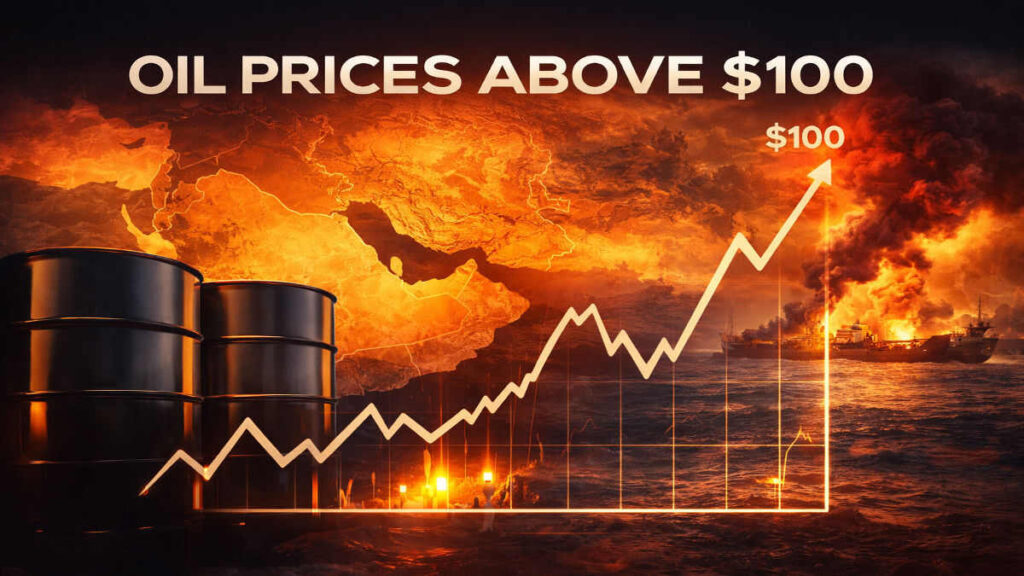
Oil prices above $100 have returned to global energy markets after escalating geopolitical tensions in the Middle East raised fears of supply disruptions. Crude oil futures surged sharply during early trading as traders reacted to reports of shipping interruptions and security risks near the Strait of Hormuz, one of the world’s most critical oil transport corridors.
Benchmark WTI crude oil futures jumped dramatically, while Brent crude futures also moved above the $100 mark. The sudden rally reflects growing concern that prolonged geopolitical instability could restrict oil shipments and tighten global energy supply.
Energy markets often react quickly to geopolitical developments, particularly when they involve regions responsible for a large share of global oil exports.
Why Oil Prices Above $100 Matter for Global Energy Markets
The move pushing oil prices above $100 signals a significant shift in energy market sentiment. Crude oil remains one of the most important commodities in the global economy because it affects transportation costs, industrial production, and inflation levels.
When oil prices rise sharply, it can influence a wide range of economic activities. Higher energy costs can increase shipping expenses, raise manufacturing costs, and affect consumer prices.
Rising energy prices often influence multiple commodity markets. For a deeper understanding of how commodities behave during volatility, read our guide on Range Trading Strategies for Volatile Markets.
Meanwhile, energy-importing countries may face higher inflation pressures, while oil-exporting nations could benefit from stronger revenues.
Because oil prices influence both financial markets and economic activity, traders monitor price movements closely when crude oil approaches major levels such as $100 per barrel.
Middle East Supply Risk Is Driving the Rally
The latest surge in crude oil prices is closely linked to rising geopolitical tensions in the Middle East.
Reports indicate that commercial shipping activity in the Strait of Hormuz has slowed due to security concerns. This narrow waterway is responsible for transporting nearly one-fifth of the world’s oil supply, making it one of the most strategically important energy routes in global trade.
When traders perceive a risk to this corridor, oil markets often react quickly. Even the possibility of disruptions can trigger rapid price increases as buyers attempt to secure supply.
As a result, geopolitical developments in the region frequently cause large price swings in crude oil markets.
Institutional Investors React to Supply Concerns
Institutional traders and hedge funds play a significant role in oil market movements. These participants analyze geopolitical developments, shipping data, and supply trends to assess potential risks.
When supply uncertainty increases, institutional investors often increase their exposure to energy markets. This behavior can amplify price movements because large financial flows enter oil futures markets within a short period of time.
Energy companies may also adjust hedging strategies during volatile periods. Producers sometimes lock in higher prices, while refiners manage exposure to rising input costs.
Crude oil futures are primarily traded on regulated exchanges such as the Chicago Mercantile Exchange, which provides global price benchmarks for energy markets.
Institutional traders also analyze currency strength because oil is priced globally in US dollars. Learn how currency movements influence commodities in our analysis of The Impact of US Dollar Fluctuations on Commodity Markets.
These actions collectively contribute to stronger price momentum when markets react to supply concerns.
Oil Market Volatility Is Expanding
Another factor behind the surge is the transition from price consolidation to volatility expansion.
For several weeks, crude oil prices traded within a relatively stable range. Markets often enter these consolidation phases when supply and demand remain balanced.
However, once prices break above major resistance levels, momentum traders may increase buying activity. This shift can lead to rapid price acceleration.
The recent breakout above key resistance zones has therefore triggered a wave of momentum buying, pushing oil prices sharply higher.
What Energy Markets Are Watching Next
Energy traders are now focusing on several developments that could influence the direction of oil markets.
First, shipping activity in the Strait of Hormuz will remain a key indicator of supply stability. Any prolonged disruption could tighten global oil supply significantly.
Second, analysts are monitoring production responses from major oil exporters. Countries within the Organization of the Petroleum Exporting Countries (OPEC) may adjust production strategies depending on market conditions.
Finally, global economic indicators will influence demand expectations. Strong industrial activity supports energy consumption, while economic slowdowns may weaken demand.
These factors will continue shaping oil market sentiment in the coming weeks.
Why Oil Markets React Strongly to Geopolitical Events
Crude oil markets are particularly sensitive to geopolitical developments because supply chains rely heavily on international transportation routes.
Unlike many commodities that can be stored easily, oil must be transported continuously from production regions to refineries and consumers. Any disruption in transportation routes can therefore affect supply availability quickly.
Because energy markets operate globally, tensions in one region can influence prices worldwide. This interconnected structure explains why geopolitical news often causes sharp movements in oil prices.
Weekly petroleum inventory reports published by the U.S. Energy Information Administration provide key insights into supply conditions and often influence short-term oil price movements.
Key Takeaways
- Oil prices above $100 reflect rising geopolitical risk in energy markets.
- Supply concerns near the Strait of Hormuz triggered the latest rally.
- Nearly 20% of global oil supply passes through this shipping corridor.
- Institutional investors increased exposure to oil futures.
- Market volatility expanded after prices broke major resistance levels.
