
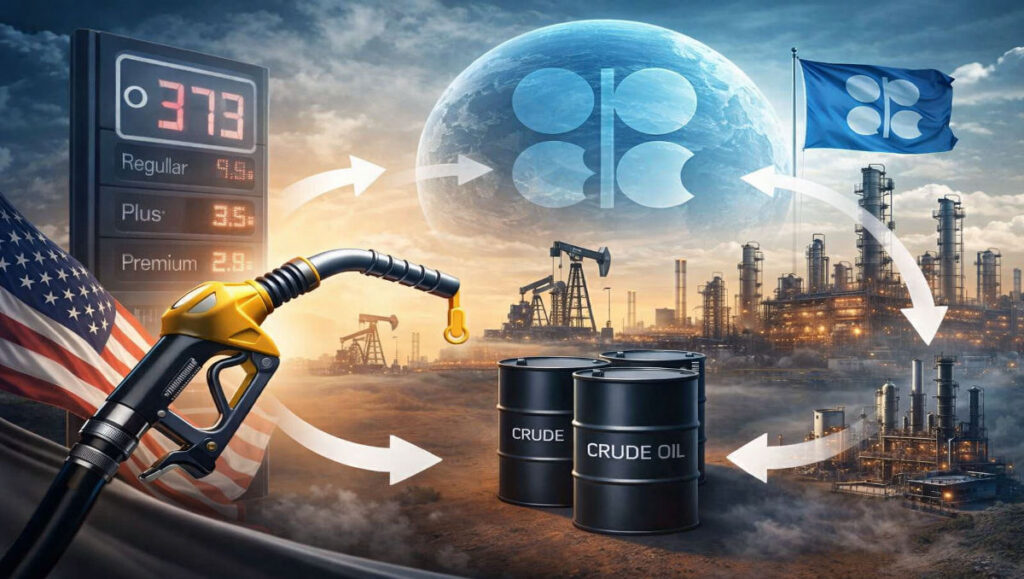
Understanding how OPEC meetings impact US gasoline prices requires looking beyond headlines and examining the structured transmission mechanism connecting global crude supply decisions to American fuel stations.
When OPEC adjusts production quotas, it does not directly change pump prices overnight. Instead, the impact moves through crude oil benchmarks, refinery economics, domestic inventories, and seasonal demand patterns.
This guide explains the full structural chain using recent 2025–2026 production data and institutional market dynamics.
Key Takeaways
- OPEC coordinates global oil supply through production quotas
- 2025–2026 output increases followed multi-million barrel voluntary cuts
- WTI crude is the main transmission channel to US gasoline pricing
- Refining margins and seasonal demand determine pass-through speed
- Weekly EIA inventory data confirms whether supply changes affect US markets
Table of Contents
- What Is OPEC? Meaning, History, and Market Power
- Recent OPEC Production Cuts and Increases (2025–2026)
- How OPEC Meetings Impact US Gasoline Prices: The Transmission Chain
- The Role of Weekly US Storage Data
- Refining Margins and Seasonal Demand
- Who Holds the Most Influence Within OPEC?
- What This Means for Investors
- FAQ: How OPEC Meetings Impact US Gasoline Prices
- Final Thoughts
What Is OPEC? Meaning, History, and Market Power
OPEC, the Organization of the Petroleum Exporting Countries, was founded in 1960 by Iran, Iraq, Kuwait, Saudi Arabia, and Venezuela. The organization was created to coordinate petroleum policies, stabilize oil markets, and secure consistent revenue for member nations.
Today, OPEC includes major oil-producing countries across the Middle East, Africa, and South America. Member nations account for roughly 38–40% of global crude oil production and hold a majority share of proven global reserves.
OPEC now operates alongside non-member producers such as Russia under the OPEC+ framework. This expanded coordination significantly increases global supply influence.
Saudi Arabia is widely regarded as the most influential member due to its spare production capacity.
Understanding this structure is essential to understanding how OPEC meetings impact US gasoline prices.
To understand broader crude pricing cycles, see our long-term analysis on The Future of Natural Gas in the US Energy Transition, which examines how supply coordination affects energy pricing trends.
Official production policy statements and meeting summaries are published on the OPEC official website, which outlines current quota agreements and member decisions.
Recent OPEC Production Cuts and Increases (2025–2026)
In 2025, OPEC+ began reversing voluntary production cuts introduced in earlier periods of weak demand.
By September 2025, approximately 2.5 million barrels per day of cuts had been unwound. Monthly increases included additions near 137,000 barrels per day. By November 2025, output had risen by roughly 160,000 barrels per day for that month alone.
Cumulative increases since April 2025 exceeded 2.2 million barrels per day.
However, in early 2026, OPEC+ paused further increases during the first quarter amid strong prices and geopolitical tensions.
These gradual adjustments illustrate how coordinated policy influences supply expectations, the first step in how OPEC meetings impact US gasoline prices.
Market reaction to production adjustments is frequently covered by Reuters Energy News, which tracks output changes and geopolitical developments influencing oil supply.
How OPEC Meetings Impact US Gasoline Prices: The Transmission Chain
The mechanism through which OPEC meetings impact US gasoline prices operates sequentially:
OPEC production policy influences global supply expectations.
Supply expectations move Brent crude pricing.
Brent influences WTI crude futures.
WTI determines US refinery input costs.
Refinery costs influence wholesale gasoline prices.
Wholesale prices gradually adjust retail gasoline prices.
Crude oil accounts for the largest share of gasoline cost. Sustained movements in WTI therefore determine how OPEC meetings impact US gasoline prices over time.
The adjustment is indirect but powerful.
For real-time structural movements in crude benchmarks, read our Crude Oil Market Status Today (WTI) analysis, where we track how global supply shifts influence US energy pricing dynamics.
The Role of Weekly US Storage Data
The Energy Information Administration (EIA) releases its Weekly Petroleum Status Report every Wednesday at 10:30 AM Eastern Time.
This report includes:
- Crude oil inventories
- Gasoline inventories
- Refinery utilization rates
- Domestic production data
The Energy Information Administration Weekly Petroleum Status Report provides detailed inventory data used by institutional traders to assess supply conditions.
When evaluating how OPEC meetings impact US gasoline prices, inventory confirmation is critical.
If crude prices rise after production cuts but US inventories remain elevated, pump prices may adjust slowly. If inventories decline sharply alongside higher crude, gasoline prices typically respond more quickly.
Inventory data validates whether global supply shifts are influencing domestic markets.
You can also review our Daily Commodity Market Snapshot in the USA, where we interpret weekly crude and gasoline inventory changes in structured format.
Refining Margins and Seasonal Demand
OPEC meetings impact US gasoline prices primarily through crude costs, but refining margins determine pass-through strength.
During peak summer driving season, gasoline demand increases and refineries operate near capacity. In such conditions, crude price increases are more likely to transmit fully into retail prices.
During lower-demand months, refiners may absorb part of crude volatility.
Weather disruptions, hurricane risks, and refinery maintenance schedules can temporarily override global supply signals.
Seasonality therefore shapes how OPEC meetings impact US gasoline prices in practical terms.
Who Holds the Most Influence Within OPEC?
Although OPEC decisions are collective, Saudi Arabia holds the greatest structural influence due to its spare production capacity.
Russia plays a major role within OPEC+ coordination.
However, US shale production growth can partially offset OPEC supply reductions. Oil markets reflect a balance between coordinated policy and competitive supply response.
This balance determines the durability of price changes following OPEC meetings.
What This Means for Investors
Understanding how OPEC meetings impact US gasoline prices is important for energy investors, transportation companies, and macroeconomic planners.
Upstream producers benefit from sustained crude price strength. Refiners must balance rising input costs against demand conditions. Consumer sectors remain sensitive to gasoline price volatility.
OPEC meetings often trigger short-term market reactions. However, long-term trends depend on sustained quota discipline and inventory follow-through.
Investors should monitor:
- Multi-month crude price trends
- OPEC compliance levels
- US shale production growth
- Weekly EIA inventory trajectories
Structural confirmation matters more than meeting-day headlines.
Investors monitoring gasoline-sensitive sectors should also review our detailed breakdown on How Renewable Energy Trends Impact Fossil Fuel Commodities, which explores broader structural shifts in energy markets.
FAQ: How OPEC Meetings Impact US Gasoline Prices
How quickly do OPEC meetings impact US gasoline prices?
Crude futures react immediately, but retail gasoline prices adjust gradually as refiners update wholesale pricing and inventory levels shift.
Do production increases lower US gasoline prices?
If sustained and confirmed by rising inventories, increased supply can reduce crude price pressure and eventually ease gasoline prices.
When is US storage data released?
The EIA publishes weekly petroleum inventory data every Wednesday at 10:30 AM ET.
Can US shale offset OPEC cuts?
Yes. Rapid growth in US shale production can partially counteract coordinated supply reductions.
Final Thoughts
Understanding how OPEC meetings impact US gasoline prices requires focusing on structural transmission rather than short-term volatility.
Production quotas influence global supply expectations.
Supply expectations move crude benchmarks.
Crude benchmarks influence refinery input costs.
Refinery economics and inventory trends determine pump prices.
Monitoring sustained production policy and domestic inventory confirmation provides clearer insight than reacting to headlines alone.
Author
US Commodity Price Editorial Team
Providing structured analysis of US commodity markets, focusing on observable supply-demand dynamics.
Disclaimer
This article is for informational purposes only and does not constitute financial, investment, or trading advice. Energy markets are influenced by global and domestic factors beyond OPEC policy decisions.
