
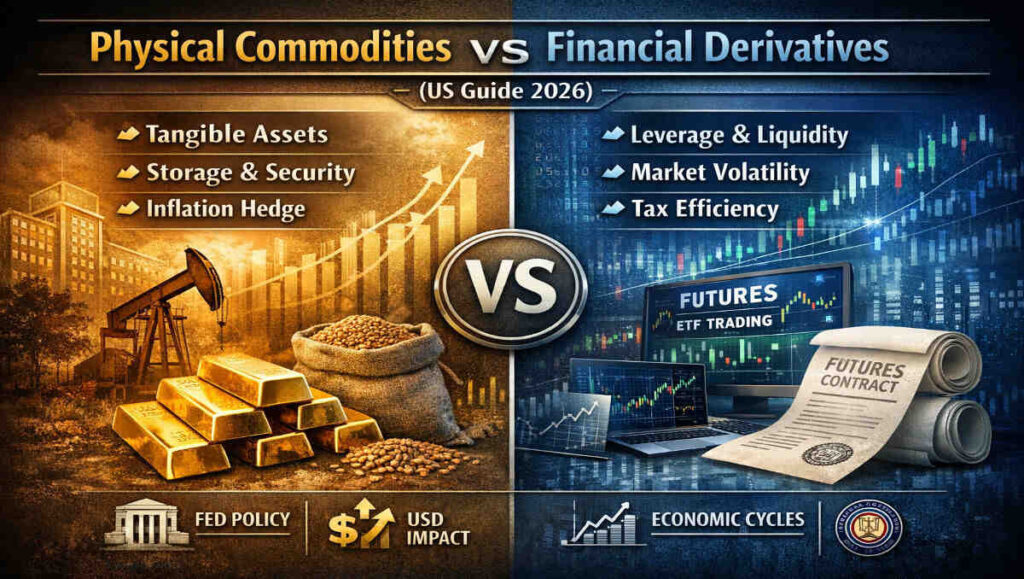
Physical commodities vs financial derivatives explained clearly: physical commodities involve direct ownership of a tangible asset such as gold or silver, while financial derivatives are contracts like futures or ETFs that track commodity prices without transferring ownership. In the United States, investors choose between physical commodities vs financial derivatives based on liquidity needs, leverage tolerance, taxation structure, and risk management goals.
In 2026, this distinction matters more than ever due to tightening liquidity cycles, evolving Federal Reserve policy, and heightened commodity volatility.
Key Takeaways
- Physical commodities vs financial derivatives represent two fundamentally different exposure structures in US commodity markets.
• Physical ownership removes counterparty exposure but introduces storage and liquidity friction.
• Financial derivatives increase capital efficiency but amplify volatility risk through leverage.
• Federal Reserve policy and US dollar strength influence derivatives pricing more immediately than physical markets.
• Strategic US portfolios often combine both physical commodities vs financial derivatives for structural balance.
Table of Contents
- Why Physical Commodities vs Financial Derivatives Matters in 2026
- Physical Commodities vs Financial Derivatives: Core Structural Differences
- What Are Physical Commodities?
- What Are Financial Derivatives?
- How to Invest in Physical Commodities vs Financial Derivatives in the US
- What Is There for US Investors?
- Macro Regime Modeling: When Each Structure Dominates
- Risks to Consider
- Structural Signals to Monitor
- Comparison With Other Commodities
- Frequently Asked Questions
- Final Market Perspective
Why Physical Commodities vs Financial Derivatives Matters in 2026
The debate around physical commodities vs financial derivatives is no longer academic. It is structural and cycle-driven.
During tightening monetary regimes, higher real interest rates increase the opportunity cost of holding physical commodities. In contrast, derivatives become more capital efficient because investors can maintain liquidity elsewhere.
Over the past five years, futures and ETF participation has increased significantly relative to direct physical ownership. This shift reflects institutional demand for scalable exposure and rapid liquidity.
However, during systemic uncertainty, physical ownership demand rises sharply. Historical comparisons between the 2020 liquidity crisis and the 2024 tightening cycle show rotation between physical commodities vs financial derivatives depending on macro stress levels.
Official Federal Reserve policy statements and rate projections are available through the Federal Reserve Board website
For example, our detailed breakdown in “Gold As A Hedge Against Inflation: Ultimate 2026 Strategy” explains how physical ownership demand shifts during tightening and easing cycles in the US.
Understanding physical commodities vs financial derivatives therefore requires analyzing economic regime shifts, not just asset preference.
Physical Commodities vs Financial Derivatives: Core Structural Differences
Physical commodities vs financial derivatives differ in five core dimensions: ownership, leverage, liquidity, cost structure, and risk exposure.
Physical commodities provide direct asset ownership. Investors hold the underlying commodity, eliminating exchange-based counterparty exposure.
Financial derivatives represent contractual exposure to price movement without physical transfer. Futures contracts on CME or COMEX allow significant notional exposure through margin.
Liquidity differs materially. Futures can be closed instantly during US trading hours. Physical bullion requires dealer interaction and bid-ask negotiation.
Cost structure also diverges. Physical commodities involve storage, insurance, and transportation costs. Derivatives involve margin requirements and rollover expenses.
Risk exposure amplifies in derivatives due to leverage. A 2% move in the underlying commodity can translate into double-digit percentage changes in margin accounts.
To better understand how futures contracts differ structurally from spot ownership, see “What Is the Difference Between Spot Price and Futures Price? A Complete Derivatives Guide.”
These structural differences define the physical commodities vs financial derivatives framework.
What Are Physical Commodities?
Physical commodities refer to tangible goods such as gold bars, silver coins, agricultural produce, or stored energy products. Retail US investors most commonly access physical precious metals.
Owning physical commodities removes counterparty exposure to exchange clearinghouses. The asset exists independent of financial infrastructure.
However, liquidity friction exists. Selling physical gold requires dealer access and spread costs, which can widen during volatility.
Storage risk must also be managed. Vaulting solutions reduce risk but increase cost.
In the physical commodities vs financial derivatives comparison, physical ownership prioritizes asset security over speed.
What Are Financial Derivatives?
Financial derivatives derive value from an underlying commodity price. US-regulated futures contracts trade primarily through CME and COMEX exchanges under CFTC oversight.
Futures markets in the United States are regulated by the Commodity Futures Trading Commission, which provides public market transparency and oversight
Futures allow traders to control large notional exposure with relatively small margin deposits. This leverage magnifies returns and losses.
Commodity ETFs offer simplified exposure for retail investors. Options contracts provide additional hedging flexibility.
Derivatives introduce rollover mechanics. Futures contracts expire and must be rolled forward to maintain exposure, introducing cost considerations.
The physical commodities vs financial derivatives decision often depends on whether the investor values leverage and liquidity more than tangible ownership.
How to Invest in Physical Commodities vs Financial Derivatives in the US
Investing in physical commodities vs financial derivatives in the US begins with understanding the structural differences in access. Physical commodities require direct purchase of the underlying asset, while financial derivatives require brokerage access to regulated exchanges. The choice depends on capital size, liquidity needs, and risk tolerance.
US investors who choose physical commodities typically purchase gold or silver through reputable bullion dealers or approved depositories. Ownership can be direct, allocated storage-based, or structured within a self-directed IRA. This approach requires full capital upfront and includes storage, insurance, and transaction spread considerations.
In contrast, financial derivatives are accessed through regulated brokerage accounts that provide futures or ETF trading capability. Futures contracts trade on exchanges such as CME and COMEX under CFTC oversight. These contracts allow investors to control larger notional positions through margin requirements rather than full capital payment.
Contract specifications and margin requirements are publicly available through CME Group’s official exchange documentation.
Commodity ETFs offer simplified derivative exposure for retail participants who do not wish to manage futures contracts directly. ETFs track underlying commodity prices and trade like stocks during US market hours. This structure provides liquidity and ease of execution but may include management fees and tracking differences.
When comparing physical commodities vs financial derivatives in the US, tax treatment also becomes relevant. Futures contracts often qualify under Section 1256 tax rules, which apply blended capital gains treatment. Physical precious metals, however, may be taxed under collectible rates depending on holding period.
Liquidity access differs materially between the two structures. Financial derivatives allow rapid entry and exit during exchange trading hours. Physical commodities require dealer transactions, which can widen spreads during periods of volatility.
Risk management discipline also differs. Derivatives require active monitoring due to margin exposure and potential liquidation risk. Physical commodities reduce leverage risk but introduce storage and liquidity considerations.
Ultimately, investing in physical commodities vs financial derivatives in the US is not about selecting a superior method. It is about aligning exposure structure with financial goals, investment horizon, and comfort with volatility.
Long-term capital preservation strategies may favor physical ownership. Tactical trading strategies often favor derivatives. Strategic portfolios frequently combine both to balance stability and flexibility.
Understanding how to invest in physical commodities vs financial derivatives in the US enables investors to deploy capital more intelligently across economic cycles.
What Is There for US Investors?
For US investors, physical commodities vs financial derivatives represents a strategic allocation choice across economic regimes.
Long-term inflation hedge strategies may favor physical gold ownership. Tangible assets provide psychological and structural comfort during systemic stress.
Active traders seeking short-term volatility typically prefer derivatives because futures provide superior liquidity and capital efficiency.
Retirement accounts can access commodity ETFs within standard brokerage IRAs, while physical bullion IRAs require approved custodians.
Additionally, CFTC oversight and CME clearing infrastructure enhance transparency in derivative markets, providing institutional confidence.
Physical commodities vs financial derivatives should therefore be viewed as complementary tools within diversified US portfolios.
Macro Regime Modeling: When Each Structure Dominates
During easing cycles with falling interest rates, physical commodities often outperform due to declining opportunity cost.
During tightening cycles, derivatives may offer superior flexibility due to rapid repricing and margin-based capital efficiency.
In crisis-driven liquidity shocks, physical commodity premiums can widen relative to futures pricing.
In stable expansion cycles, derivative-based strategies often dominate due to carry efficiency and speculative liquidity.
This macro regime analysis strengthens the physical commodities vs financial derivatives framework beyond simple ownership comparison.
Risks to Consider
Physical commodities carry storage risk, liquidity lag, and potential theft exposure. Insurance mitigates but does not eliminate risk.
Financial derivatives introduce leverage risk. Margin calls can trigger forced liquidation during volatility spikes.
Policy changes such as margin requirement increases can immediately impact derivative exposure.
Liquidity tightening disproportionately increases volatility in derivative markets compared to physical holdings.
Risk discipline must therefore differ when managing physical commodities vs financial derivatives.
Structural Signals to Monitor
Monitoring macro signals improves decision-making between physical commodities vs financial derivatives.
US Dollar Index strength typically pressures commodity pricing.
Federal Reserve rate expectations influence cost-of-carry dynamics in futures markets.
Inventory data from EIA and USDA reports can trigger sharp derivative volatility.
Weekly petroleum inventory reports are published by the US Energy Information Administration and frequently influence commodity volatility
CFTC Commitment of Traders positioning reveals speculative extremes in futures.
We analyze speculative positioning trends in detail in “Role of Central Bank Gold Reserves in Price Movements.”
Seasonal cycles influence agricultural derivatives more strongly than physical markets.
Comparison With Other Commodities
The decision between physical commodities vs financial derivatives varies significantly across different asset classes. Structural preference depends on storage feasibility, liquidity depth, and institutional participation. Investors should not assume that the same exposure model applies equally to all commodities.
Gold remains the primary example where physical commodities vs financial derivatives are both widely used. Physical gold ownership dominates during systemic risk events because portability and intrinsic value matter most during currency stress. However, derivative-based gold exposure through futures and ETFs often dominates during active trading cycles due to superior liquidity and tighter spreads.
For a deeper asset-specific comparison, review “Physical Gold vs Gold ETFs: Pros and Cons for US Investors (2026 Guide).”
Silver presents a different structural profile. While physical silver ownership exists, industrial demand volatility makes financial derivatives more prominent in short-term trading strategies. As a result, physical commodities vs financial derivatives decisions in silver markets often tilt toward derivatives for tactical positioning.
Crude oil illustrates a structural bias toward financial derivatives. Retail investors rarely engage in physical oil ownership due to storage and transportation complexity. Futures contracts on NYMEX provide the primary mechanism for price exposure, making physical commodities vs financial derivatives largely a derivative-driven comparison in energy markets.
Agricultural commodities such as corn, wheat, and soybeans further emphasize the dominance of derivatives. Physical delivery is generally impractical for individual investors, so futures markets serve as the standard exposure vehicle. In these markets, physical commodities vs financial derivatives is effectively resolved in favor of derivatives for accessibility reasons.
Industrial metals like copper and aluminum also favor financial derivatives for price participation. While physical metal markets exist for commercial users, investors typically access exposure through futures contracts or mining equities. Therefore, the physical commodities vs financial derivatives framework in industrial metals reflects scalability and capital efficiency considerations.
The key insight across asset classes is that physical commodities vs financial derivatives is not a binary superiority question. Instead, structural practicality, liquidity depth, and macroeconomic regime determine which exposure model dominates within each commodity category.
Understanding these cross-commodity differences allows US investors to apply the physical commodities vs financial derivatives framework more strategically rather than uniformly.
Frequently Asked Questions
What is the main difference between physical commodities vs financial derivatives?
Physical commodities involve direct ownership of a tangible asset. Financial derivatives provide price exposure through contracts without transferring ownership.
Are physical commodities safer than derivatives?
Physical ownership removes leverage risk but introduces storage and liquidity considerations. Derivatives increase volatility risk due to leverage.
Why do institutions prefer financial derivatives?
Institutions value liquidity, scalability, and capital efficiency. Futures markets allow rapid allocation shifts without logistical constraints.
Can US investors combine physical commodities vs financial derivatives?
Yes. Many diversified portfolios include both to balance security and flexibility.
Do derivatives always involve leverage?
Most futures contracts involve margin, but leverage levels depend on position sizing.
Final Market Perspective
Physical commodities vs financial derivatives is not a debate of superiority. It is a structural alignment decision.
Physical ownership emphasizes asset control and long-term wealth preservation. Financial derivatives emphasize liquidity, capital efficiency, and tactical positioning.
In 2026, volatility regimes and Federal Reserve policy shifts make structural awareness critical.
US investors who understand physical commodities vs financial derivatives gain a strategic advantage across economic cycles.
Disclaimer
This content is for informational purposes only and does not constitute financial or investment advice. Commodity markets involve substantial risk, including potential loss of principal. Investors should conduct independent research and consult licensed financial professionals before making investment decisions.
Author & Research Integrity
USCommodityPrice Research Team
Specializing in US commodity market structure, macroeconomic regime analysis, and futures market mechanics.
Updated: February 2026
Data sources include the Federal Reserve, CFTC, CME Group, US Energy Information Administration, and USDA reports.
