
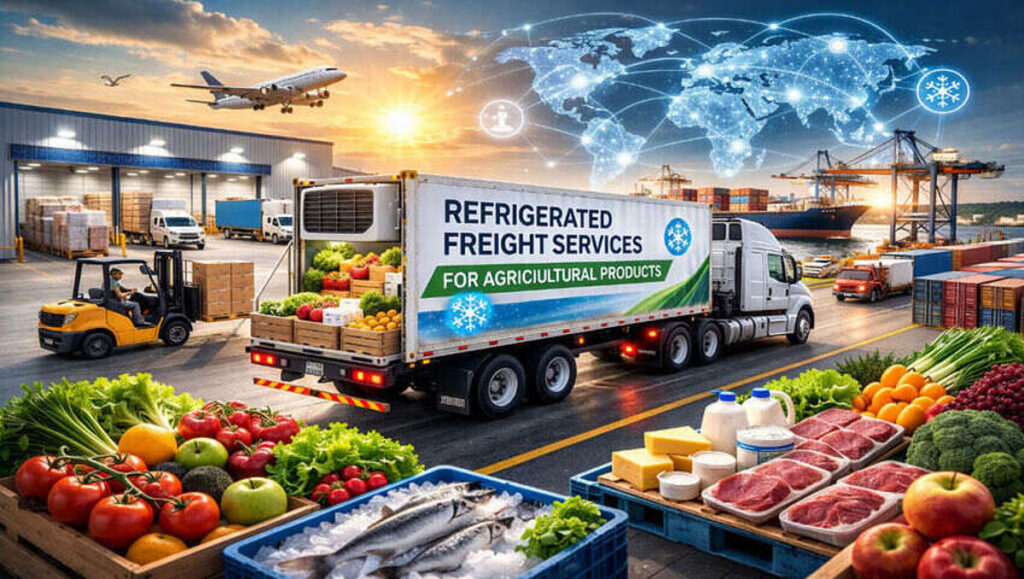
Refrigerated freight services for agricultural products are a structural backbone of the U.S. food supply chain. These services transport perishable goods such as produce, dairy, meat, poultry, and seafood using temperature-controlled “reefer” trailers and containers designed to prevent spoilage during transit.
The United States operates more than 500,000 refrigerated trailers — the largest reefer fleet in the world. This scale reflects the critical importance of refrigerated freight services for agricultural products in maintaining food safety, protecting farm revenue, and supporting export competitiveness.
Without a functioning cold chain, large segments of American agriculture would face substantial loss. As supply chains expand and grocery demand becomes more time-sensitive, refrigerated freight services for agricultural products have evolved from logistical support into a strategic economic pillar.
Refrigerated freight services for agricultural products transport temperature-sensitive goods such as fruits, vegetables, dairy, meat, and seafood using specialized reefer trucks and containers. These services maintain precise cooling conditions throughout transit, prevent spoilage, comply with food safety regulations, and protect farm-to-market supply chains across the United States.
Key Takeaways
- Refrigerated freight services for agricultural products preserve perishable goods and stabilize agricultural margins.
- The U.S. leads globally with over 500,000 refrigerated trailers in operation.
- Fuel, labor, seasonality, and compliance costs drive reefer rate volatility.
- Cold storage infrastructure expands alongside reefer freight demand.
- Investors monitor reefer capacity as a leading indicator of agricultural output.
Table of Contents
- What Are Refrigerated Freight Services for Agricultural Products?
- Scale and Economic Importance of the U.S. Reefer Market
- How the Agricultural Cold Chain System Works
- Industry Structure and Major Providers
- Cost Drivers and Freight Rate Volatility
- Regulatory Framework and Compliance Standards
- Dry Freight vs Refrigerated Freight: Structural Differences
- Cold Storage Infrastructure and Logistics Real Estate
- Market Outlook and Structural Growth Drivers
- What Refrigerated Freight Services for Agricultural Products Mean for US Investors
- Frequently Asked Questions
- Final Thoughts
- Author
- Disclaimer
What Are Refrigerated Freight Services for Agricultural Products?
Refrigerated freight services for agricultural products specialize in moving temperature-sensitive goods under controlled cooling conditions. These services rely on reefer trucks, railcars, and ocean containers equipped with active refrigeration units.
Unlike dry freight, refrigerated freight services for agricultural products require continuous monitoring and calibrated temperature settings. Fresh produce may travel just above freezing, while frozen meat and poultry demand sub-zero transport conditions.
Breaks in the cold chain create immediate spoilage risk. Even minor temperature deviations can reduce shelf life or trigger regulatory rejection. This precision requirement makes refrigerated freight services for agricultural products operationally complex and capital intensive.
Scale and Economic Importance of the U.S. Reefer Market
The United States operates the world’s largest refrigerated trailer fleet, exceeding 500,000 units. This infrastructure supports:
- Interstate produce movement
- Meat and poultry processing distribution
- Dairy logistics networks
- Seafood import and export channels
Agricultural hubs such as California, Florida, Texas, Iowa, and Nebraska rely heavily on refrigerated freight services for agricultural products to move goods efficiently to population centers.
Peak harvest seasons tighten capacity sharply. During berry, citrus, and vegetable harvest cycles, reefer rates often rise significantly above dry van benchmarks. Rate spreads between dry and reefer markets frequently widen sharply during these seasonal peaks.
This volatility reflects the structural importance of refrigerated freight services for agricultural products in balancing supply and demand.
National freight market data is published regularly by the U.S. Bureau of Transportation Statistics.
How the Agricultural Cold Chain System Works
Refrigerated freight services for agricultural products operate within a multi-stage cold chain:
- Post-harvest pre-cooling
- Temperature-controlled warehousing
- Reefer transport
- Distribution center staging
- Retail refrigeration
Modern fleets incorporate telematics systems that monitor temperature, humidity, and route performance in real time. Automated alerts help prevent cargo loss.
The integration of digital monitoring technology has significantly improved reliability within refrigerated freight services for agricultural products. This digital oversight reduces insurance claims and enhances compliance reporting.
Industry Structure and Major Providers
The refrigerated freight market consists of large national carriers and specialized regional operators.
Major participants include:
- Prime Inc.
- C.R. England
- Marten Transport
- Pinnacle Freight
- Star Freight Services
Ocean-focused providers such as Crowley and UWL support international refrigerated container transport.
Refrigerated freight services for agricultural products operate across Full Truckload (FTL) and Less-than-Truckload (LTL) structures. FTL dominates during peak harvest periods when shippers require dedicated capacity.
Industry consolidation continues gradually, improving route optimization and equipment utilization.
Cost Drivers and Freight Rate Volatility
Fuel is one of the largest cost components in refrigerated freight services for agricultural products. Reefer units consume additional diesel to maintain cooling systems, increasing per-mile operating costs.
Labor availability remains another structural pressure point. Drivers trained to handle temperature-sensitive freight command wage premiums.
Seasonality introduces the most visible volatility. Harvest surges compress available capacity and push rates upward. In certain high-demand corridors, refrigerated freight services for agricultural products can trade at substantial premiums to dry freight.
Maintenance expenses are also elevated. Refrigeration system failures may result in total cargo loss, increasing insurance exposure.
Energy price trends that impact reefer operating costs are tracked weekly by the U.S. Energy Information Administration.
Seasonal fuel price fluctuations also affect agricultural logistics, similar to the broader dynamics explained in our analysis of Impact of US Shale Production on Spot Oil Prices.
Regulatory Framework and Compliance Standards
The Food Safety Modernization Act (FSMA) established strict transportation requirements affecting refrigerated freight services for agricultural products.
Carriers must:
- Document temperature control
- Maintain sanitation standards
- Preserve shipment records
Export shipments face additional scrutiny. Temperature logs are frequently audited before customs clearance.
Regulatory compliance increases operating costs but enhances consumer protection and international trade credibility.
The Food Safety Modernization Act transportation guidelines can be reviewed directly on the U.S. Food and Drug Administration website.
Dry Freight vs Refrigerated Freight: Structural Differences
Dry freight transports non-perishable goods without active cooling systems. Equipment is simpler, operating costs are lower, and spoilage risk is minimal.
Refrigerated freight services for agricultural products, however, require:
- Active refrigeration units
- Continuous monitoring
- Higher insurance coverage
- Specialized equipment maintenance
Because food demand is relatively inelastic, refrigerated freight services for agricultural products often remain resilient even when industrial freight volumes soften.
Cold Storage Infrastructure and Logistics Real Estate
Cold storage facilities extend the cold chain beyond transportation. These warehouses buffer inventory between harvest cycles and retail demand.
The growth of grocery e-commerce has increased demand for regional cold storage hubs. Institutional real estate investors have shown rising interest in temperature-controlled logistics properties.
The expansion of refrigerated freight services for agricultural products and cold storage real estate often moves in parallel, reinforcing long-term structural demand.
The expansion of temperature-controlled facilities mirrors trends seen in sustainable construction materials, explored in our article on Sustainable Timber Options for Construction in USA.
Market Outlook and Structural Growth Drivers
Several long-term forces support continued expansion of refrigerated freight services for agricultural products:
- Rising global protein consumption
- Increasing U.S. agricultural exports
- Growth in online grocery fulfillment
- Stricter food safety standards
Sustainability trends are encouraging experimentation with electric refrigeration systems and alternative fuels. Over time, refrigerated freight services for agricultural products may transition toward lower-emission cooling technologies.
U.S. agricultural export data can be accessed through the U.S. Department of Agriculture Economic Research Service.
Export expansion in agricultural products is closely tied to global commodity flows, as discussed in our article on Factors Driving Oil Demand in the Transportation Sector.
What Refrigerated Freight Services for Agricultural Products Mean for US Investors
For investors, refrigerated freight services for agricultural products function as a macroeconomic signal.
Reefer capacity utilization often reflects harvest strength and export demand. Rising freight volumes can precede shifts in agricultural pricing and retail food inflation.
Investable segments tied to refrigerated freight services for agricultural products include:
- Refrigerated trucking fleets
- Cold storage real estate trusts
- Intermodal container operators
- Logistics technology providers
Because food demand remains structurally necessary, refrigerated freight services for agricultural products provide exposure to essential consumption patterns rather than purely cyclical trade flows.
Investors tracking agricultural supply chains may also benefit from understanding A Beginner’s Guide to Trading Soybean Futures, since soybean harvest volumes heavily influence reefer demand.
Frequently Asked Questions
Why are refrigerated freight services more expensive?
They require active cooling systems, higher fuel consumption, regulatory compliance, and specialized handling.
How large is the U.S. reefer market?
The United States operates over 500,000 refrigerated trailers, making it the largest reefer market globally.
Do reefer freight rates affect food prices?
Yes. Increased refrigerated freight costs can translate into higher retail food prices.
Is refrigerated freight demand growing?
Yes. Growth is supported by export expansion, protein consumption, and e-commerce grocery trends.
Final Thoughts
Refrigerated freight services for agricultural products are not a secondary logistics niche. They are a structural pillar of the American agricultural economy.
From farm to global market, temperature-controlled transport preserves value, protects public health, and sustains export competitiveness.
As infrastructure investment increases and food demand expands, refrigerated freight services for agricultural products will remain central to supply chain stability and commodity market dynamics.
Author
US Commodity Price Research Desk
Independent research team covering agricultural logistics, commodity pricing cycles, transportation infrastructure, and macroeconomic policy impacts.
Disclaimer
This article is for informational purposes only and does not constitute investment or transportation advice. Readers should conduct independent research before making financial or business decisions.
