
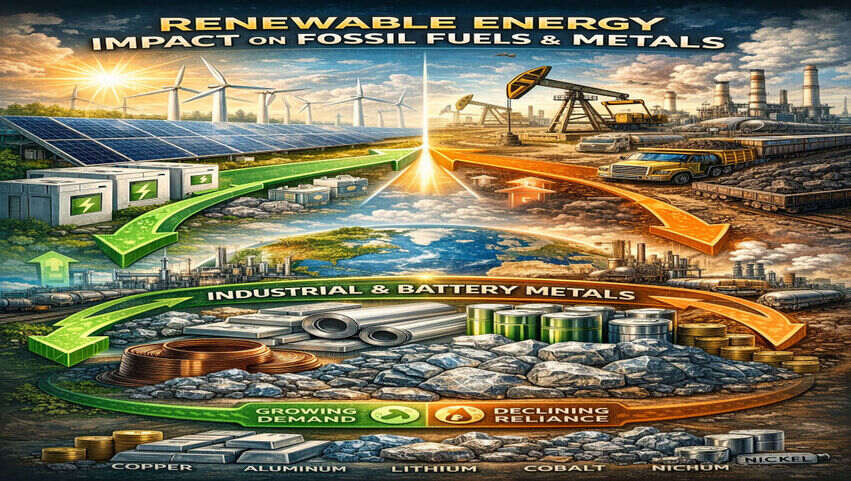
Understanding how renewable energy trends impact fossil fuel commodities requires a structural supply-demand lens rather than headline-driven assumptions. Renewable expansion is reshaping energy systems, but fossil fuel commodities continue playing essential roles in transportation, petrochemicals, aviation, and grid balancing.
The question is not whether renewables replace fossil fuels overnight. The real issue is how renewable energy trends impact fossil fuel commodities through participation shifts, infrastructure intensity, and industrial metal demand growth.
This 2026 outlook explains how renewable energy trends impact fossil fuel commodities while highlighting why industrial and battery metals represent high-growth beneficiaries of the transition.
Key Takeaways: How Renewable Energy Trends Impact Fossil Fuel Commodities
How renewable energy trends impact fossil fuel commodities depends on participation shifts, not abrupt elimination.
Industrial and battery metals benefit structurally from renewable infrastructure expansion.
Oil demand evolves rather than collapses.
Natural gas supports grid stability in renewable-heavy systems.
Commodity rotation replaces linear decline.
Table of Contents
- Why How Renewable Energy Trends Impact Fossil Fuel Commodities Matters
- Current Market Structure: Energy Participation Rotation
- Industrial Metals Demand Expansion
- Battery Metals and Electrification Acceleration
- How Renewable Energy Trends Impact Fossil Fuel Commodities in Oil Markets
- How Renewable Energy Trends Impact Fossil Fuel Commodities in Natural Gas
- Coal Market Adjustments
- Structural Rotation vs Commodity Collapse
- Long-Term Outlook (2026–2035)
- What Investors Should Monitor
- FAQ
- Final Thoughts
- Author
- Disclaimer
Why How Renewable Energy Trends Impact Fossil Fuel Commodities Matters
Commodity markets respond to capital allocation and infrastructure intensity. Renewable systems require high metal input per megawatt installed. Wind turbines, solar farms, and grid modernization increase demand for copper, aluminum, nickel, and rare earth elements.
Understanding how renewable energy trends impact fossil fuel commodities means recognizing layered demand. Fossil fuels continue supporting sectors that renewables cannot immediately replace.
Participation rotates before it declines.
Current Market Structure: Energy Participation Rotation
Energy systems now operate in a dual-structure model. Fossil fuels supply reliability and transport density. Renewables supply growing electricity generation.
How renewable energy trends impact fossil fuel commodities becomes visible when analyzing electricity generation shares, electric vehicle adoption, and industrial electrification rates.
Market structure today shows transition, not displacement.
Electricity generation mix statistics are available from the US Energy Information Administration.
Industrial Metals Demand Expansion
Renewable installations are metal-intensive. Copper demand rises with grid expansion. Aluminum demand increases for structural framing and transmission systems.
The more renewable capacity installed, the greater the demand for industrial metals.
How renewable energy trends impact fossil fuel commodities is closely tied to this metal intensity ratio. As renewable infrastructure grows, capital shifts toward metal supply chains.
Industrial metals represent structural growth beneficiaries.
For deeper insight into sector-specific metal participation, see our detailed breakdown of aluminum market trends in aerospace and construction, which explains how infrastructure and manufacturing cycles drive structural demand.
According to the International Energy Agency (IEA), renewable infrastructure significantly increases metal intensity per megawatt installed.
Battery Metals and Electrification Acceleration
Electric vehicle adoption increases demand for lithium, nickel, cobalt, and manganese. Grid-scale battery storage adds additional consumption.
Electrification shifts transportation energy demand from oil to battery metals.
Understanding how renewable energy trends impact fossil fuel commodities requires tracking electric vehicle penetration and battery production expansion.
Battery metals demonstrate higher growth volatility but stronger structural demand expansion.
You can also review our structural analysis on the overview of the global cobalt supply chain to understand how battery metal concentration affects long-term pricing volatility.
US electric vehicle adoption data is published by the US Department of Energy.
How Renewable Energy Trends Impact Fossil Fuel Commodities in Oil Markets
Oil markets face demand moderation rather than collapse. Transportation electrification reduces gasoline demand growth, but petrochemical feedstocks and aviation maintain structural usage.
Oil demand composition changes before total volume declines.
How renewable energy trends impact fossil fuel commodities in oil markets depends on EV adoption speed and global economic expansion.
Structural adaptation replaces abrupt contraction.
For a broader transition perspective, read our report on the future of natural gas in the US energy transition, which explains gas’s stabilizing role in renewable-heavy grids.
Global oil demand projections are regularly updated by the US Energy Information Administration (EIA).
How Renewable Energy Trends Impact Fossil Fuel Commodities in Natural Gas
Natural gas remains critical in balancing intermittent renewable power.
As wind and solar penetration increases, gas-fired generation often supports peak demand stability.
How renewable energy trends impact fossil fuel commodities in gas markets reflects complementarity rather than direct competition.
Gas demand may fluctuate regionally but remains central during transition phases.
Coal Market Adjustments
Coal faces stronger policy-driven headwinds in developed markets.
However, emerging economies still rely on coal for industrial growth.
Structural decline is uneven and regionally segmented.
Structural Rotation vs Commodity Collapse
Commodity markets rarely collapse without technological redundancy and regulatory enforcement.
Renewable energy trends create rotation toward industrial and battery metals while fossil fuels adjust participation rates.
Understanding how renewable energy trends impact fossil fuel commodities requires distinguishing between cyclical demand weakness and long-term structural erosion.
Transition is layered, not binary.
Long-Term Outlook (2026–2035)
Renewable energy capacity expansion is projected to continue steadily.
Industrial and battery metals likely grow at faster rates than fossil fuels.
Oil demand may plateau gradually. Natural gas remains transition-relevant.
How renewable energy trends impact fossil fuel commodities long term depends on grid innovation, storage breakthroughs, and industrial electrification.
The transition is additive before subtractive.
What Investors Should Monitor
Electric vehicle adoption data.
Copper and aluminum production capacity.
Battery metal supply chain concentration.
Natural gas generation shares.
Petrochemical demand growth.
Monitoring these indicators helps clarify how renewable energy trends impact fossil fuel commodities beyond daily price noise.
Investors tracking commodity rotation can follow our daily US commodity market snapshot for updated participation trends across metals, energy, and agricultural markets.
FAQ: How Renewable Energy Trends Impact Fossil Fuel Commodities
Do renewables eliminate fossil fuel commodities?
No. Renewable growth shifts energy composition gradually.
Which commodities benefit most?
Industrial and battery metals benefit structurally.
Is natural gas displaced?
Gas often supports renewable reliability.
Will oil collapse?
Oil demand may evolve rather than collapse.
Final Thoughts on How Renewable Energy Trends Impact Fossil Fuel Commodities
How renewable energy trends impact fossil fuel commodities reflects participation rotation across global energy systems. Industrial and battery metals show structural growth, while oil and gas adapt to evolving demand composition.
Commodity markets rotate with capital flows and infrastructure expansion. They rarely disappear.
Author
US Commodity Market Research Team
Specializing in structural commodity market analysis and energy transition trends.
Disclaimer
This article is for informational and educational purposes only and does not constitute financial advice. Commodity markets involve risk and volatility.
