
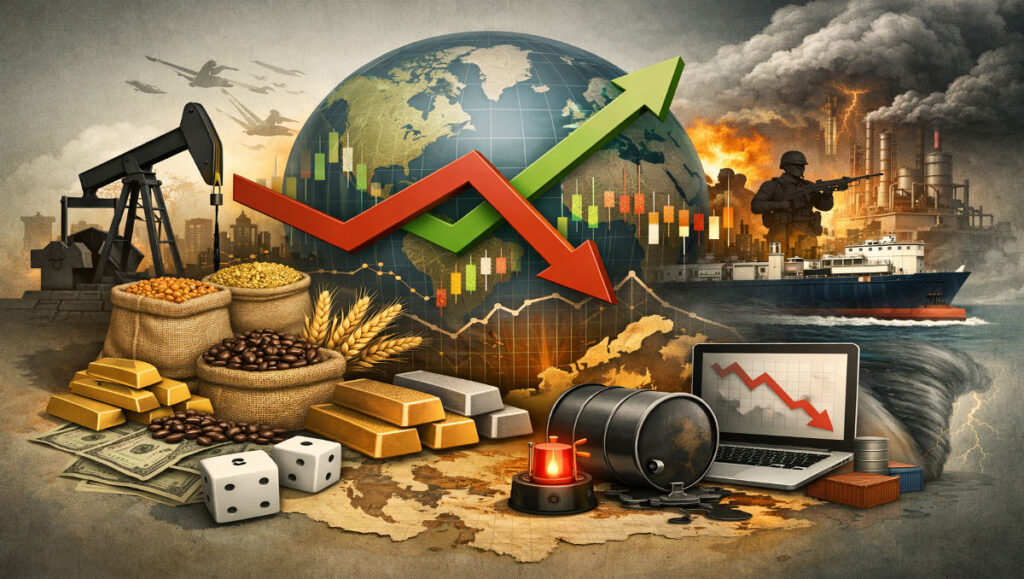
In April 2020, crude oil futures collapsed below negative $37 per barrel. In 2008, oil fell nearly 75% in six months. In 2011, silver lost half its value within weeks.
These were not anomalies.
They represent the structural nature of commodity markets.
Before allocating capital, every serious investor must ask: what are the risks of trading in commodity markets?
What are the risks of trading in commodity markets?The answer is multi-layered. Volatility, leverage, futures curve dynamics, geopolitical instability, liquidity stress, and policy intervention all interact. Understanding what are the risks of trading in commodity markets is not about fear. It is about disciplined allocation.
Key Takeaways
- Commodity markets are structurally volatile, not temporarily unstable.
- Leverage amplifies small price movements into large capital swings.
- Futures curve mechanics can erode returns silently.
- Geopolitical and regulatory shifts create abrupt repricing.
- U.S. investors must treat commodities as tactical exposure, not speculation.
Table of Contents
- Structural Volatility Risk
- Leverage and Margin Risk
- Futures Curve and Roll Yield Risk
- Liquidity and Execution Risk
- Geopolitical and OPEC Risk
- Regulatory and Policy Risk
- Currency Exposure Risk
- Weather and Agricultural Risk
- Storage and Physical Delivery Risk
- Speculative Positioning Risk
- Correlation and Portfolio Risk
- Black Swan and Systemic Risk
- What Are the Risks of Trading in Commodity Markets for U.S. Investors?
- Institutional Risk Framework
- FAQ
- Final Thoughts
- Author
- Disclaimer
Structural Volatility Risk
Commodities are among the most volatile major asset classes. Crude oil frequently exhibits annualized volatility between 30% and 50%. Agricultural commodities can surge 20% or more during drought cycles.
Unlike equities, commodities do not grow earnings over time. Prices are driven by supply constraints, demand shocks, and macroeconomic changes.
This structural volatility explains why investors must evaluate what are the risks of trading in commodity markets before increasing exposure.
Volatility is not temporary noise. It is embedded in the pricing mechanism.
Leverage and Margin Risk
Commodity futures require only a fraction of contract value as margin. Initial margin often ranges from 5% to 15% of notional value.
A 5% adverse move in the underlying commodity can translate into a 30% to 60% loss relative to posted margin.
Leverage sits at the core of what are the risks of trading in commodity markets because it magnifies volatility into capital instability. During stress periods, exchanges raise margin requirements, forcing liquidation.
Leverage transforms normal price fluctuation into amplified financial exposure.
Official contract specifications and margin requirements are published by the CME Group, which oversees major U.S. futures markets.
Futures Curve and Roll Yield Risk
Many investors access commodities through ETFs holding futures contracts. When the futures curve is in contango, rolling contracts forward creates negative roll yield.
For example, if spot crude trades at $75 and the next contract trades at $78, ETF investors repeatedly sell lower-priced contracts and buy higher-priced ones. Over time, this erodes performance.
Investors who are new to futures pricing mechanics can review our detailed guide on what is the difference between spot price and futures price to better understand how contract structure influences long-term returns.
Futures curve mechanics are a sophisticated but essential element of understanding what are the risks of trading in commodity markets for long-term participants.
Liquidity and Execution Risk
Liquidity conditions vary across commodities. Major contracts such as crude oil and gold are deep, while smaller agricultural or metal contracts may thin rapidly during stress.
In high volatility environments, bid-ask spreads widen and slippage increases. Execution risk compounds losses.
Liquidity fragility is another structural dimension of what are the risks of trading in commodity markets.
Geopolitical and OPEC Risk
Commodity markets are globally interconnected. OPEC production cuts, sanctions, and regional conflicts alter supply balances rapidly.
Energy markets in particular reprice quickly in response to geopolitical developments. Price swings of 10% within days are not unusual.
Geopolitical exposure remains one of the most visible examples of what are the risks of trading in commodity markets.
The U.S. Energy Information Administration regularly publishes data on energy production, inventories, and supply disruptions.
For real-time examples of how production cuts and supply shocks impact energy markets, see our latest analysis on crude oil price today USA.
Regulatory and Policy Risk
U.S. commodity derivatives are regulated by the Commodity Futures Trading Commission. Margin rules, speculative position limits, and reporting requirements can evolve.
Environmental policy, export controls, and biofuel mandates influence supply-demand balances.
Policy intervention forms a central part of what are the risks of trading in commodity markets because it can override traditional fundamentals.
Commodity derivatives in the United States are regulated by the Commodity Futures Trading Commission, which sets enforcement and reporting standards.
Currency Exposure Risk
Commodities are typically priced in U.S. dollars. A strengthening dollar reduces global purchasing power and often pressures commodity prices.
Currency fluctuations introduce macroeconomic sensitivity that investors must factor into what are the risks of trading in commodity markets.
Dollar exposure adds another layer of volatility.
Weather and Agricultural Risk
Agricultural commodities depend on planting cycles and climate conditions. Drought, frost, hurricanes, and flooding disrupt production.
Corn, soybeans, coffee, and cocoa can experience sharp repricing during key seasonal windows.
Weather unpredictability strengthens the structural answer to what are the risks of trading in commodity markets.
Storage and Physical Delivery Risk
Futures contracts are tied to physical delivery. While most financial participants close positions before expiration, storage constraints can distort pricing.
The negative oil episode demonstrated how physical capacity limits can overwhelm financial positioning.
Storage and delivery constraints represent an underappreciated aspect of what are the risks of trading in commodity markets.
Speculative Positioning Risk
Large hedge funds and institutional traders influence short-term price dynamics. When positioning becomes crowded, unwinds can be violent.
Commitment of Traders reports often reveal extreme positioning prior to reversals.
Speculative concentration amplifies what are the risks of trading in commodity markets during momentum shifts.
Correlation and Portfolio Risk
During financial stress, commodities can become positively correlated with equities. Diversification benefits may diminish when risk assets sell off broadly.
Portfolio correlation risk is frequently overlooked when evaluating what are the risks of trading in commodity markets.
Investors considering metals exposure should also review our guide on how to invest in copper mining stocks for 2026 to understand equity-linked commodity risk.
Risk is dynamic, not static.
Black Swan and Systemic Risk
Pandemics, global recessions, and sudden regulatory bans create systemic repricing events.
Commodity markets are especially vulnerable because they reflect real economic activity.
Black swan events reinforce that what are the risks of trading in commodity markets extends beyond normal cyclical volatility.
What Are the Risks of Trading in Commodity Markets for U.S. Investors?
Understanding what are the risks of trading in commodity markets is particularly important for U.S. investors accessing exposure through futures, ETFs, mining stocks, or physical holdings.
Futures introduce leverage risk. ETFs face roll yield erosion. Mining equities add corporate management and equity market risk. Physical holdings require insurance and storage considerations.
Tax treatment also varies between instruments.
Evaluating what are the risks of trading in commodity markets allows U.S. investors to align exposure with capital preservation goals.
Tax treatment also matters, which is why investors should understand the tax implications of selling inherited gold coins when holding physical commodities.
Institutional Risk Framework
Professional investors approach commodities through structured risk budgeting.
Exposure is sized relative to total portfolio volatility. Leverage is controlled. Stop-loss mechanisms are defined in advance. Macro indicators such as dollar strength, inventory levels, and central bank policy are monitored continuously.
This disciplined approach reframes what are the risks of trading in commodity markets from speculation into controlled allocation.
Frequently Asked Questions
What are the risks of trading in commodity markets?
They include structural volatility, leverage exposure, futures curve erosion, liquidity stress, geopolitical shocks, currency fluctuations, and regulatory intervention.
Why is leverage dangerous in commodities?
Because margin requirements are small relative to contract value, price swings translate into amplified capital impact.
Are commodity ETFs safer than futures?
They reduce leverage risk but introduce roll yield and tracking risk.
Do commodities always hedge inflation?
Not always. They can underperform during strong dollar environments or demand slowdowns.
How should investors manage commodity risk?
Limit exposure size, avoid excessive leverage, diversify instruments, and monitor macroeconomic conditions.
Final Thoughts: Respect Structural Risk
Commodity markets are essential components of the global financial system. They offer diversification and inflation protection.
Yet the question what are the risks of trading in commodity markets must always precede allocation decisions.
Risk in commodity markets is structural, cyclical, and occasionally extreme.
Investors who understand what are the risks of trading in commodity markets position themselves not as speculators, but as disciplined capital allocators.
Author
Prepared by a commodity market strategist specializing in energy, metals, and agricultural derivatives. Research integrates macroeconomic modeling, futures curve analysis, and regulatory frameworks to provide institutional-grade perspective.
Disclaimer
This content is for informational purposes only and does not constitute financial, legal, or investment advice. Commodity trading involves substantial risk of loss. Investors should consult licensed professionals before making investment decisions.
