
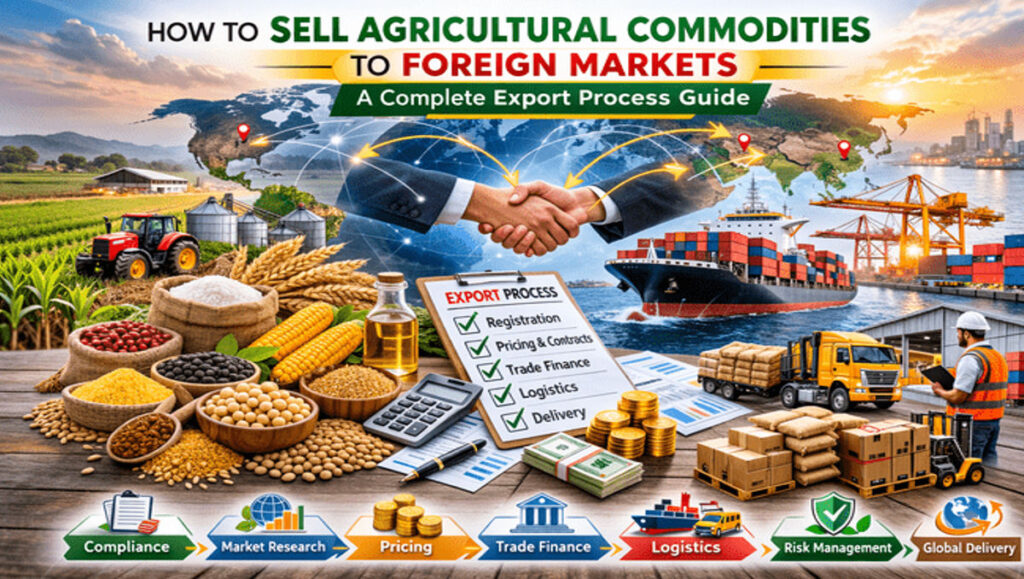
Global agricultural trade exceeds two trillion dollars annually, driven by food security demand, livestock feed requirements, biofuel expansion, and climate-related supply disruptions. Import-dependent economies across Asia, Africa, and the Middle East increasingly rely on structured agricultural imports to stabilize domestic supply chains.
Understanding how to sell agricultural commodities to foreign markets is no longer optional for competitive producers. It is a strategic growth pathway that requires regulatory compliance, disciplined pricing, secure payment systems, and structured risk management.
Bottom Line Up Front: Exporters who implement a defined agricultural export process from registration and HS code classification to trade finance protection and logistics control significantly reduce operational risk while protecting margins in international agricultural trade.
This guide explains in detail how to sell agricultural commodities to foreign markets using a professional, step-by-step framework aligned with global trade standards.
Key Takeaways
- Knowing how to sell agricultural commodities to foreign markets begins with regulatory authorization and proper HS code classification.
- The agricultural export process requires structured pricing using Incoterms and full cost modeling.
- Trade finance tools such as letters of credit reduce payment exposure in international agricultural trade.
- Documentation precision determines customs clearance efficiency.
- Hedging and diversification reduce volatility risk when exporting agricultural products internationally.
Table of Contents
- Who This Framework Applies To
- Regulatory Authorization and HS Code Classification
- Market Intelligence and Buyer Verification
- Pricing Structure and Incoterms
- Documentation and Compliance Standards
- Trade Finance and Payment Protection
- Logistics and Supply Chain Management
- Risk Management in International Agricultural Trade
- What This Means for US Exporters and Investors
- Execution Framework Recap
- FAQ
- Final Thoughts
- Author
- Disclaimer
How to Sell Agricultural Commodities to Foreign Markets
Understanding how to sell agricultural commodities to foreign markets requires a structured approach rather than transactional selling. The agricultural export process integrates compliance, pricing discipline, financial protection, logistics coordination, and risk mitigation into one operational framework.
Exporters who treat international agricultural trade as a controlled system consistently outperform informal traders who rely on opportunistic sales.
The following sections break down exactly how to sell agricultural commodities to foreign markets step by step.
Who This Framework Applies To
This agricultural commodity exporting guide applies to farmers, aggregators, export houses, commodity traders, food processors, and institutional supply chain operators seeking to export agricultural products internationally.
Businesses with reliable production volumes, traceability systems, and financial discipline are best positioned to sell agricultural commodities to foreign markets successfully. Exporting agricultural products internationally requires operational consistency and liquidity planning.
Regulatory Authorization and HS Code Classification
The agricultural export process begins with legal authorization. Exporters must obtain official export registration or trade licenses before engaging in international agricultural trade.
Every commodity must be classified correctly under the Harmonized System (HS) code. HS codes determine tariff rates, customs documentation, and inspection requirements in international markets.
Exporters can verify international tariff classifications using the official Harmonized System database provided by the World Customs Organization (WCO).
Misclassification can lead to shipment delays, penalties, or rejection at destination ports. Regulatory compliance is foundational when learning how to sell agricultural commodities to foreign markets legally and sustainably.
Market Intelligence and Buyer Verification
International agricultural trade depends on informed market selection. Exporters must analyze import demand trends, tariff structures, domestic production gaps, and currency stability in target countries.
Buyer verification is equally critical. Professional exporters conduct due diligence to confirm financial credibility and transaction history before entering contracts.
Reducing counterparty risk is central to how to sell agricultural commodities to foreign markets while protecting working capital.
Exporters exploring mineral-linked agricultural demand trends may also review our analysis on how to invest in copper mining stocks for 2026, as industrial growth often influences agricultural import capacity.
Pricing Structure and Incoterms
Structured pricing ensures margin protection. Exporters must calculate total landed cost by incorporating production cost, inland transport, port handling, freight, marine insurance, and applicable duties.
Incoterms such as FOB, CFR, and CIF define risk transfer between buyer and seller. Clear contractual allocation prevents disputes and ensures predictable cost exposure.
Proper pricing discipline strengthens competitiveness when exporters sell agricultural commodities to foreign markets in dynamic global conditions.
Documentation and Compliance Standards
Documentation accuracy is critical in the agricultural export process. Required documents typically include commercial invoices, packing lists, bills of lading, certificates of origin, and phytosanitary certificates.
Importing countries often impose strict food safety and inspection standards. Incomplete documentation can delay customs clearance or result in cargo rejection.
Documentation precision is one of the most decisive factors in how to sell agricultural commodities to foreign markets efficiently.
Trade Finance and Payment Protection
Payment security remains a primary concern in international agricultural trade. Letters of credit provide strong financial protection, especially when dealing with new buyers. Documentary collections are common among established partners.
The International Chamber of Commerce (ICC) provides standardized guidance on letters of credit under UCP 600 rules, which govern global trade finance transactions.
Export credit insurance helps mitigate exposure to buyer default and political risk. Structured trade finance mechanisms protect liquidity and stabilize cash flow.
Financial discipline is essential in how to sell agricultural commodities to foreign markets without exposing working capital to unnecessary risk.
Logistics and Supply Chain Management
Bulk commodities typically ship via ocean freight, while perishable goods require cold-chain logistics and temperature monitoring.
Exporters must coordinate freight forwarders, customs brokers, port authorities, and insurance providers to ensure timely shipment.
Port congestion, weather disruptions, and regulatory inspections can affect delivery schedules. Effective logistics integration strengthens reliability in international agricultural trade.
Risk Management in International Agricultural Trade
Agricultural markets are sensitive to weather volatility, geopolitical developments, and supply disruptions. Price fluctuations between contract signing and delivery can erode margins.
Exporters often hedge price exposure using futures contracts. Currency hedging may also be required when invoices are denominated in foreign currency.
Exporters who hedge agricultural price exposure should also understand the broader risks outlined in our guide on what are the risks of trading in commodity markets, which explains volatility, leverage, and geopolitical exposure in detail.
Agricultural futures contracts are traded on regulated exchanges such as the Chicago Board of Trade (CBOT), which provides transparency and price discovery in global grain markets.
Political instability, sanctions, and trade embargoes can abruptly restrict access to certain markets. Diversification across multiple export destinations enhances resilience.
Risk management converts exporting agricultural products internationally into a structured, controllable enterprise.
What This Means for US Exporters and Investors
For US exporters, understanding how to sell agricultural commodities to foreign markets is strategically important, as the United States remains one of the largest global grain suppliers.
For exporters monitoring energy-driven freight costs, reviewing our daily analysis on crude oil price today USA can provide insight into shipping cost trends that impact agricultural export margins.
Established futures markets and hedging infrastructure provide structural advantages in international agricultural trade.
For investors, export growth trends influence agricultural commodity futures, shipping firms, fertilizer producers, and agribusiness equities.
International agricultural trade patterns often reflect broader macroeconomic shifts in food security and currency flows.
Execution Framework Recap
To execute the agricultural export process effectively, exporters must secure legal authorization, confirm HS classification, conduct market research, verify buyers, structure pricing using Incoterms, prepare accurate documentation, implement protected payment mechanisms, coordinate logistics, and hedge price or currency exposure when necessary.
This integrated system defines how to sell agricultural commodities to foreign markets with margin protection and compliance stability.
Frequently Asked Questions
What is the first step in how to sell agricultural commodities to foreign markets?
The first step is obtaining official export authorization and correctly classifying the product under the appropriate HS code. Without legal registration and accurate tariff classification, exporters cannot clear customs or enter international agricultural trade legally. Regulatory compliance establishes the foundation for the agricultural export process.
How can exporters reduce payment risk in international agricultural trade?
Exporters reduce payment risk by using structured trade finance tools such as letters of credit, documentary collections, and export credit insurance. These mechanisms provide financial protection against buyer default and political instability. Implementing secure banking channels strengthens liquidity control when selling agricultural commodities internationally.
Why is documentation so important when exporting agricultural products internationally?
Documentation ensures customs compliance and regulatory approval. Commercial invoices, bills of lading, certificates of origin, and phytosanitary certificates verify product origin and quality standards. Inaccurate documentation can lead to shipment delays or cargo rejection, affecting profitability.
How do exporters manage volatility when learning how to sell agricultural commodities to foreign markets?
Exporters manage volatility through futures hedging and currency risk management strategies. Hedging stabilizes selling prices between contract signing and shipment, while currency management protects against exchange rate fluctuations. These tools convert international agricultural trade from speculative exposure into structured risk control.
Final Thoughts
Understanding how to sell agricultural commodities to foreign markets requires disciplined execution across compliance, pricing, finance, logistics, and risk management.
The agricultural export process must function as a coordinated system rather than an isolated transaction.
Exporters who integrate regulatory precision, financial protection, and operational discipline build scalable global trade operations capable of long-term stability.
Author
Prepared by a commodity trade analyst specializing in agricultural export compliance, international trade finance structuring, and commodity risk management.
Disclaimer
This content is for informational purposes only and does not constitute legal, regulatory, or financial advice. Export regulations vary by jurisdiction. Consult qualified professionals before conducting international trade operations.
