
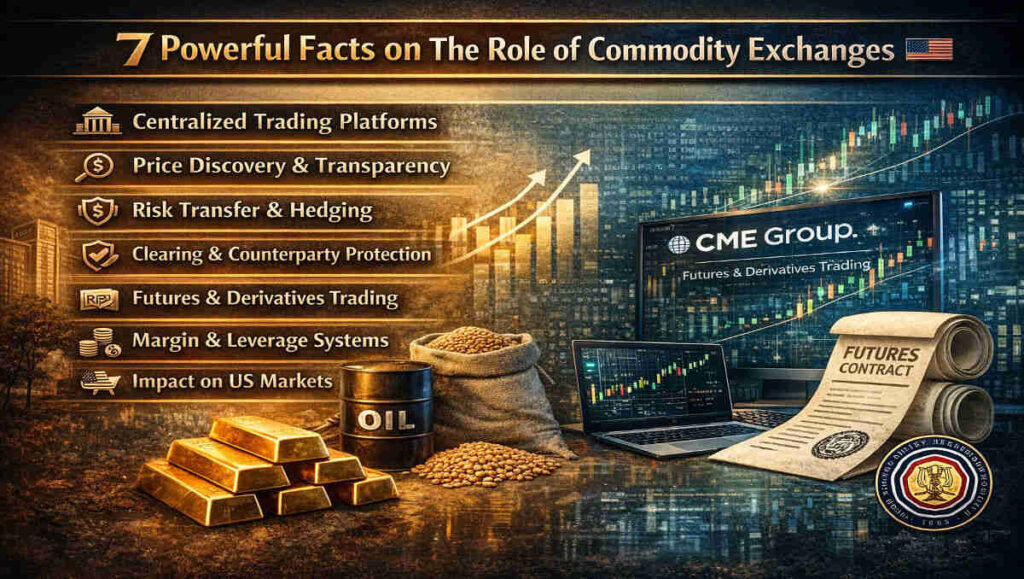
The role of commodity exchanges is to provide centralized, regulated marketplaces where standardized futures contracts are traded, cleared, and settled. CME Group, the largest US commodity exchange operator, enables price discovery, risk management, and counterparty protection across energy, metals, and agricultural markets. For US investors, understanding the role of commodity exchanges is essential for accessing futures markets safely and efficiently.
Key Takeaways
- The role of commodity exchanges is to provide centralized, regulated futures markets that enable price discovery and structured risk transfer.
- CME Group is the dominant US commodity exchange operator, clearing the majority of energy, metals, and agricultural futures contracts.
- Exchange clearing reduces counterparty risk through margin requirements and daily settlement mechanisms.
- Commodity exchanges enhance transparency by publishing open interest, volume, and positioning data.
- For US investors, understanding the role of commodity exchanges is essential for disciplined commodity exposure.
Table of Contents
- Featured Snippet Overview
- Why The Role of Commodity Exchanges Matters in 2026
- The Role of Commodity Exchanges: CME Group Explained
- Margin Systems and Leverage Structure
- Price Discovery and Risk Transfer in Practice
- Stress Testing the Exchange System: 2020 Oil Event
- How US Investors Access Commodity Exchanges
- What This Means for US Investors
- Risks and Structural Limitations
- Structural Signals to Monitor
- Comparison With Other Global Exchanges
- Frequently Asked Questions
- Final Market Perspective
- Disclaimer
- Author & Research Integrity
Why The Role of Commodity Exchanges Matters in 2026
The role of commodity exchanges has become more important in 2026 as global supply chains fragment and volatility cycles intensify. Energy markets face geopolitical uncertainty, agricultural markets experience climate-driven variability, and industrial metals respond to electrification demand. In such conditions, centralized trading infrastructure becomes critical.
For a broader macro context on commodity volatility, see our analysis in “How to Start Commodity Trading for Beginners in the US.”
Commodity exchanges provide transparency that over-the-counter markets cannot replicate. Prices are publicly quoted, trades are standardized, and risk is continuously collateralized. This structure reduces systemic fragility during periods of market stress.
When comparing current futures trading volumes to five-year historical averages, energy and metals participation has remained structurally elevated. This confirms that exchange-based trading remains the backbone of US commodity price formation.
Official monetary policy statements and rate projections are available through the Federal Reserve Board.
The role of commodity exchanges is therefore foundational to modern financial and physical commodity systems.
The Role of Commodity Exchanges: CME Group Explained
To fully understand the role of commodity exchanges: CME Group explained requires examining scale and function. CME Group operates four major exchanges: CME, CBOT, NYMEX, and COMEX. Together, they list contracts spanning crude oil, natural gas, gold, silver, copper, corn, soybeans, wheat, and financial derivatives.
Every trade executed on these platforms is cleared through CME Clearing. This clearinghouse becomes the legal counterparty to both sides of every futures contract. As a result, buyers and sellers do not face direct bilateral exposure.
This structure dramatically reduces counterparty risk. Instead of relying on individual creditworthiness, market participants rely on the financial integrity of the clearinghouse.
The role of commodity exchanges here is institutional infrastructure, not speculation facilitation.
CME Group’s clearing framework and contract specifications are publicly detailed on the official CME website.
Margin Systems and Leverage Structure
A central component of the role of commodity exchanges is the margin system. Futures contracts allow market participants to control large notional values with a smaller capital deposit. However, this leverage is strictly regulated through initial and maintenance margin requirements.
For example, consider a crude oil futures contract with a notional value of $85,000. The initial margin requirement may be approximately $9,000 depending on market volatility. This means the trader controls the full notional value with roughly 10–11 percent of capital.
If you want a deeper understanding of leverage mechanics, review “Technical Indicators for Short-Term Commodity Trading.”
Daily settlement, known as mark-to-market accounting, ensures that profits and losses are realized every trading session. If the market moves against a trader, variation margin must be posted immediately. This continuous collateral adjustment protects the clearing system from accumulating hidden losses.
The role of commodity exchanges is to enforce discipline in leveraged markets through transparent and dynamic margin systems.
Price Discovery and Risk Transfer in Practice
Price discovery is one of the most important outcomes of the role of commodity exchanges. Futures prices reflect collective expectations about supply, demand, macroeconomic conditions, and inventory data. These expectations update instantly when new information becomes available.
For instance, weekly petroleum inventory reports from the US Energy Information Administration frequently move crude oil futures within seconds of release. Agricultural futures respond similarly to USDA crop production estimates.
Producers use futures contracts to hedge forward production. Airlines hedge jet fuel exposure, farmers hedge crop output, and mining companies hedge metal production. Speculators, in turn, assume price risk in exchange for potential return.
The role of commodity exchanges ensures that this risk transfer occurs in a transparent and enforceable environment.
Stress Testing the Exchange System: 2020 Oil Event
The role of commodity exchanges faced a historic test in April 2020 when front-month WTI crude oil futures briefly traded below zero. This unprecedented event exposed structural fragilities in storage capacity and contract positioning.
Despite extreme volatility, CME Clearing continued to function. Margin requirements were adjusted to reflect heightened risk, and clearing guarantees were maintained. Although individual traders suffered losses, the centralized clearing structure prevented systemic collapse.
This episode demonstrated the resilience of regulated exchanges compared to unregulated bilateral markets. It reinforced the importance of centralized clearing during periods of extreme market dislocation.
We break down crude oil market structure further in “Crude Oil Price Volatility Explained: What’s Moving WTI Now.”
The role of commodity exchanges proved critical to maintaining order under stress.
How US Investors Access Commodity Exchanges
US investors access commodity exchanges through regulated futures brokerage accounts. These brokers operate under oversight from the Commodity Futures Trading Commission and the National Futures Association. Approval for futures trading typically requires acknowledgment of leverage risk.
Institutional investors frequently trade CME futures directly due to liquidity and capital efficiency advantages. Retail investors may prefer exchange-traded funds that hold futures contracts to replicate commodity exposure.
Regardless of the vehicle used, the underlying exposure originates from exchange-listed futures contracts. Therefore, understanding the role of commodity exchanges clarifies how commodity-linked financial products derive their pricing.
US futures brokers operate under oversight from the Commodity Futures Trading Commission.
Exchange infrastructure ultimately anchors all US futures-based exposure.
What This Means for US Investors
For US investors, the role of commodity exchanges provides structured access to global commodity markets with regulatory oversight. Centralized clearing reduces counterparty uncertainty, while standardized contracts simplify execution.
Additionally, many regulated futures contracts qualify for Section 1256 tax treatment, which blends short-term and long-term capital gains rates. This can create tax efficiency relative to other leveraged instruments.
Commodity exchanges also publish open interest and positioning data. These datasets allow investors to analyze speculative participation and hedging flows.
The role of commodity exchanges therefore enhances both access and analytical transparency.
Risks and Structural Limitations
While exchange clearing mitigates counterparty risk, market risk remains substantial. Futures contracts are inherently leveraged instruments, and adverse price movements can quickly generate significant losses.
Margin calls during volatility spikes may force liquidation if capital is insufficient. Additionally, liquidity can temporarily decline during macro shocks, widening bid-ask spreads.
Exchange infrastructure protects system stability but does not guarantee investor profitability. Risk management discipline is essential when participating in futures markets.
The role of commodity exchanges reduces structural fragility but cannot eliminate economic uncertainty.
Structural Signals to Monitor
Understanding the role of commodity exchanges requires monitoring broader macroeconomic signals. The US Dollar Index directly influences commodity pricing because most contracts are denominated in dollars.
Federal Reserve interest rate expectations affect cost-of-carry calculations embedded in futures curves. Higher rates increase carrying costs, potentially steepening contango structures.
Inventory trends from EIA and USDA influence short-term price dynamics in energy and agricultural markets. Meanwhile, CFTC Commitment of Traders reports reveal speculative positioning that can precede volatility reversals.
Weekly petroleum inventory statistics are published by the US Energy Information Administration.
These structural indicators provide context for exchange-driven price movement.
Comparison With Other Global Exchanges
While CME Group dominates US commodity futures, other global exchanges operate parallel systems. Intercontinental Exchange lists Brent crude and certain agricultural contracts with significant global participation.
London Metal Exchange specializes in industrial metals and warehouse-based settlement structures. Shanghai Futures Exchange plays a major role in Chinese domestic commodity pricing.
However, CME remains the benchmark for US-based futures liquidity and clearing integrity. Its scale, regulatory oversight, and diversified contract listings reinforce its central role in US markets.
The role of commodity exchanges globally varies, but CME Group remains the cornerstone of American futures trading.
For a structural asset comparison, read “Physical Commodities vs Financial Derivatives Explained.”
Frequently Asked Questions
What is the primary role of commodity exchanges?
The primary role of commodity exchanges is to provide regulated marketplaces where standardized futures contracts enable transparent price discovery and structured risk transfer.
Why is CME Group important in the United States?
CME Group operates the largest US commodity exchanges and provides centralized clearing services that protect against counterparty default.
Do commodity exchanges eliminate all trading risk?
Commodity exchanges eliminate counterparty default risk through clearing but do not eliminate price volatility risk.
How do futures contracts create leverage?
Futures contracts require only a fraction of notional value as margin, allowing traders to control large exposure with smaller capital deposits.
Why do commercial firms hedge on exchanges?
Commercial firms hedge on exchanges to stabilize revenue, manage production costs, and reduce uncertainty caused by price fluctuations.
Final Market Perspective
The role of commodity exchanges underpins the entire US commodity pricing system. CME Group provides institutional infrastructure that enables transparent leverage, centralized clearing, and disciplined risk transfer.
As volatility cycles persist and macroeconomic uncertainty remains elevated, exchange-based trading will continue to anchor price formation. Investors who understand the role of commodity exchanges gain structural clarity on how commodity markets function.
Institutional infrastructure matters most during stress, and centralized exchanges remain critical to maintaining orderly markets.
Disclaimer
This content is for informational purposes only and does not constitute financial or investment advice. Commodity futures trading involves substantial risk and may not be suitable for all investors.
Author & Research Integrity
Prepared by the USCommodityPrice Research Team, specializing in US futures market structure, exchange mechanics, and institutional commodity risk systems.
Updated: February 2026
Data sources referenced include CME Group publications, CFTC reports, Federal Reserve releases, EIA statistics, and USDA market reports.
