
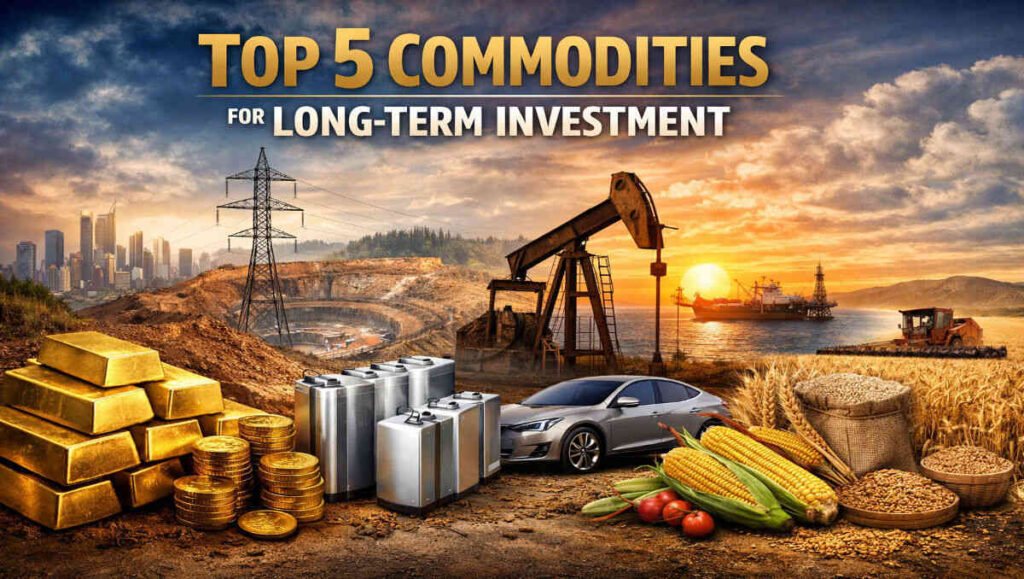
The top 5 commodities for long-term investment are gold, copper, lithium, crude oil, and agricultural grains. These assets offer structural demand growth, supply constraints, inflation protection, and geopolitical relevance. From 2026 to 2035, they represent the strongest long-duration opportunities in global commodity markets.
Long-term commodity investing is not speculative positioning around daily price fluctuations. It is a structural allocation strategy grounded in macroeconomic trends, capital discipline, geopolitical risk, and physical scarcity. Investors seeking inflation resilience, diversification beyond financial assets, and exposure to multi-year global transitions consistently evaluate the top 5 commodities for long-term investment as core portfolio components.
This pillar guide presents a comprehensive institutional framework explaining why these five commodities stand apart, how their demand trajectories differ, what supply constraints exist, and how investors can approach allocation intelligently.
Key Takeaway
The top 5 commodities for long-term investment combine structural demand expansion, multi-year supply constraints, geopolitical influence, and capital cycle dynamics that historically generate extended appreciation phases. Gold protects monetary stability, copper powers electrification, lithium drives battery growth, crude oil anchors energy systems, and agricultural grains sustain food security.
Table of Contents
- Structural Case for Long-Term Commodity Investing
- Institutional Selection Framework
- Capital Cycles and Supply Discipline
- Gold – Monetary Stability Asset
- Copper – Electrification and Infrastructure Metal
- Lithium – Battery Revolution Growth Driver
- Crude Oil – Energy Security Foundation
- Agricultural Grains – Global Food Demand Core
- 2026–2035 Institutional Demand Forecast Modeling
- Inflation Hedge Performance Analysis
- Volatility and Correlation Assessment
- Risk Factors and Structural Threats
- Portfolio Construction Strategy
- What Is There for US Investors
- Frequently Asked Questions
- Final Strategic Outlook
- Disclaimer
- Author
Structural Case for Long-Term Commodity Investing
The global economy operates on physical inputs. Financial markets expand and contract based on liquidity conditions, but commodities represent the tangible foundation of industrial production, transportation, infrastructure, energy systems, and food supply.
The structural case for allocating capital to the top 5 commodities for long-term investment rests on four long-duration forces.
First, electrification and decarbonization significantly increase material intensity per unit of economic output. Second, sovereign debt expansion weakens confidence in fiat currency systems, strengthening demand for monetary metals.
Third, geopolitical fragmentation increases the strategic value of energy and raw materials. Fourth, population growth and rising protein consumption sustain agricultural demand.
Unlike cyclical booms that fade within quarters, these forces are expected to unfold across decades. That long time horizon distinguishes structural commodity exposure from short-term speculation.
Institutional Selection Framework
Not every commodity qualifies as a long-term strategic asset. The top 5 commodities for long-term investment were selected based on measurable institutional criteria.
The first criterion is demand durability. Demand must grow steadily regardless of short-term economic fluctuations. Copper demand from electrification and lithium demand from batteries satisfy this condition.
The second criterion is supply rigidity. If supply can scale rapidly, price appreciation becomes limited. Mining projects for copper and lithium require extensive permitting, environmental approvals, and infrastructure investment, often exceeding seven years.
The third criterion is geopolitical leverage. Commodities that influence national security or economic stability hold strategic pricing power. Oil and gold both meet this requirement.
The fourth criterion is historical resilience. Assets must demonstrate performance during inflationary or crisis periods. Gold and agricultural commodities historically provide defensive characteristics.
Only gold, copper, lithium, crude oil, and agricultural grains meet all four institutional thresholds simultaneously, justifying their classification as the top 5 commodities for long-term investment.
Capital Cycles and Supply Discipline
Commodity markets follow capital cycles. When prices decline, exploration budgets shrink and production capacity contracts. Years later, when demand accelerates, supply cannot respond immediately because new capacity requires multi-year investment.
After the commodity downturn of the mid-2010s, capital expenditure across mining and energy sectors declined significantly. Environmental scrutiny and shareholder return discipline further constrained expansion. This supply discipline has created conditions where incremental demand increases produce disproportionate price movements.
The top 5 commodities for long-term investment benefit directly from this capital restraint. Copper projects face declining ore grades. Lithium processing capacity remains geographically concentrated. Oil exploration budgets have not fully recovered to previous peaks. Agricultural expansion is limited by land availability and water stress. Gold mine discovery rates have declined over decades.
Capital cycles amplify structural demand trends, reinforcing long-term pricing support.
Gold – Monetary Stability Asset
Gold serves as the monetary anchor within the top 5 commodities for long-term investment. Unlike industrial commodities, gold demand is influenced primarily by monetary policy, currency stability, and sovereign debt conditions.
Over the past two decades, gold has demonstrated resilience during financial crises and inflationary periods. Central banks have steadily diversified reserves toward gold, particularly amid geopolitical uncertainty.
Gold’s long-term positioning in diversified portfolios is reinforced by central bank accumulation trends tracked by the World Gold Council, which publishes detailed global demand data and reserve statistics.
From 2026 to 2035, gold’s trajectory depends largely on real interest rates and fiscal stability. In base-case modeling, gold appreciation aligns with inflation plus incremental demand from emerging markets. In stress scenarios involving currency instability, gold historically experiences accelerated upside.
Gold’s strategic function as monetary insurance secures its inclusion among the top 5 commodities for long-term investment.
For real-time structural levels and price behavior, investors can review our latest analysis in Gold Price Today in USA.
Copper – Electrification and Infrastructure Metal
Copper stands at the intersection of infrastructure modernization and electrification. Electric vehicles require significantly more copper than combustion vehicles. Renewable energy installations, transmission grids, and data centers increase copper intensity across sectors.
Projected demand growth between 2026 and 2035 remains robust due to sustained electrification investment. However, supply growth remains limited by permitting delays and declining ore grades.
Global electrification projections from the International Energy Agency continue to highlight copper as a backbone metal for renewable power grids and EV expansion.
The mismatch between accelerating electrification demand and constrained new supply positions copper as one of the most compelling assets within the top 5 commodities for long-term investment.
A deeper structural breakdown is available in our Beginner’s Guide to Trading Renewable Energy Metals (Lithium/Copper).
Lithium – Battery Revolution Growth Driver
Lithium demand is tightly linked to battery production for electric vehicles and grid storage systems. Adoption rates across North America, Europe, and Asia continue to expand.
Lithium markets exhibit higher volatility due to concentrated supply and relatively thin liquidity compared to major metals. However, structural demand growth remains significant.
As per U.S. Geological Survey Lithium demand forecasts from industry scenario modeling emphasize battery storage growth as a defining multi-year demand catalyst.
Our renewable metals strategy guide further explores lithium volatility cycles within the broader electrification theme.
As energy storage becomes essential to renewable integration, lithium solidifies its role among the top 5 commodities for long-term investment.
Crude Oil – Energy Security Foundation
Oil remains embedded in global transportation, aviation, petrochemicals, and industrial activity. While renewable energy expands, oil demand transitions gradually rather than collapsing abruptly.
Supply discipline since the previous investment cycle has tightened capacity growth. Geopolitical risk further reinforces supply uncertainty.
Oil supply-demand balances are regularly assessed in the U.S. Energy Information Administration’s Short-Term Energy Outlook, which provides institutional energy projections.
Investors can also read How Do Geopolitical Risks Impact Oil Supply Chains? to understand long-term structural risk factors in crude markets.
Oil’s strategic relevance and supply rigidity justify its continued inclusion in the top 5 commodities for long-term investment.
Agricultural Grains – Global Food Demand Core
Agricultural grains represent non-discretionary consumption. Population growth and dietary shifts sustain baseline demand.
Climate variability introduces yield unpredictability, increasing volatility. However, long-term consumption remains stable and necessary.
Agricultural commodities provide diversification and defensive characteristics within the top 5 commodities for long-term investment.
2026–2035 Institutional Demand Forecast Modeling
Base-case projections suggest steady appreciation across the five selected assets. Gold remains tied to monetary expansion. Copper benefits from infrastructure investment. Lithium shows the highest projected growth rate. Oil demand stabilizes under supply constraints. Agriculture maintains consistent consumption growth.
Bull scenarios include accelerated electrification and supply shocks. Bear scenarios involve temporary global recession effects. Across cycles, the top 5 commodities for long-term investment demonstrate structural endurance.
Inflation Hedge Performance Analysis
Historically, commodities outperform financial assets during inflationary cycles. Gold protects purchasing power during currency debasement. Energy prices often rise during inflationary expansions. Agricultural prices respond to input cost increases.
Including exposure to the top 5 commodities for long-term investment enhances portfolio resilience during macroeconomic stress.
Volatility and Correlation Assessment
Volatility differs across commodities. Lithium exhibits higher price swings. Oil reacts to geopolitical shifts. Copper correlates with industrial growth. Gold responds to monetary policy changes. Agriculture reacts to weather and supply shocks.
Correlation among these assets remains imperfect, making diversification across the top 5 commodities for long-term investment structurally advantageous.
Risk Factors and Structural Threats
Risks include technological substitution, policy shifts, demand slowdown, and supply breakthroughs. However, multi-year project development timelines limit rapid supply expansion.
Structural monitoring remains essential for long-term allocation decisions.
Portfolio Construction Strategy
Commodity allocation should complement rather than replace traditional assets. Conservative portfolios may prioritize gold and agriculture. Balanced portfolios incorporate copper exposure. Growth-oriented allocations include lithium and oil.
Diversification across the top 5 commodities for long-term investment reduces concentration risk while maintaining macro alignment.
What Is There for US Investors
US investors benefit from regulated futures markets, ETF vehicles, mining equities, and agricultural exposure. Domestic infrastructure initiatives and energy transition policies reinforce copper and lithium demand. Monetary uncertainty supports gold allocation. Energy security ensures oil relevance. Agricultural production strengthens export exposure.
The top 5 commodities for long-term investment provide structural inflation diversification within US portfolios.
Frequently Asked Questions
Which commodity is safest for long-term investment?
Gold historically shows lower volatility relative to industrial metals.
Which has highest growth potential?
Lithium currently projects the strongest demand expansion.
Are commodities suitable for retirement portfolios?
Moderate exposure improves diversification.
Do commodities outperform equities?
During inflationary or supply shock cycles, commodities often outperform.
When should allocation occur?
Long-term investors prioritize disciplined exposure rather than precise timing.
Final Strategic Outlook
The top 5 commodities for long-term investment represent structural transformation assets. Gold protects monetary stability. Copper powers electrification. Lithium drives battery expansion. Oil anchors energy continuity. Agriculture secures food supply.
Scarcity, capital discipline, and structural demand converge to support long-cycle opportunity through 2035.
Disclaimer
This content is provided for informational and educational purposes only and does not constitute investment, financial, or legal advice. Commodity markets involve substantial risk, including volatility and potential loss of principal. Past performance is not indicative of future results. Investors should conduct independent research and consult licensed financial professionals before making investment decisions.
Author
US Commodity Research Desk
The US Commodity Research Desk specializes in macro-driven commodity analysis, capital cycle modeling, and long-term structural market research. The team focuses on energy, metals, and agricultural markets, delivering data-backed institutional insights for informed investment decision-making.
