
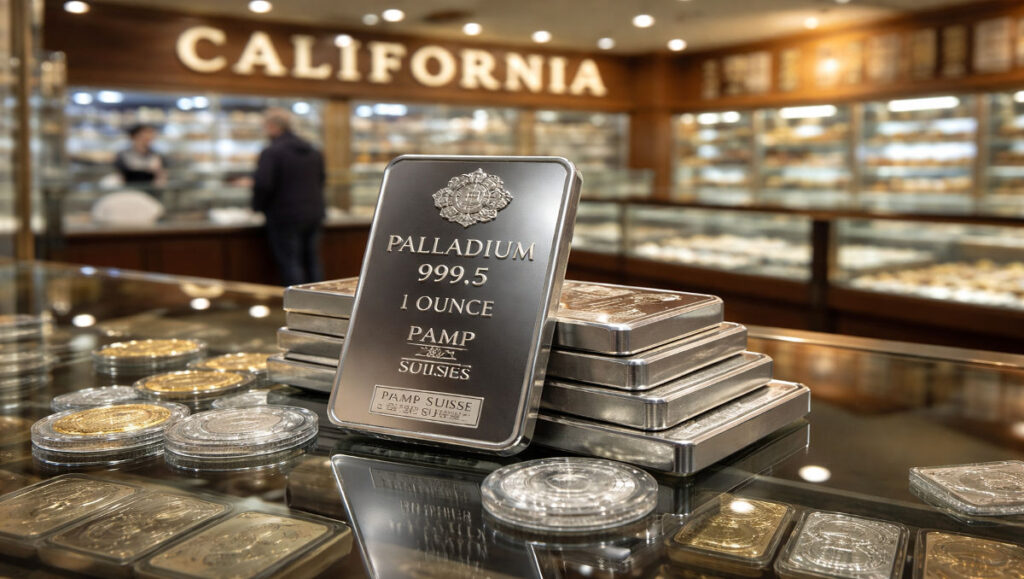
Investors searching for where to buy palladium bars in California are entering one of the most specialized segments of the precious metals market. Palladium is not a traditional safe-haven metal like gold. Instead, its value is heavily influenced by industrial demand, particularly from automotive catalytic converters and emissions systems.
Because global supply is concentrated in a few regions and industrial demand fluctuates with economic cycles, palladium has historically experienced wide price swings. In recent years, prices have traded below $1,000 per ounce and above $3,000 per ounce during supply disruptions. This volatility makes dealer selection, premium comparison, and resale planning especially important for California investors.
Understanding where to buy palladium bars in California requires evaluating credibility, liquidity, pricing transparency, and long-term investment strategy.
To determine where to buy palladium bars in California, investors should compare reputable local bullion dealers in Los Angeles, San Francisco, and San Diego with established national online retailers that ship insured to California. Buyers must review premiums over spot price, confirm refinery certification, verify buyback policies, and understand state tax considerations before investing.
Key Takeaways
- Palladium is more volatile than gold and silver.
- Retail premiums typically range between 5% and 12% above spot.
- Dealer buyback spreads significantly impact long-term returns.
- Authentication and refinery credibility are critical.
- Palladium suits disciplined, medium- to long-term investors.
Table of Contents
- Why Palladium Is Different from Gold
- Where to Buy Palladium Bars in California (Local Dealers)
- Buying Palladium Bars Online
- Pricing, Premiums, and Resale Spreads
- Authenticity and Refinery Standards
- California Sales Tax Rules
- Storage and Liquidity Planning
- Palladium vs Platinum
- What This Means for Investors
- Frequently Asked Questions
- Final Thoughts
- Author
- Disclaimer
Why Palladium Is Different from Gold
Before deciding where to buy palladium bars in California, investors should understand how palladium behaves in the broader commodity market.
Gold primarily functions as a store of value. Silver balances monetary and industrial demand. Palladium, however, is heavily dependent on automotive production and emissions regulations. When global vehicle production rises or environmental standards tighten, demand for palladium increases.
Supply concentration in countries such as Russia and South Africa adds geopolitical sensitivity. Mining disruptions or export restrictions can sharply impact global pricing. These factors contribute to higher volatility compared to gold and silver.
Because of these dynamics, palladium premiums and dealer inventory levels can change quickly during periods of market stress.
Investors comparing industrial metals may also review our detailed breakdown of factors influencing silver prices in 2026 and 2027 to understand how silver differs from palladium in market behavior.
Global supply concentration and production statistics are regularly reported by the U.S. Geological Survey in its annual Mineral Commodity Summaries.
Where to Buy Palladium Bars in California (Local Dealers)
When evaluating where to buy palladium bars in California, major metropolitan areas offer the most reliable access.
In the Los Angeles area, investors can purchase palladium bars through established dealers such as Hollywood Gold & Silver Exchange, Bishop Gold Group, GoldDealer (California Numismatic Investments), True Gold Republic, Revelation Gold Group, and PandaAmerica. These dealers serve the greater Los Angeles market and typically provide both bullion bars and platinum-group metals.
In the San Francisco Bay Area, buyers may explore Pacific Precious Metals, which operates multiple locations including Palo Alto and Sausalito, as well as Polyak Precious Metals and The New York Gold Company, which serves both San Francisco and San Jose investors. These firms often handle platinum-group metals and may source palladium bars upon request if not immediately in stock.
In San Diego, investors can consider First National Bullion and CV Coins & Collectables, both of which offer access to palladium bullion depending on availability and market conditions.
For investors located in California’s Central Valley, Fresno Coin Gallery is a long-standing dealer that specializes in precious metals, including palladium bullion products.
When comparing local options, always review premium levels and confirm dealer buyback policies before purchasing.
Buying Palladium Bars Online
For investors who prefer remote purchasing, Monex Precious Metals, headquartered in Newport Beach, California, offers palladium bars including larger 10-ounce formats. National online retailers such as APMEX, JM Bullion, KITCO, and Provident Metals also ship insured palladium bars directly to California addresses.
Suisse Gold provides international sourcing options and specializes in low-premium palladium bars produced by recognized refiners such as PAMP Suisse, Credit Suisse, and Johnson Matthey.
Investors may also review current palladium market trends and historical price charts through trusted market data providers such as KITCO.
Pricing, Premiums, and Resale Spreads
Pricing mechanics directly affect investment outcomes.
Palladium spot prices are derived from global futures markets. Retail dealers add a premium to cover fabrication costs and operational expenses. For 1-ounce bars, premiums often range between mid-single digits and low double digits.
Palladium spot prices are derived from global futures markets such as the COMEX division of the CME Group, where real-time contracts can be monitored through the official CME website.
Resale values typically fall slightly below spot price. The difference between purchase premium and resale discount is known as the spread. Wider spreads require stronger price appreciation to achieve profitability.
For example, if palladium trades at $1,400 and a dealer charges an 8% premium, the purchase cost exceeds $1,500. If resale occurs at 5% below spot, the investor must rely on future price gains to offset the transaction spread.
Understanding this structure is essential before deciding where to buy palladium bars in California.
For a broader understanding of spot pricing mechanics, see our guide on the difference between spot price and futures price, which explains how metals are priced globally.
Authenticity and Refinery Standards
Authentication is critical when purchasing palladium bullion.
Investors typically find palladium bars produced by major refiners including PAMP Suisse, Credit Suisse, Valcambi Suisse, Johnson Matthey, and Stillwater. These refiners are recognized globally for producing investment-grade bullion with .9995 purity standards. Commonly available bar sizes include 1 ounce, 10 ounces, and in some cases smaller gram-denominated formats.
Investors should verify serial numbers, assay certificates, and original packaging. Purchasing from reputable, licensed dealers significantly reduces counterfeit risk.
California Sales Tax Rules
California’s tax treatment of precious metals depends on transaction size and current state regulations. Certain qualifying purchases may be exempt from sales tax, while smaller transactions may not.
Because tax policies can change, investors should verify current rules before finalizing a purchase. Tax considerations can influence overall investment cost.
Investors can review current precious metals tax guidance directly from the California Department of Tax and Fee Administration to confirm transaction thresholds and exemptions.
Storage and Liquidity Planning
Due to its high value per ounce, palladium requires secure storage.
Investors typically choose between home safes, bank deposit boxes, or professional vault services. Vault storage often includes insurance coverage and third-party auditing, which may be preferable for larger allocations.
Maintaining documentation and packaging supports future resale liquidity.
If you are considering physical metal ownership strategies, our article on how to safely store physical gold in the United States outlines secure storage options that also apply to palladium.
Palladium vs Platinum
Palladium and platinum share industrial uses but differ in market structure.
Platinum generally has broader retail liquidity and often trades at different relative valuations. Palladium has historically experienced sharper price movements due to supply concentration and automotive demand shifts.
Investors comparing the two should evaluate risk tolerance and portfolio diversification goals.
What This Means for Investors
Understanding where to buy palladium bars in California is only one part of the investment decision.
Investors must evaluate premium competitiveness, resale flexibility, storage logistics, and portfolio allocation size. Palladium can enhance diversification but should represent a measured portion of a broader precious metals strategy due to its volatility.
Disciplined investors who understand spreads and market cycles are better positioned to navigate price fluctuations.
Investors evaluating diversification may also explore our comparison of physical gold vs. gold ETFs to better understand physical ownership trade-offs.
Frequently Asked Questions
Where can I buy palladium bars in California?
You can purchase palladium bars from established bullion dealers in major California cities or from reputable national online retailers that ship insured to the state.
Are palladium premiums higher than gold?
Yes. Palladium typically carries higher retail premiums because minting volume is lower and retail liquidity is thinner.
What purity should palladium bars have?
Most investment-grade palladium bars are .9995 fine.
Is palladium easy to resell?
Liquidity depends on dealer policy and market conditions. Confirm buyback spreads before purchasing.
Final Thoughts
Choosing where to buy palladium bars in California requires careful evaluation of dealer credibility, premium structure, and resale liquidity. Palladium offers diversification benefits within a precious metals portfolio but carries higher volatility than gold.
Investors who approach the market with disciplined strategy and clear understanding of spreads are better positioned for long-term success.
Author
US Commodity Price Research Desk
Independent analysts specializing in precious metals and US commodity market structure.
Disclaimer
This content is for educational purposes only and does not constitute financial advice. Precious metals investing involves risk, including price volatility and liquidity considerations. Investors should conduct independent research before making financial decisions.
